Shows how much effort you put into fitting in around other people: watching and copying how others behave, managing how you come across, or acting as if you feel at ease. It is not a test for autism and not a diagnosis, only a way to see how much social situations ask of you.
The CAT-Q (Camouflaging Autistic Traits Questionnaire) was developed by Laura Hull and colleagues in 2019 from what autistic adults described about their own experience. Its 25 statements are rated from 1 (strongly disagree) to 7 (strongly agree) and fall into three groups: compensation (learning social behaviour from watching people, television or books), masking (managing your face, body language and the impression you make) and assimilation (pretending, or forcing yourself to take part). Five statements are reversed. This page shows the average of each group and of all 25 statements, from 1 to 7, as the authors' tables do; multiply the whole-test average by 25 for a total from 25 to 175. The authors give no cutoff, so there are no levels.
This is not a test for autism
Camouflaging is not limited to autistic people: in the original study non-autistic adults also scored on every group, and higher scores were linked to social anxiety. A high score shows that social situations cost you effort, not why. Whether you are autistic is something only a specialist can assess after a full evaluation.
What happens to your answers
Your score is calculated right in your browser. Your answers reach our server only if you ask for your result by email: we write the email and do not keep them.
How is the CAT-Q different from the RAADS-14?
The RAADS-14 asks whether you recognize autistic traits in yourself, now and in childhood. The CAT-Q asks what you do with them around other people: how much you hide, copy or make up for. They answer different questions, so the results do not have to match. To look at the traits themselves, take the RAADS-14: Autism test for adults
Is there a normal range or a cutoff?
No. The authors published neither a cutoff nor norms. In their study autistic adults scored higher on average than non-autistic adults, but the two groups overlapped a lot, so one number cannot tell you which group you belong to. Use it to see where your effort goes and how it changes over time.
Source: CAT-Q: Hull L., Mandy W., Lai M.-C., Baron-Cohen S., Allison C., Smith P., Petrides K. V., 2019, Development and Validation of the Camouflaging Autistic Traits Questionnaire (CAT-Q), Journal of Autism and Developmental Disorders 49(3), 819-833, DOI 10.1007/s10803-018-3792-6, licensed CC BY 4.0 (creativecommons.org/licenses/by/4.0/). English text: Online Appendix 1 to the article, unchanged; the answers are scored as averages here, not sums.
For therapists
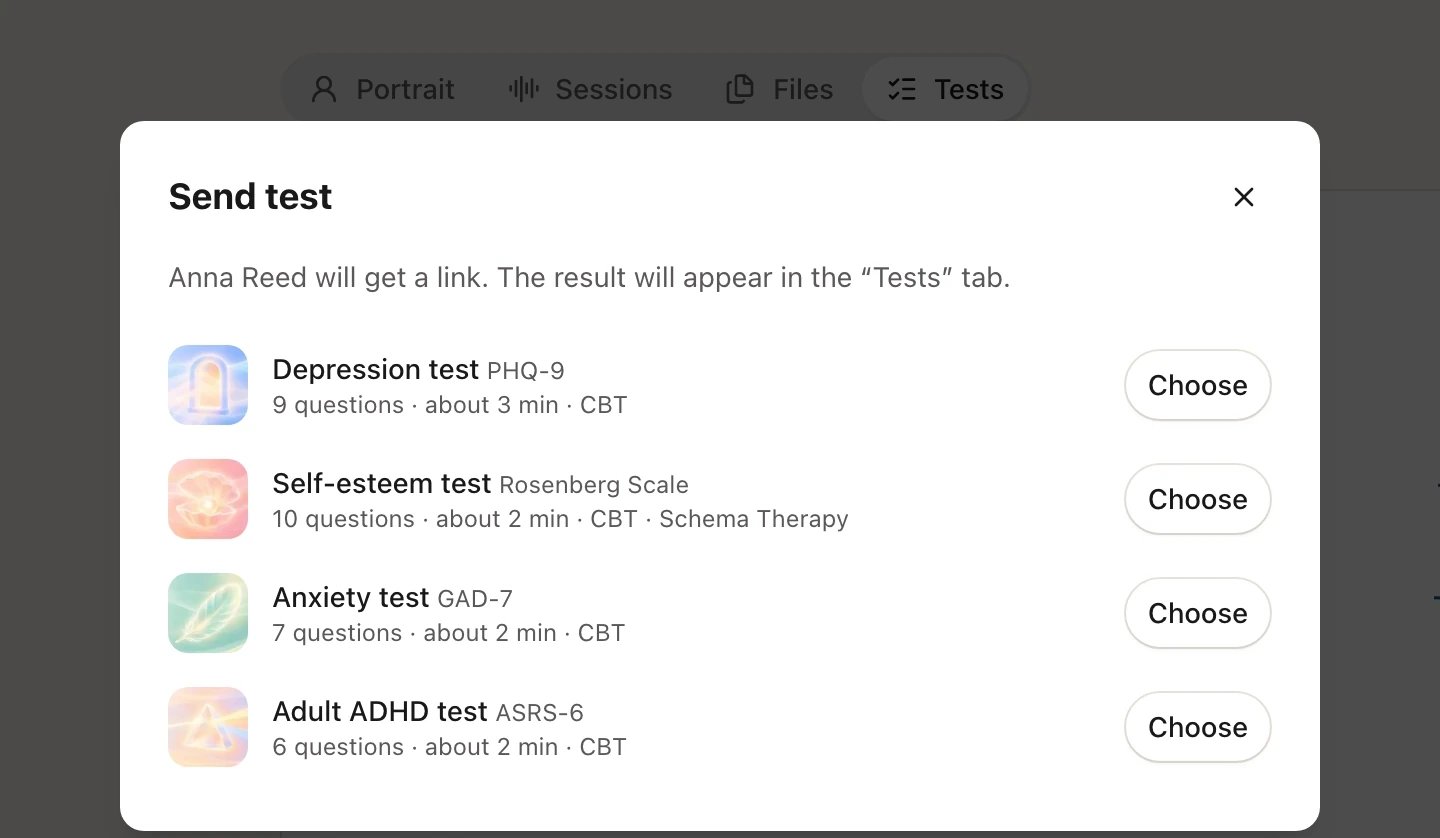
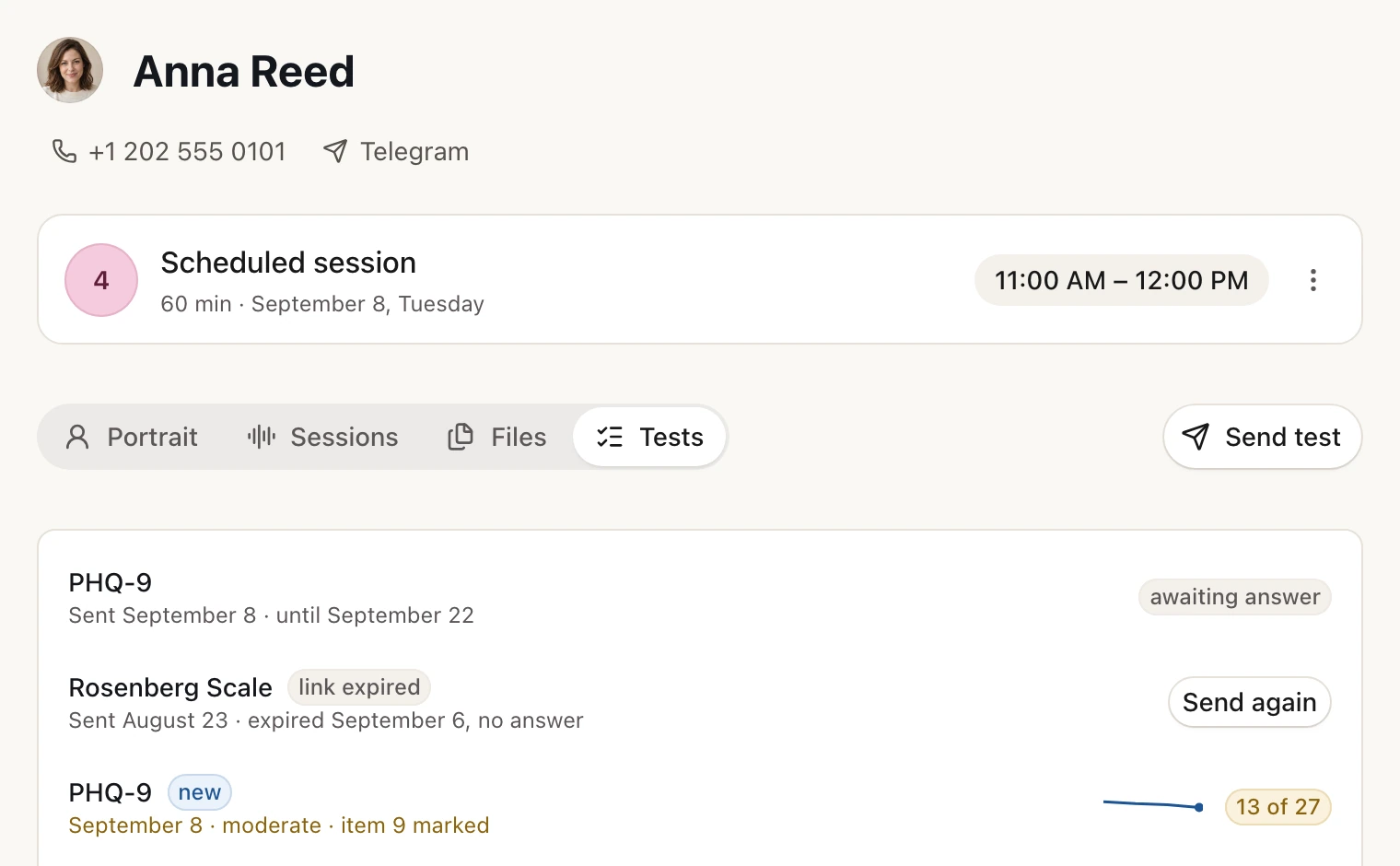
Send scales to clients and watch the change in their card
The client takes the test from a link, no account needed. The result lands in their card and Sessio compares it with last time.