Shows how much you recognize yourself in statements about four personality traits that psychologists call the Dark Tetrad: Machiavellianism, narcissism, psychopathy and sadism. These are subclinical traits, everyday tendencies most people have to some degree. They are not diagnoses and not labels, and you get four separate scores.
The Short Dark Tetrad (SD4) was created by Delroy Paulhus, Erin Buckels, Paul Trapnell and Daniel Jones. Its 28 statements cover four traits, seven statements each: Machiavellianism (a calculating, strategic way of dealing with people), narcissism (feeling special and wanting to be noticed), psychopathy (impulsiveness, risk-taking, breaking rules and hitting back) and sadism (enjoying violence or other people’s misfortune, even in mild forms). Each answer scores 1 to 5, and a trait score is the average of its seven answers, also from 1 to 5. The authors give no total score and no cutoffs. In their student sample the average was highest for Machiavellianism and lowest for psychopathy, so compare each score with itself and not with the other traits.
This is not a diagnosis
The words psychopathy and sadism here name everyday personality traits at a subclinical level. They are not diagnoses, and a high score is not a verdict on you. It shows how you describe yourself today.
What happens to your answers
Your score is calculated right in your browser. Your answers reach our server only if you ask for your result by email: we write the email and do not keep them.
Does a high score mean I have psychopathy or sadism?
No. The SD4 captures subclinical versions of these traits: everyday attitudes and habits that anyone can have to some degree. A score describes your answers, not who you are, and the authors’ form gives no cutoffs that would turn a score into a diagnosis. If your behavior worries you or hurts people close to you, a psychologist can help you look at it.
Why are there four scores and no total?
The authors’ scoring gives four averages of seven statements each and no overall score, and Sessio shows the same. Each trait is scored on its own, so read the four scores one by one.
How do I read my score when there are no cutoffs?
Look at each trait separately: 1 means you strongly disagreed with all seven statements, 3 that you were neutral on average, 5 that you strongly agreed with all of them. The traits differ in how common they are: in the authors’ student sample the average was highest for Machiavellianism and lowest for psychopathy. So compare each score with itself, for example by taking the test again later.
Source: Short Dark Tetrad (SD4): Paulhus D. L., Buckels E. E., Trapnell P. D., Jones D. N., 2021, Screening for dark personalities: The Short Dark Tetrad (SD4), European Journal of Psychological Assessment 37(3), 208-222, DOI 10.1027/1015-5759/a000602. Text: the authors’ SD4 form, D. L. Paulhus, University of British Columbia (www2.psych.ubc.ca/~dpaulhus/Paulhus_measures/SD4.docx), unchanged apart from the removed form title, the numbers row and the group labels.
For therapists
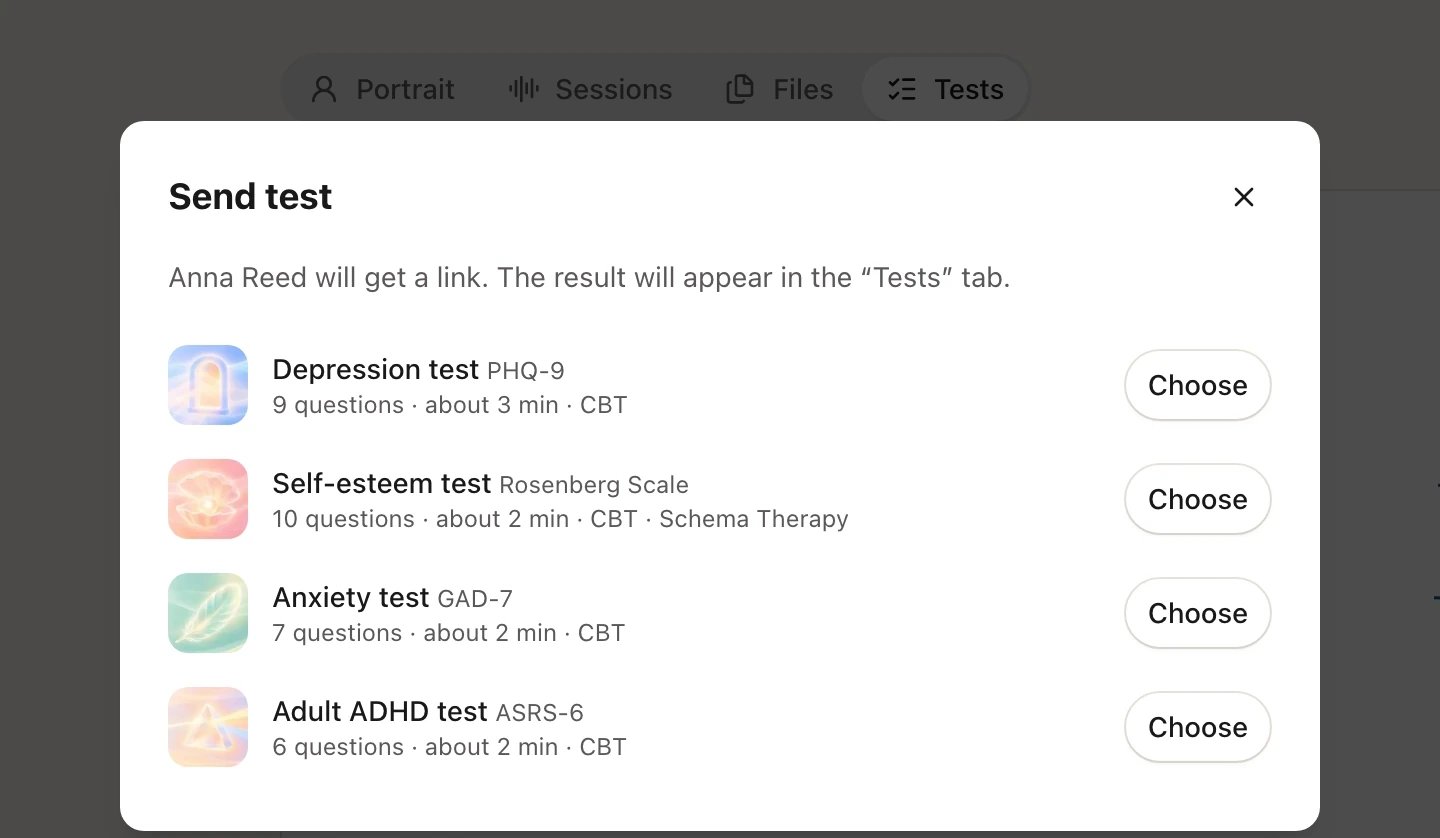
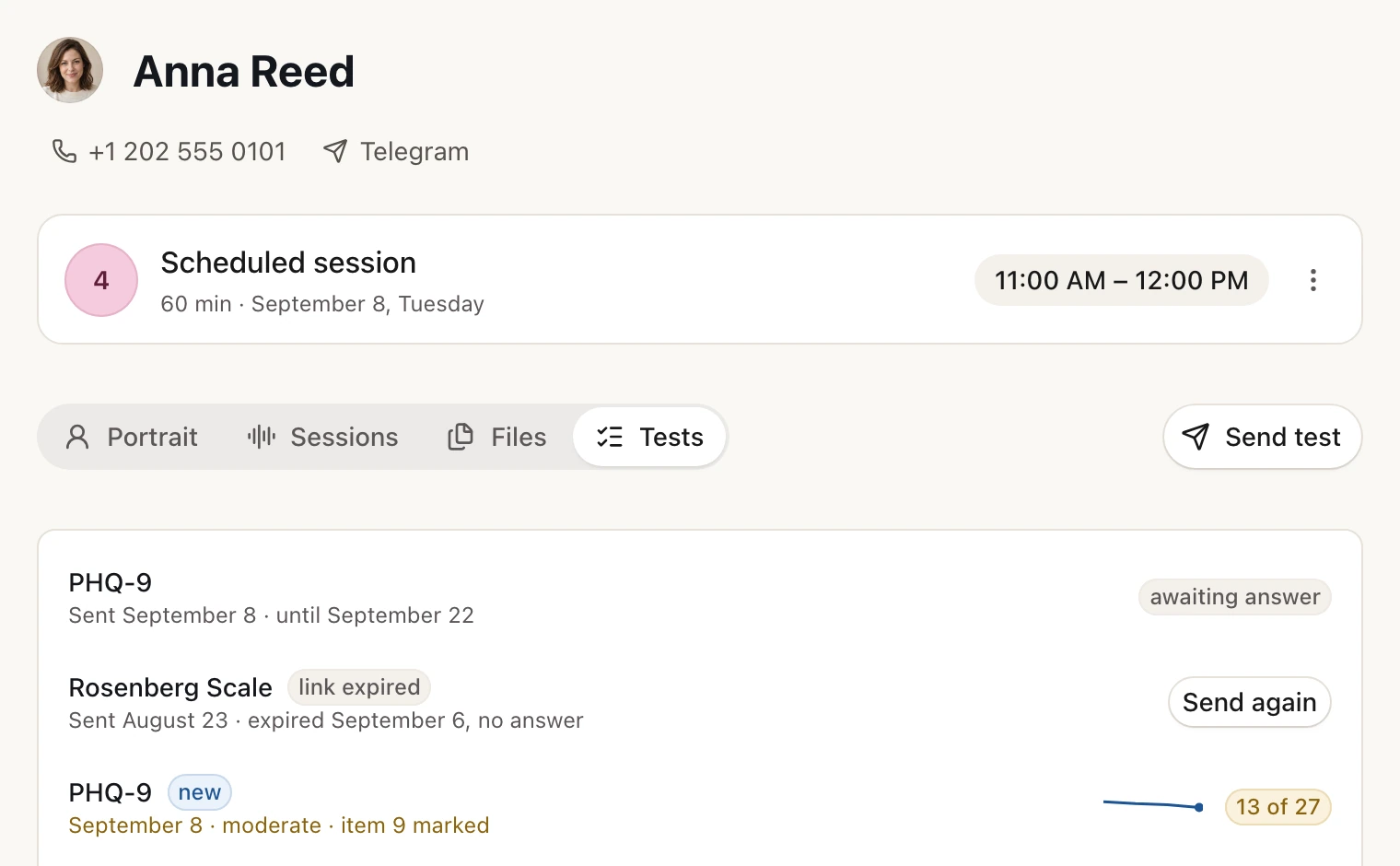
Send scales to clients and watch the change in their card
The client takes the test from a link, no account needed. The result lands in their card and Sessio compares it with last time.