Thirty-two short statements show how you tend to behave with other people. Your answers place you on the interpersonal circle: eight styles, each scored from 1 to 5, arranged between two axes, dominance and warmth. It takes about 5 minutes. The result shows how you see yourself, not a diagnosis.
The IPIP-IPC (Markey and Markey, 2009) is a 32-statement self-report measure built from the public-domain International Personality Item Pool. It covers the eight octants of the interpersonal circumplex, a model that places social behavior between two axes: dominance and warmth. Each of the eight styles is the average of four statements rated from 1 (very inaccurate) to 5 (very accurate). All statements are scored in the same direction. There is no total score and there are no cut-offs.
This is not a diagnosis
Interpersonal styles are ways of behaving with people, not disorders, and none of them is good or bad in itself. The names of the styles come from research and can sound harsh: they describe behavior, not character. The test cannot say whether you need treatment. If a pattern gets in your way, a therapist can help you work on it.
What happens to your answers
Your score is calculated right in your browser. Your answers reach our server only if you ask for your result by email: we write the email and do not keep them.
How precise are the scores?
Each style rests on only four statements, so one unusual answer moves its score noticeably. In the original study the reliability of a single four-item style was modest, about .6 on average (Markey and Markey, 2009), so a small gap between two styles should not be read as meaningful. The overall picture of high and low styles is more trustworthy than any single number.
How is it related to the Big Five?
The circle’s two axes, dominance and warmth, sit about 45° away from two Big Five traits: extraversion lies near “Gregarious-Extraverted” and agreeableness near “Unassuming-Ingenuous” (Markey and Markey, 2009). The circle says little about conscientiousness, emotional stability or openness. For a quick look at all five traits, take the short Big Five test: Big Five personality test
Why are the styles arranged in a circle?
Styles next to each other on the circle tend to go together, and styles opposite each other tend to go against each other (Markey and Markey, 2009). So a high score on “Assured-Dominant” usually comes with a low score on “Unassured-Submissive”, and a high score on “Warm-Agreeable” with a low one on “Cold-Hearted”.
Source: IPIP-IPC (IPIP Interpersonal Circumplex): Markey P. M., Markey C. N., 2009, A brief assessment of the interpersonal circumplex: the IPIP-IPC, Assessment 16(4), 352-361, DOI 10.1177/1073191109340382. Items and key: International Personality Item Pool, IPIP-IPC survey and scoring key (ipip.ori.org); Goldberg L. R. et al., 2006, The international personality item pool and the future of public-domain personality measures, Journal of Research in Personality 40(1), 84-96, DOI 10.1016/j.jrp.2005.08.007.
For therapists
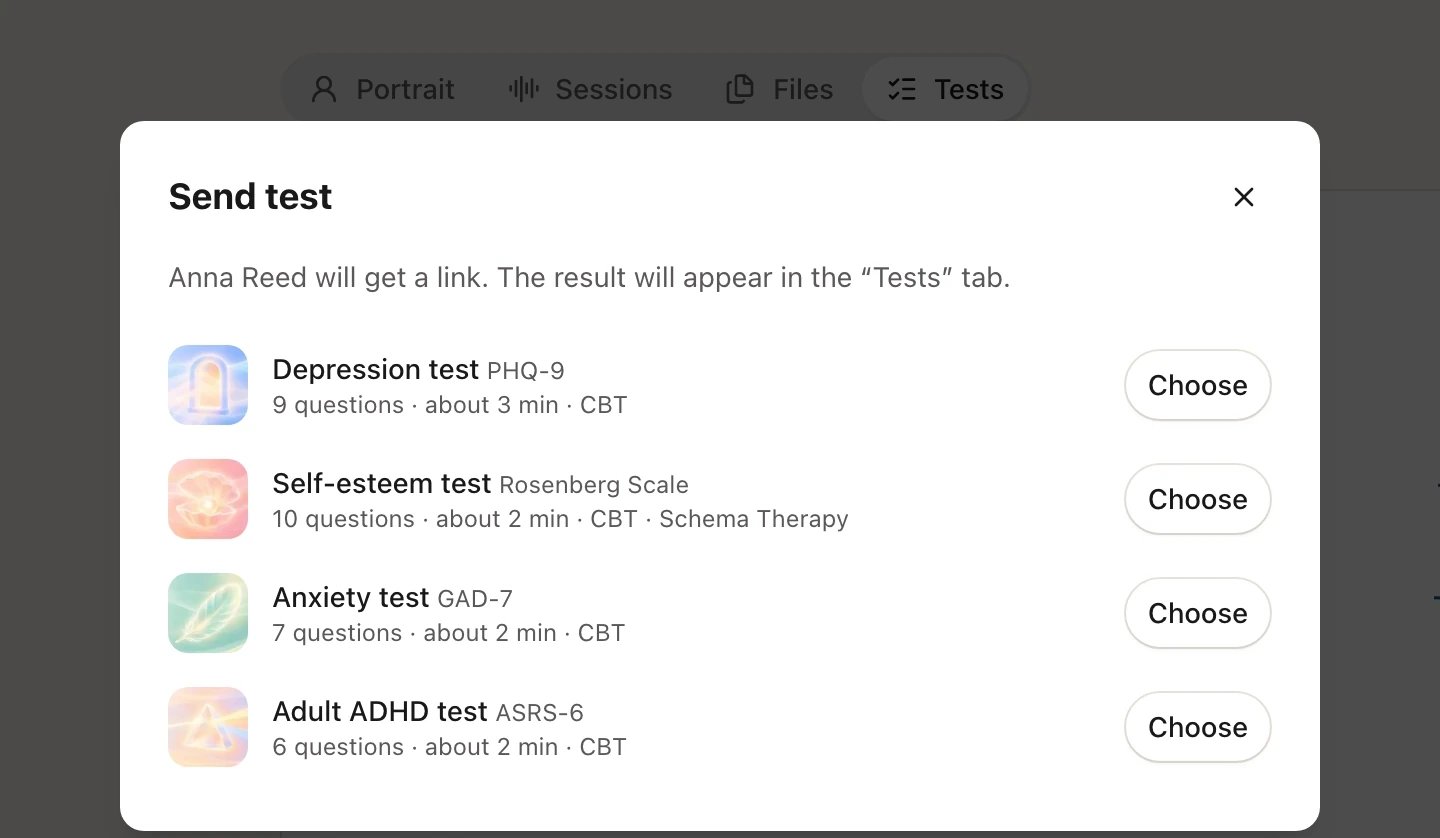
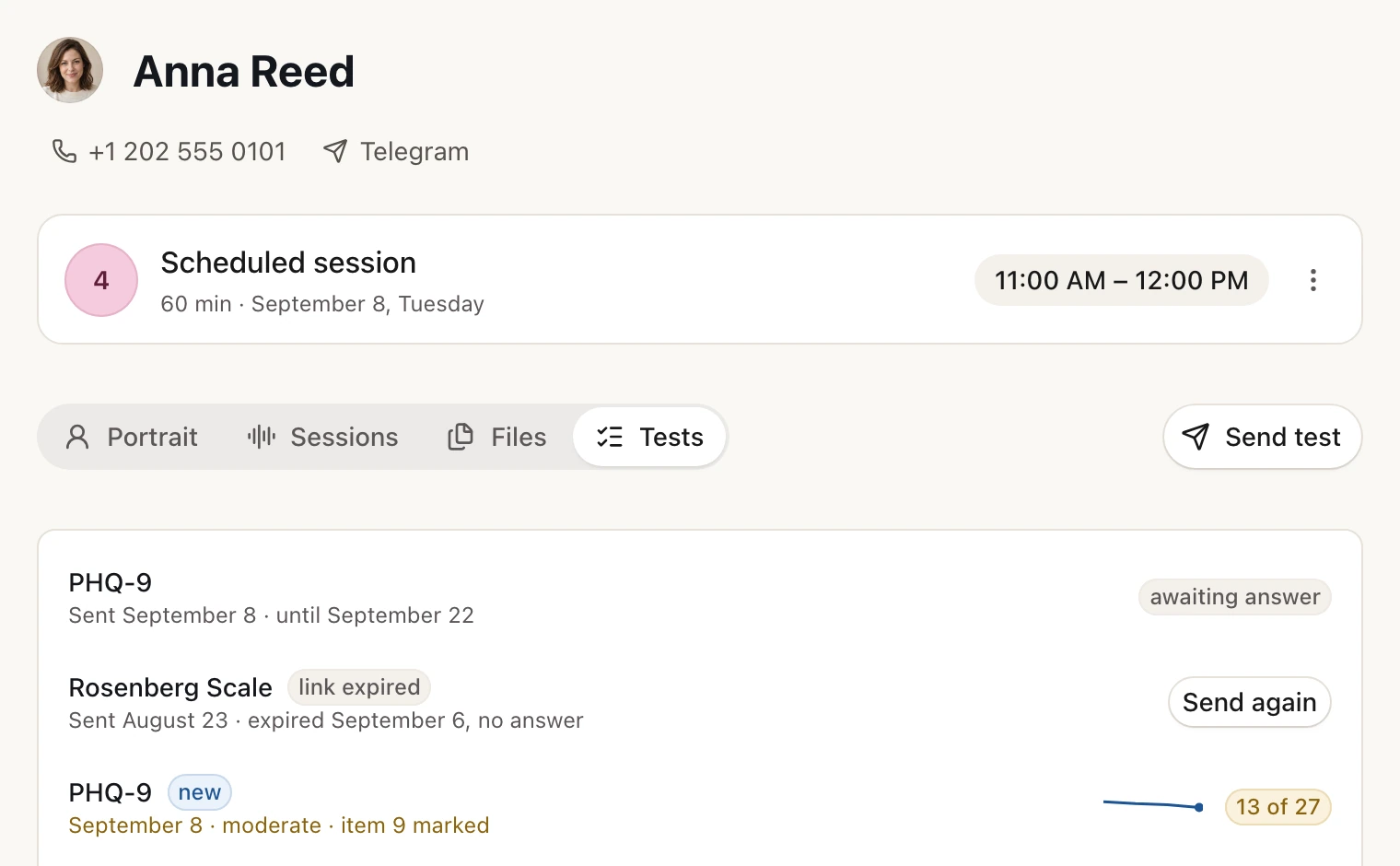
Send scales to clients and watch the change in their card
The client takes the test from a link, no account needed. The result lands in their card and Sessio compares it with last time.