Sixteen pairs of statements show how often you pick the self-view that goes with narcissistic traits: authority, superiority, entitlement and self-absorption. Your score is the number of such choices, from 0 to 16. It describes a personality trait on which people differ, not a disorder, and it is not a diagnosis.
The NPI-16 is a short form of the 40-item Narcissistic Personality Inventory of Raskin and Terry (1988). Daniel Ames, Paul Rose and Cameron Anderson (2006) took 16 of its pairs to cover different sides of narcissism: authority, superiority, entitlement and self-absorption. In each pair one statement fits narcissism and the other does not. Each narcissistic choice scores 1 and the other 0, so the total runs from 0 to 16. The authors present one overall score without subscales, describe it as a measure of subclinical narcissism, and give no cutoff.
This is not a diagnosis
The result does not show narcissistic personality disorder or any other diagnosis. The inventory measures how strongly a trait is expressed in ordinary people, and a disorder is diagnosed by a clinician after a conversation. Your answers reflect how you see yourself, so the result is a prompt for reflection, not a verdict.
What happens to your answers
Your score is calculated right in your browser. Your answers reach our server only if you ask for your result by email: we write the email and do not keep them.
Does a high score mean I am a narcissist?
No. A high score means you picked more of the narcissistic statements, nothing more. The authors give no cutoff for a high score, and the inventory is not a clinical test. A diagnosis of narcissistic personality disorder is made by a clinician.
Why do I have to choose when neither statement fits?
The inventory is built as a forced choice. The authors' own instruction says that neither statement may describe you well, but you should pick the one that comes closest. Each choice scores 1 or 0, so every pair counts toward the total.
How is the NPI-16 related to the NPI-40?
The NPI-16 is a separate short form by Ames, Rose and Anderson (2006). Its pairs are drawn from the 40-item Narcissistic Personality Inventory of Raskin and Terry. In the authors' first study, 776 university students, the two totals correlated at r = .90.
Source: NPI-16: Ames D. R., Rose P., Anderson C. P., 2006, The NPI-16 as a short measure of narcissism, Journal of Research in Personality 40(4), 440-450, DOI 10.1016/j.jrp.2005.03.002. Text and key: the authors' form, columbia.edu/~da358/npi16 (Daniel R. Ames, Columbia Business School). The 16 pairs are drawn from the NPI-40 (Raskin R., Terry H., 1988).
For rights holders: if you hold the rights to this scale or its translation and object to it being here, write to support@sessio.health. We will take it down or ask for your permission.
For therapists
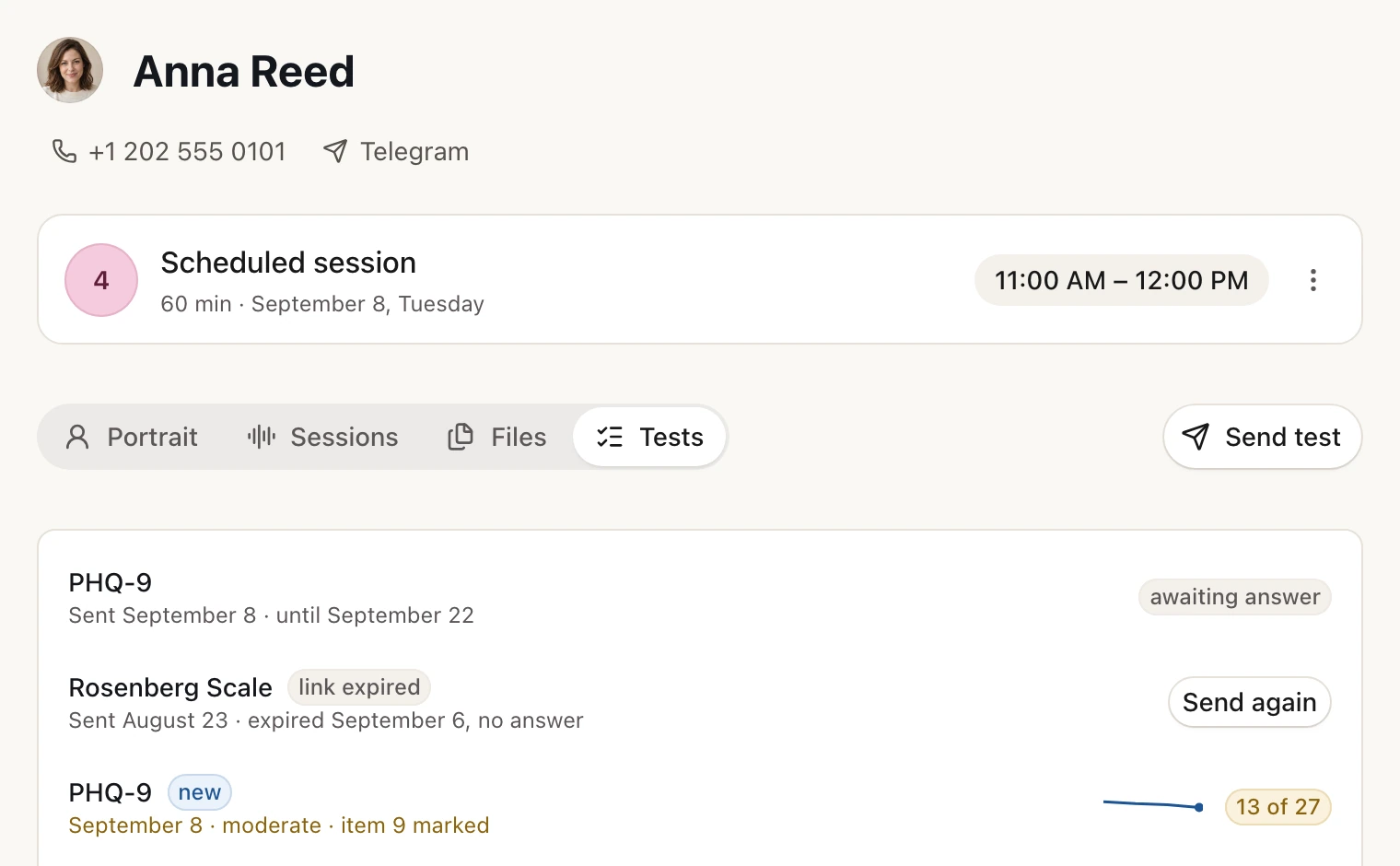
Send scales to clients and watch the change in their card
The client takes the test from a link, no account needed. The result lands in their card and Sessio compares it with last time.