Five yes-or-no questions show how much a frightening or traumatic event has affected you over the past month. It is a quick screen, not a diagnosis: a higher score is a reason to take the longer PTSD test and to talk to a professional who works with trauma.
The PC-PTSD-5 (Primary Care PTSD Screen for DSM-5) comes from the US National Center for PTSD. After a traumatic event, it asks five yes-or-no questions about the past month: nightmares or unwanted thoughts, avoiding reminders, being on guard, feeling numb or detached, and guilt or blame. Each Yes scores 1, for a total of 0 to 5. It was tested on US veterans in primary care (Prins et al., 2016; Bovin et al., 2021).
This is not a diagnosis
A five-question screen only shows whether it is worth looking closer. It cannot tell PTSD from other reactions to a hard experience. A diagnosis is made by a professional after a conversation, usually with a structured interview.
What happens to your answers
Your score is calculated right in your browser. Your answers reach our server only if you ask for your result by email: we write the email and do not keep them.
How is the PC-PTSD-5 different from the PCL-5?
The PC-PTSD-5 is a quick screen with five yes-or-no questions about the past month. The PCL-5 has 20 questions rated from 0 to 4 and shows how strong each symptom is. If your score here is 3 or more, or you want a fuller picture, take the PCL-5: PTSD test
What do I answer if nothing like this has happened to me?
Answer No to every question: the score will be 0. If something else weighs on you, such as long stress, you can talk to a professional at any score.
Source: PC-PTSD-5: Prins A., Bovin M. J., Kimerling R., Kaloupek D. G., Marx B. P., Pless Kaiser A., Schnurr P. P., 2015, The Primary Care PTSD Screen for DSM-5 (PC-PTSD-5), National Center for PTSD, ptsd.va.gov. Validation: Prins A. et al., 2016, Journal of General Internal Medicine 31, 1206-1211, DOI 10.1007/s11606-016-3703-5; Bovin M. J. et al., 2021, JAMA Network Open 4(2), e2036733, DOI 10.1001/jamanetworkopen.2020.36733.
For therapists
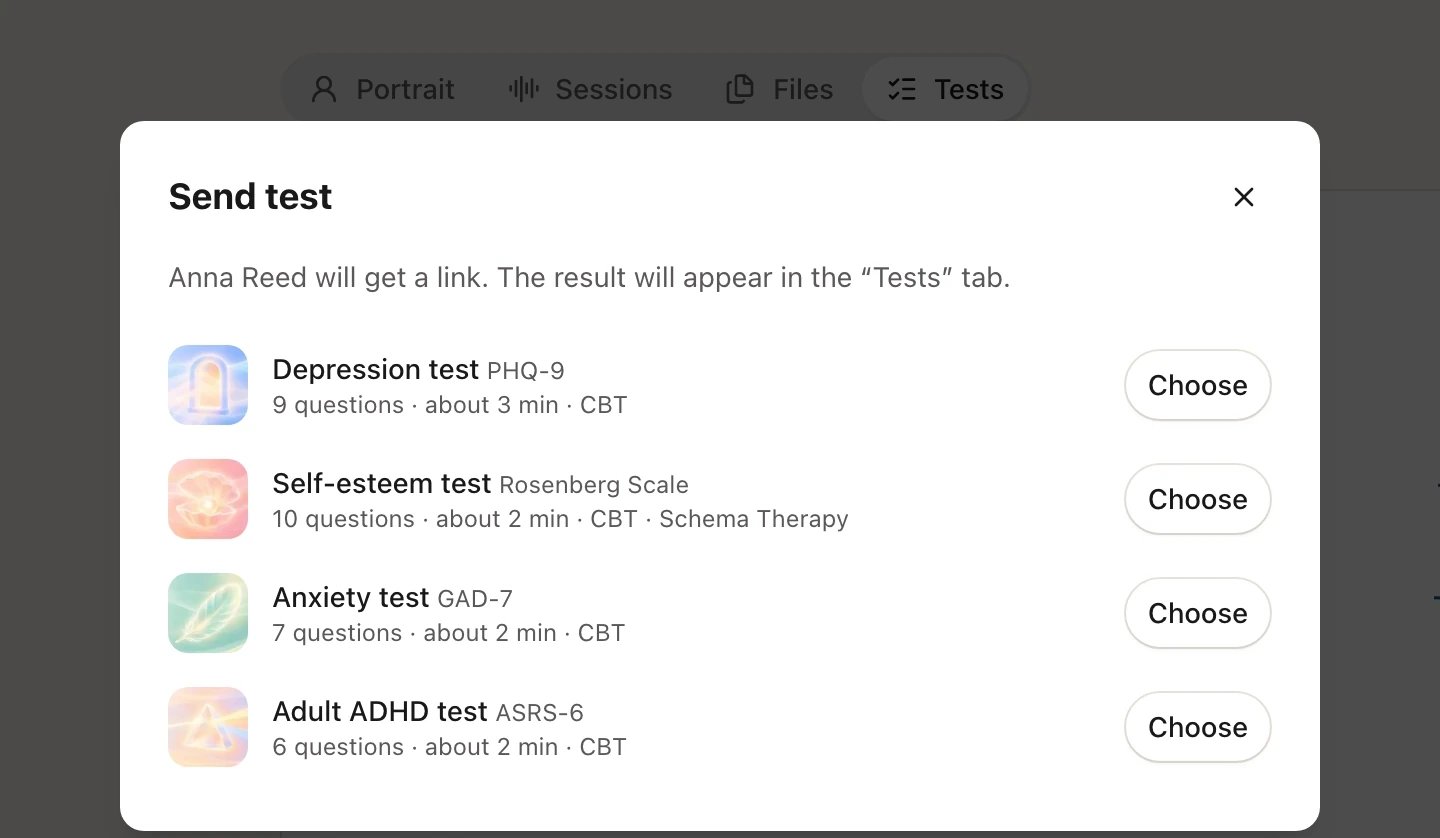
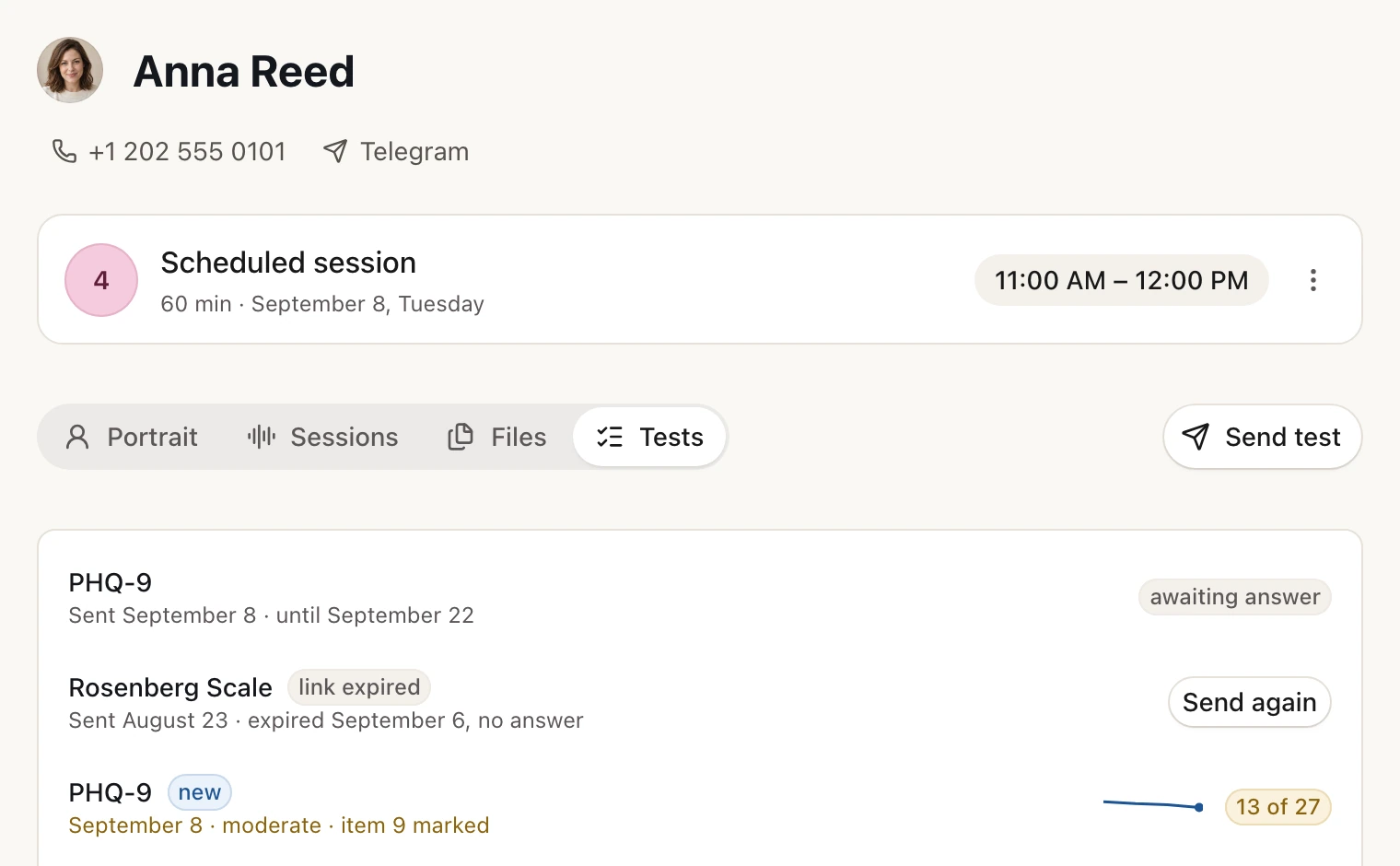
Send scales to clients and watch the change in their card
The client takes the test from a link, no account needed. The result lands in their card and Sessio compares it with last time.