Fifty short statements place you on five broad personality traits: extraversion, agreeableness, conscientiousness, emotional stability and intellect or imagination. It takes 8 to 10 minutes and gives each trait a score from 1 to 5. The result shows how you see yourself, not a diagnosis.
The IPIP-BFM-50 is the 50-item form of Goldberg's Big Five factor markers, taken from the public-domain International Personality Item Pool (Goldberg, 1992). Each of the five traits is the average of 10 statements rated from 1 (very inaccurate) to 5 (very accurate), with negatively worded statements scored in reverse. There is no total score and there are no cut-offs.
This is not a diagnosis
Personality traits are not disorders, and no trait is good or bad in itself. The test shows how you see yourself today and cannot say whether you need treatment. If a trait gets in your way, a therapist can help you work on it.
What happens to your answers
Your score is calculated right in your browser. Your answers reach our server only if you ask for your result by email: we write the email and do not keep them.
How is this different from the TIPI and from shorter versions?
The TIPI has two statements per trait, takes two minutes and gives only a rough sketch. Other short versions (about 20 statements) also trade accuracy for speed: with two to four answers per trait, one atypical answer moves the score a lot. Here every trait has ten. For a quick first look, start with the short test: Big Five personality test
Is intellect the same as openness to experience?
Not exactly. In Goldberg's markers the fifth factor is called intellect or imagination, and its statements are about vocabulary, ideas and imagination. Other tests, such as the TIPI, call it openness to experience. The two overlap, but scores from different tests are not interchangeable.
Can I compare my score with other people?
Not directly. The statements ask you to compare yourself with people you know of your own sex and age, but this page shows only your own averages and has no norm tables. Take 3 as a rough middle, compare your five traits with each other, and retake the test later to see change.
Source: IPIP Big-Five Factor Markers, 50 items: Goldberg L. R., 1992, The development of markers for the Big-Five factor structure, Psychological Assessment 4(1), 26-42, DOI 10.1037/1040-3590.4.1.26. Items and key: International Personality Item Pool, 50-item sample questionnaire (ipip.ori.org); Goldberg L. R. et al., 2006, The international personality item pool and the future of public-domain personality measures, Journal of Research in Personality 40(1), 84-96, DOI 10.1016/j.jrp.2005.08.007.
For therapists
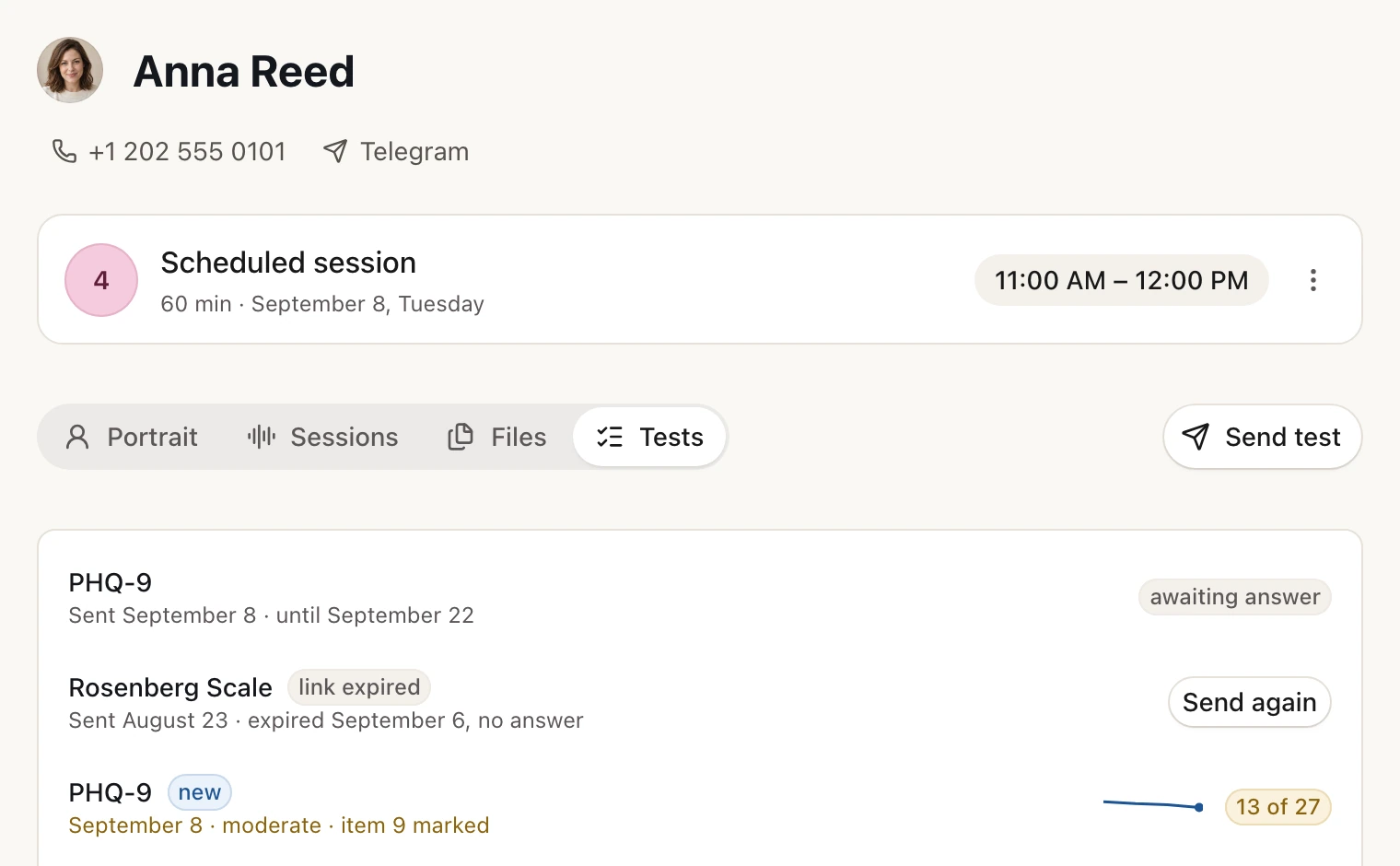
Send scales to clients and watch the change in their card
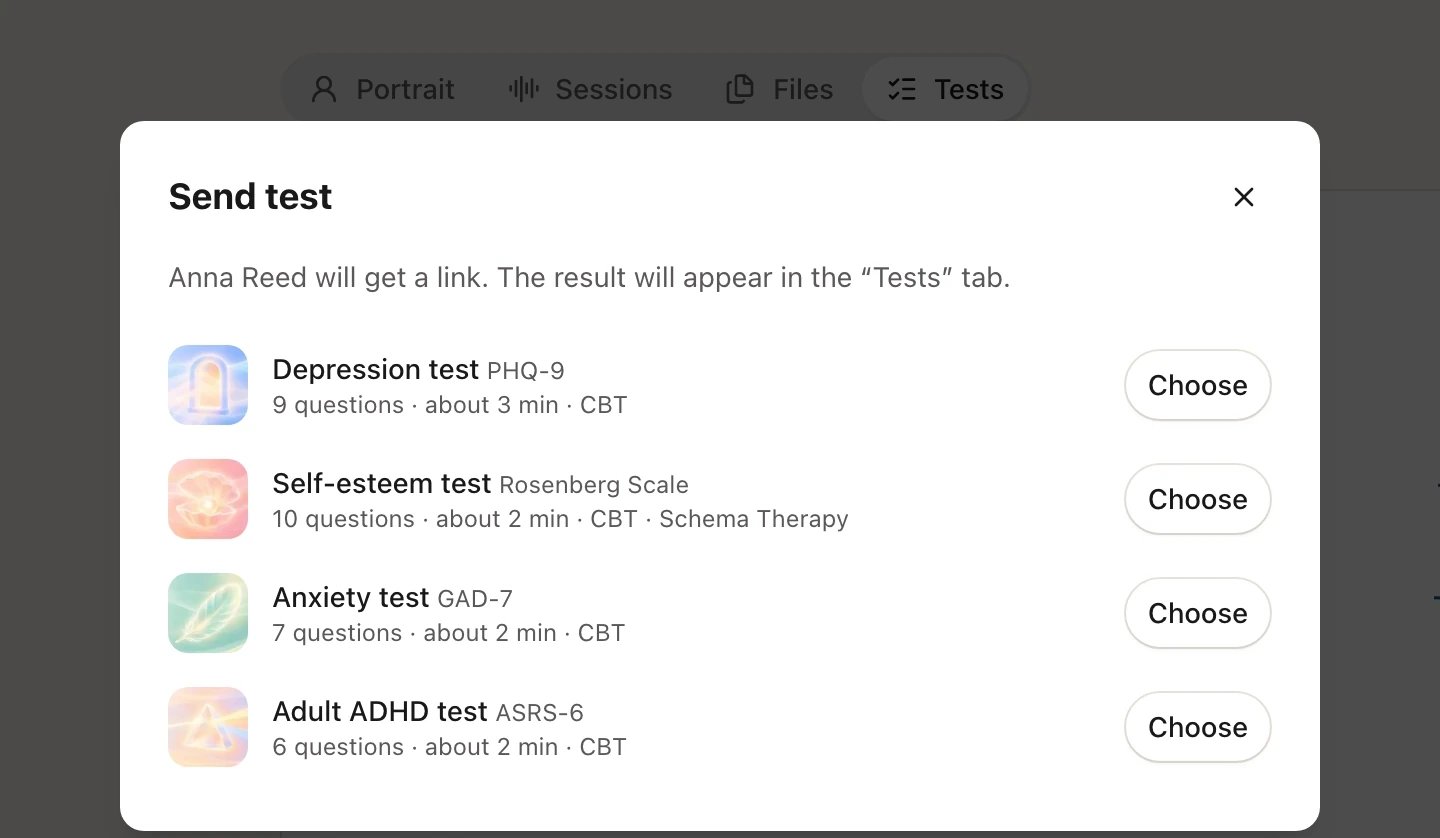
The client takes the test from a link, no account needed. The result lands in their card and Sessio compares it with last time.