Twenty short statements give a quick picture of five broad personality traits: how outgoing, caring, organized, prone to mood swings and imaginative you see yourself. It takes about 3 minutes. Each trait gets a score from 1 to 5 that shows how you see yourself today.
The Mini-IPIP by Donnellan, Oswald, Baird and Lucas (2006) is a 20-item short form of the 50-item Big Five inventory from the International Personality Item Pool (IPIP): four statements for each of extraversion, agreeableness, conscientiousness, neuroticism and intellect or imagination. Each answer scores 1 to 5, the reverse-worded statements are scored the other way, and each trait is the average of its four answers.
This is not a verdict
Twenty statements give a rough sketch, because each trait rests on only four of them. There are no good or bad traits, and a high score on Neuroticism is not a diagnosis. Longer questionnaires describe personality in more detail.
What happens to your answers
Your score is calculated right in your browser. Your answers reach our server only if you ask for your result by email: we write the email and do not keep them.
How is the Mini-IPIP different from the TIPI and from longer Big Five tests?
The Mini-IPIP has 20 statements, four per trait, while the TIPI has 10, two per trait, so each Mini-IPIP score depends less on a single answer. Longer versions with 50 or 120 statements describe each trait in more detail. For the quickest look, take the ten-question TIPI: Big Five personality test
Source: Mini-IPIP: Donnellan M. B., Oswald F. L., Baird B. M., Lucas R. E., 2006, The Mini-IPIP scales: Tiny-yet-effective measures of the Big Five factors of personality, Psychological Assessment 18(2), 192-203, DOI 10.1037/1040-3590.18.2.192. Items and key: International Personality Item Pool (ipip.ori.org/MiniIPIPKey.htm).
For therapists
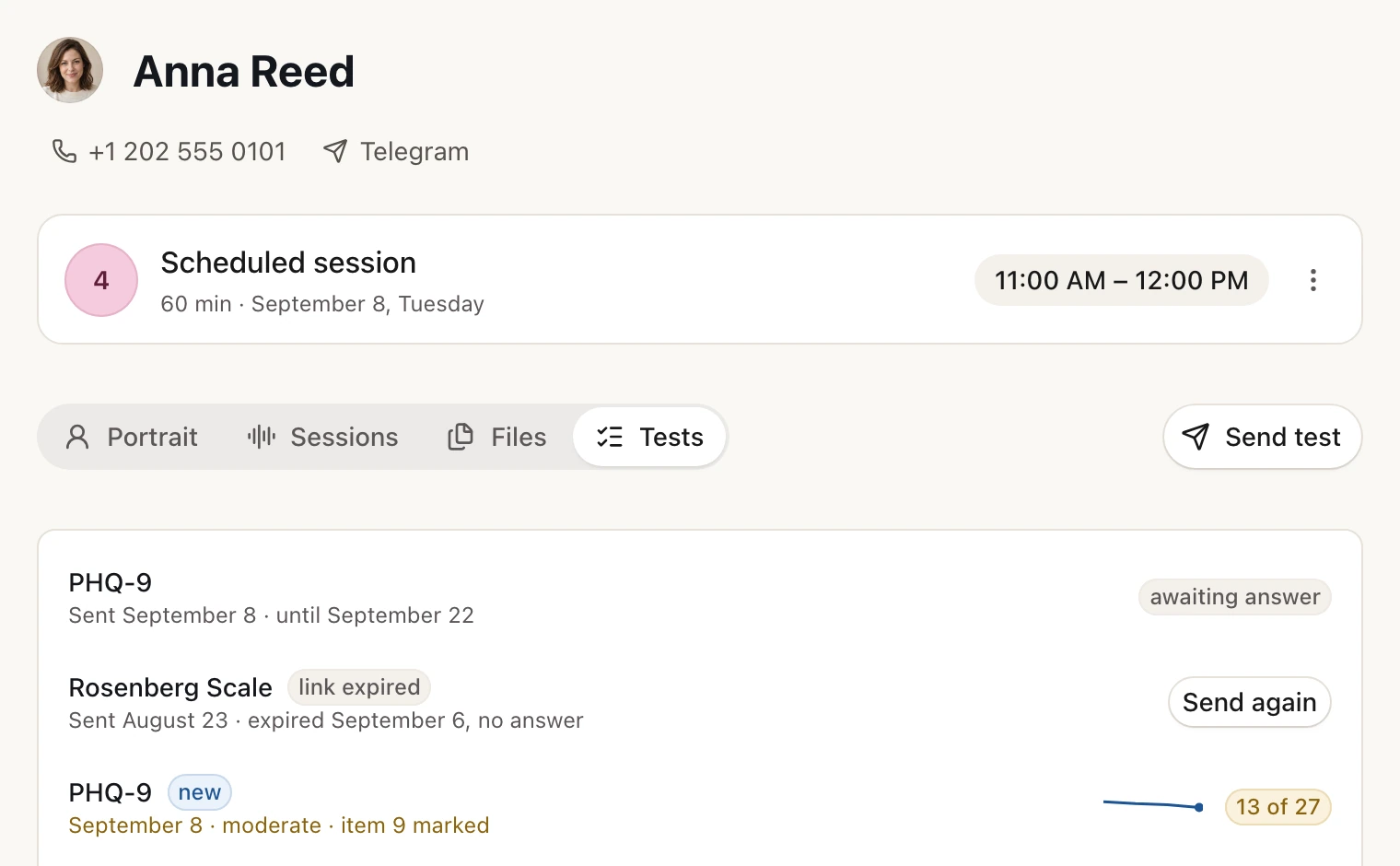
Send scales to clients and watch the change in their card
The client takes the test from a link, no account needed. The result lands in their card and Sessio compares it with last time.