Shows how many ADHD-type difficulties you remember from childhood, such as distraction, impulsiveness, temper and trouble at school. It looks back at your own memories and is not a diagnosis. It takes about five minutes, and a score from 0 to 100 appears on screen right away.
The Wender Utah Rating Scale (WURS) was developed by Ward, Wender and Reimherr in 1993 so that adults could describe their own childhood behaviour. The original has 61 items. This 25-item version keeps the ones that set apart adults with ADHD from comparison adults most clearly in the original study. Each item is a short description, such as “Concentration problems, easily distracted”, and you rate how much it applied to you as a child, from 0 (not at all or very slightly) to 4 (very much). The total runs from 0 to 100. This page shows the total only.
This is not a diagnosis
The questionnaire asks you to recall childhood with an adult memory, and memory is not exact. Many items, such as temper, mood and self-esteem, are not specific to ADHD. Only a professional can assess ADHD, through an interview and, when possible, other sources such as what a parent remembers.
What happens to your answers
Your score is calculated right in your browser. Your answers reach our server only if you ask for your result by email: we write the email and do not keep them.
What score on the WURS-25 is high?
This page shows your score only, without severity levels. In the original 1993 study, a cutoff of 46 or higher correctly identified 86% of the adults with ADHD, 99% of healthy adults (as not having ADHD) and 81% of adults with depression. Studies in other groups found other cutoffs, for example 39 in a Swedish sample of young psychiatric patients, so treat any number as a rough guide.
Does a high score mean I had ADHD as a child?
No. A high score only means you remember many of these difficulties, which is a reason to talk to a professional, not a result. The scale also asks about temper, mood and self-esteem. The authors of a Swedish study of the scale noted that low mood and low self-esteem were common in all the groups they studied, not only in ADHD.
How is this different from the adult ADHD test?
The WURS-25 looks back at childhood. The adult ADHD test (ASRS-6) asks about the last six months. They answer different questions: Adult ADHD test
Source: WURS-25: Ward M. F., Wender P. H., Reimherr F. W., 1993, The Wender Utah Rating Scale: an aid in the retrospective diagnosis of childhood attention deficit hyperactivity disorder, American Journal of Psychiatry 150(6), 885-890, DOI 10.1176/ajp.150.6.885.
For rights holders: if you hold the rights to this scale or its translation and object to it being here, write to support@sessio.health. We will take it down or ask for your permission.
For therapists
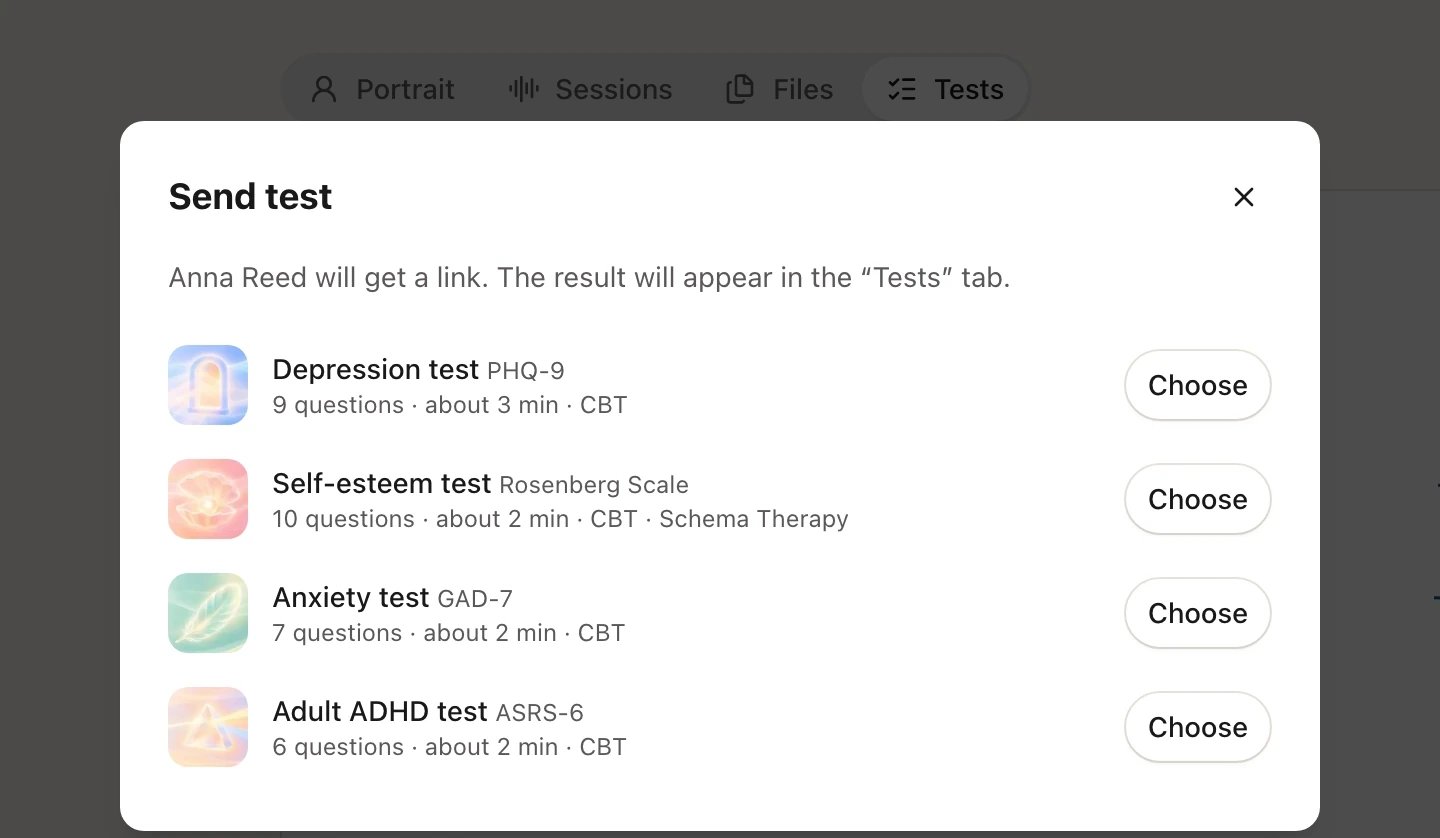
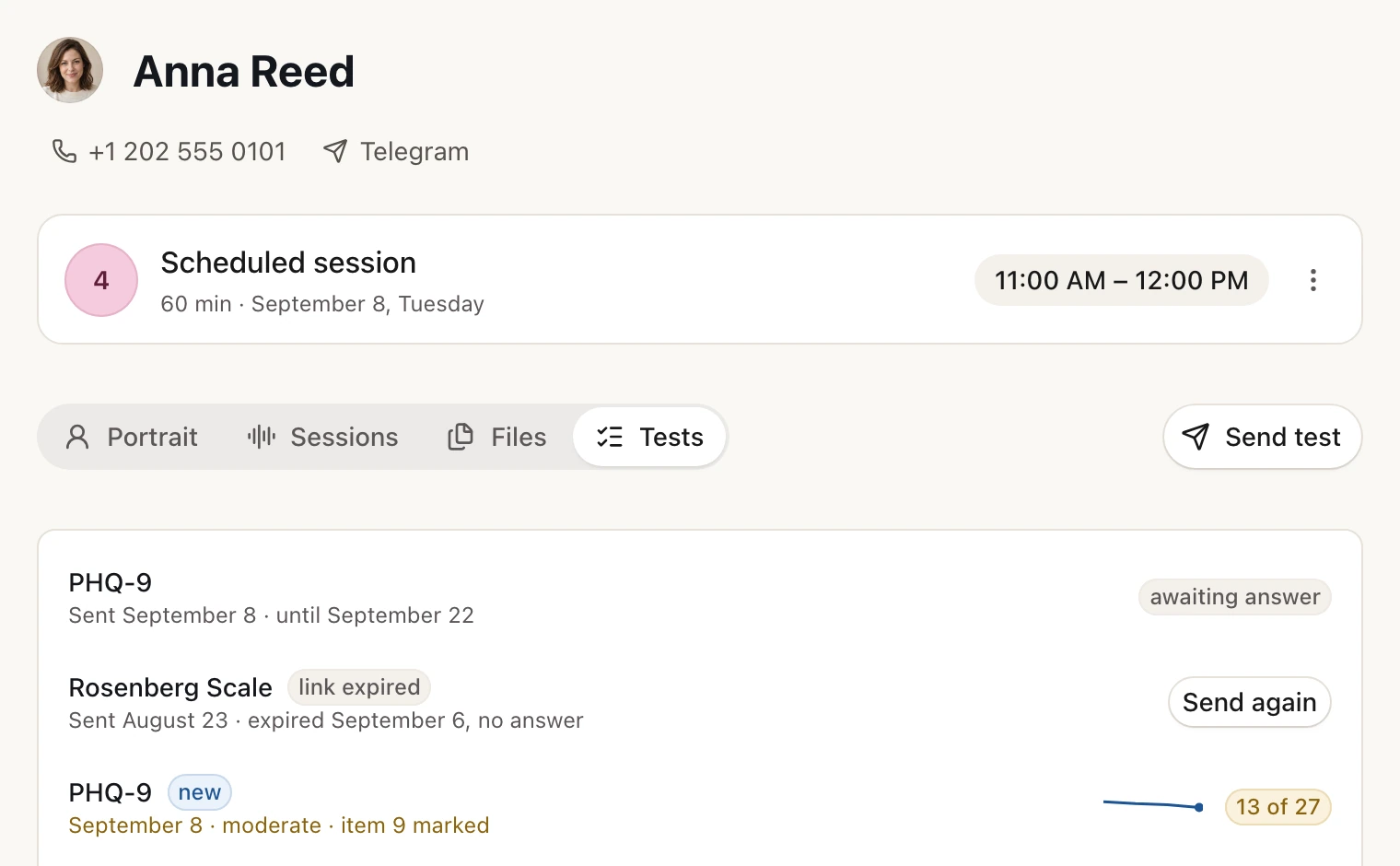
Send scales to clients and watch the change in their card
The client takes the test from a link, no account needed. The result lands in their card and Sessio compares it with last time.