Thirty-five statements show how heavily military experience still weighs on you: memories, sleep, anger, guilt, distance from people. You get a score and see where it sits against the published cutoff. It is a screen, not a diagnosis, and a therapist who works with trauma can read it with you.
The Mississippi Scale for Combat-Related PTSD (M-PTSD) was created by Keane, Caddell and Taylor in 1988 at the US National Center for PTSD. It covers PTSD symptoms as defined in DSM-III and common companions: substance use, guilt, depression and thoughts of suicide. Each answer scores 1 to 5 and ten positively worded statements are reversed, so papers report a total of 35 to 175. Sessio counts each answer from 0 to 4: your score runs from 0 to 140, and adding 35 gives the published figure. The published cutoff of 107 is 72 here (Keane and colleagues, 1988, in veterans seeking treatment).
This is not a diagnosis
The scale is old (DSM-III) and its cutoff comes from veterans in treatment in the 1980s. It can be exceeded by people with depression or anxiety without PTSD, and later studies suggested higher cutoffs. One statement asks about thoughts of killing yourself: any answer above zero, or a high total, shows help numbers. The other statements about death count only toward the total.
What happens to your answers
Your score is calculated right in your browser. Your answers reach our server only if you ask for your result by email: we write the email and do not keep them.
How do I compare my score with the published cutoff?
Add 35. Sessio counts answers from 0 to 4, papers from 1 to 5 per statement, so the published 107 is 72 here. For a check built on the current DSM-5, take the PCL-5: PTSD test
Source: M-PTSD: Keane T. M., Caddell J. M., Taylor K. L., 1988, Mississippi Scale for Combat-Related Posttraumatic Stress Disorder: three studies in reliability and validity, Journal of Consulting and Clinical Psychology 56(1), 85-90, DOI 10.1037/0022-006X.56.1.85. Text and key: VA National Center for PTSD, ptsd.va.gov (mississippi_scale_military.pdf, M-PTSD Scoring).
For therapists
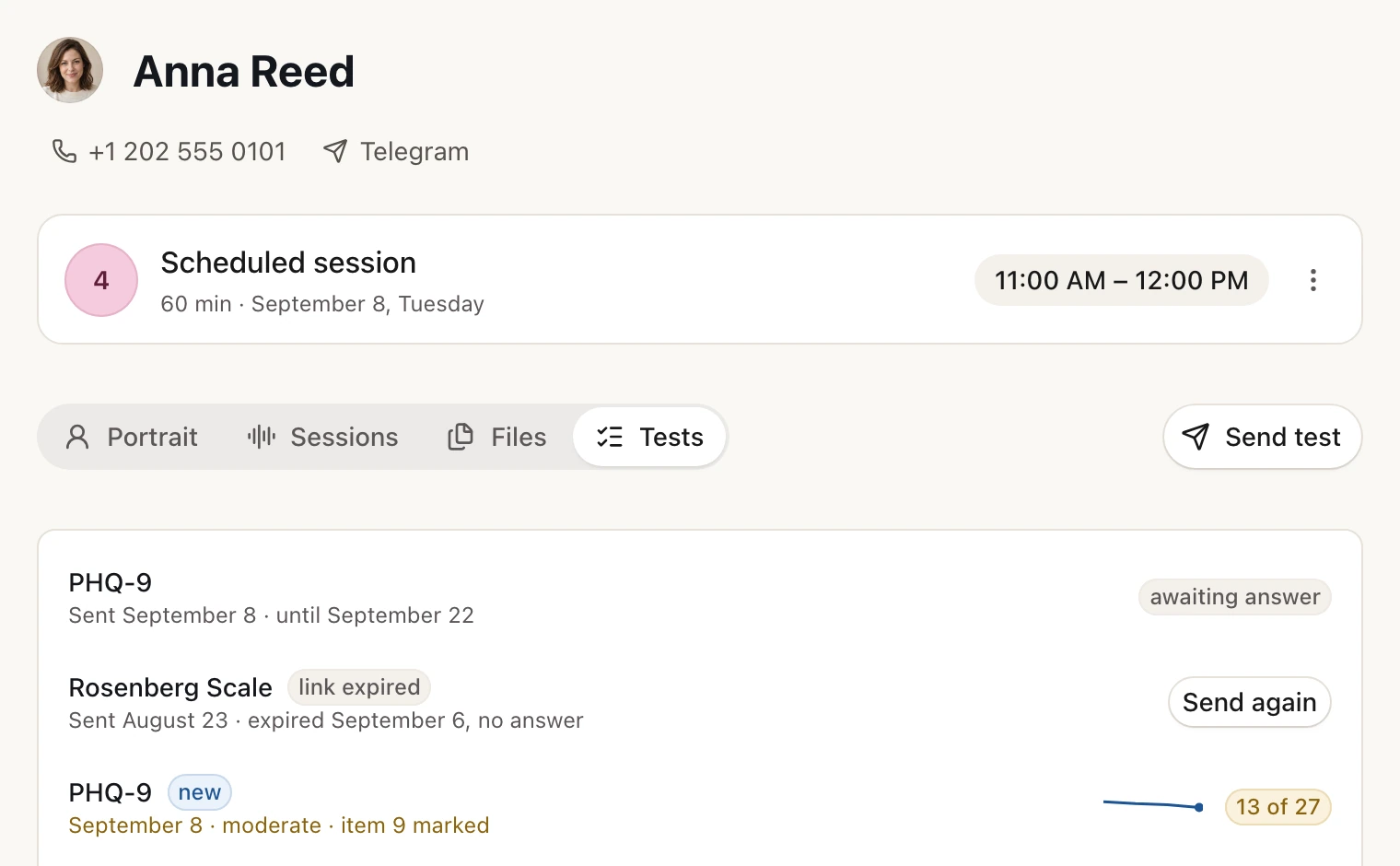
Send scales to clients and watch the change in their card
The client takes the test from a link, no account needed. The result lands in their card and Sessio compares it with last time.