Shows how many problems gambling has caused you over the last 12 months: money, health, guilt and criticism from other people. Nine questions, about two minutes. It is a screening tool, not a diagnosis, and it does not judge you: the score only helps you decide whether it is time to talk to a specialist.
The Problem Gambling Severity Index (PGSI) is the scored part of the Canadian Problem Gambling Index (CPGI), developed by Ferris and Wynne for the Canadian Centre on Substance Abuse (CCSA) in 2001. Its nine questions ask, about the last 12 months, whether you bet more than you could afford to lose, went back to win money back, borrowed money, felt you might have a problem, had health problems, were criticized by others, had money problems and felt guilty. Each answer scores 0 (never), 1 (sometimes), 2 (most of the time) or 3 (almost always), so the total runs from 0 to 27. In the original report, 0 means no problems, 1 to 2 low risk, 3 to 7 moderate risk and 8 or more problem gambling.
This is not a diagnosis
A questionnaire cannot tell whether someone has a gambling disorder. The levels describe how many problems you reported, not who you are. Only a specialist can assess your situation after a conversation. Whatever the score, you can ask for help.
What happens to your answers
Your score is calculated right in your browser. Your answers reach our server only if you ask for your result by email: we write the email and do not keep them.
I did not gamble in the last 12 months. Should I take the test?
The questions are about the last 12 months. If you did not gamble at all in that time, they do not apply to you. In the original study, people who had not gambled were counted as a separate group, not as people with no problems.
What counts as gambling here?
The nine questions say only “gambling” and “betting”, with no list. The full index they come from (the CPGI) asks separately about lotteries, scratch tickets, bingo, casino games, slot machines, sports betting and internet gambling, so those are the activities it has in mind.
How is the PGSI different from the CPGI?
The CPGI has 31 questions, but only nine of them are scored. Those nine are the PGSI. The other questions ask about the types of gambling, spending and related factors.
Source: PGSI: Ferris J., Wynne H., 2001, The Canadian Problem Gambling Index: Final Report, Canadian Centre on Substance Abuse (CCSA); the PGSI is the nine scored items of the CPGI (section 2, items 5 to 13). Source: https://www.greo.ca/Modules/EvidenceCentre/files/Ferris%20et%20al(2001)The_Canadian_Problem_Gambling_Index.pdf
For rights holders: if you hold the rights to this scale or its translation and object to it being here, write to support@sessio.health. We will take it down or ask for your permission.
For therapists
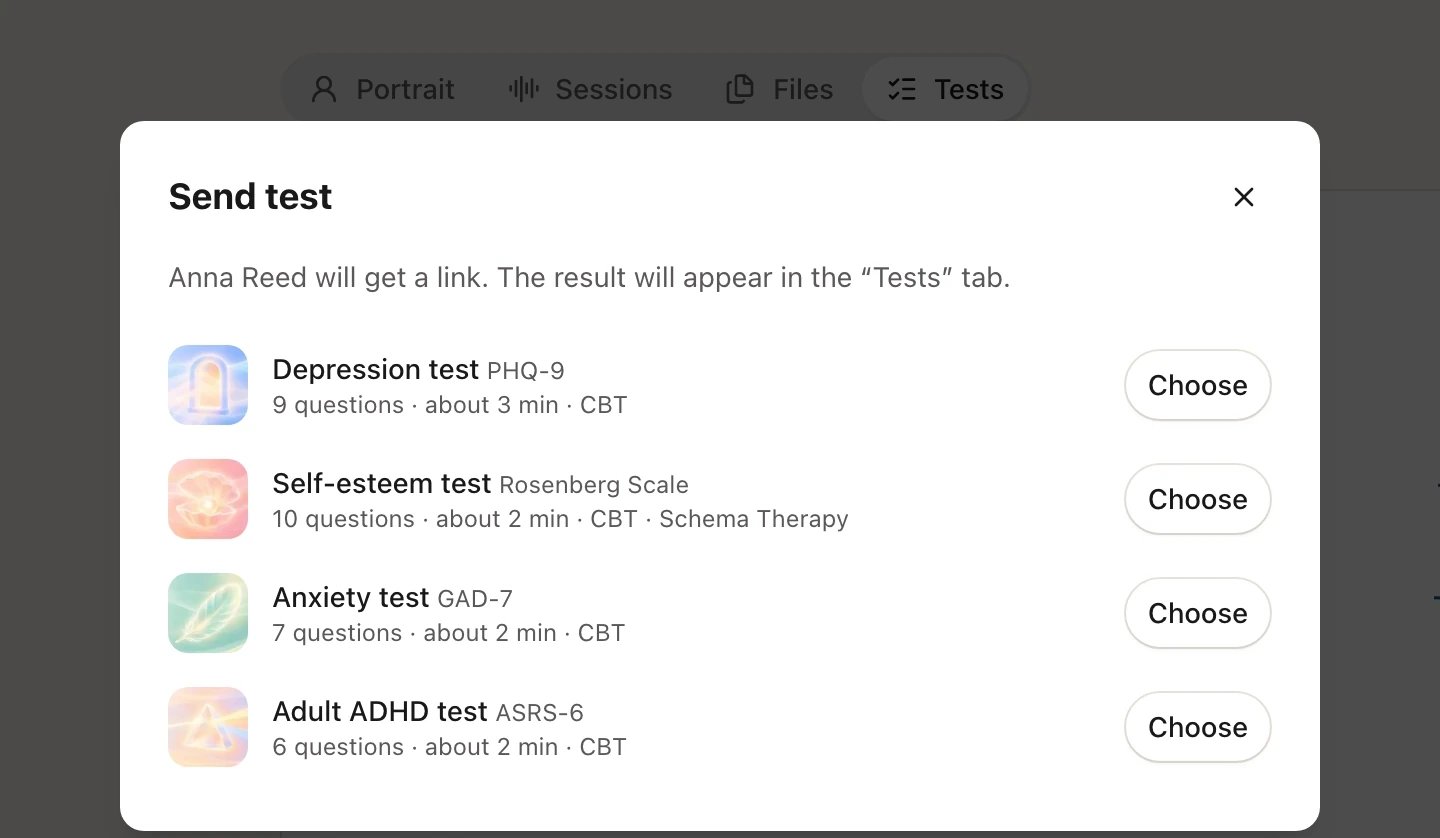
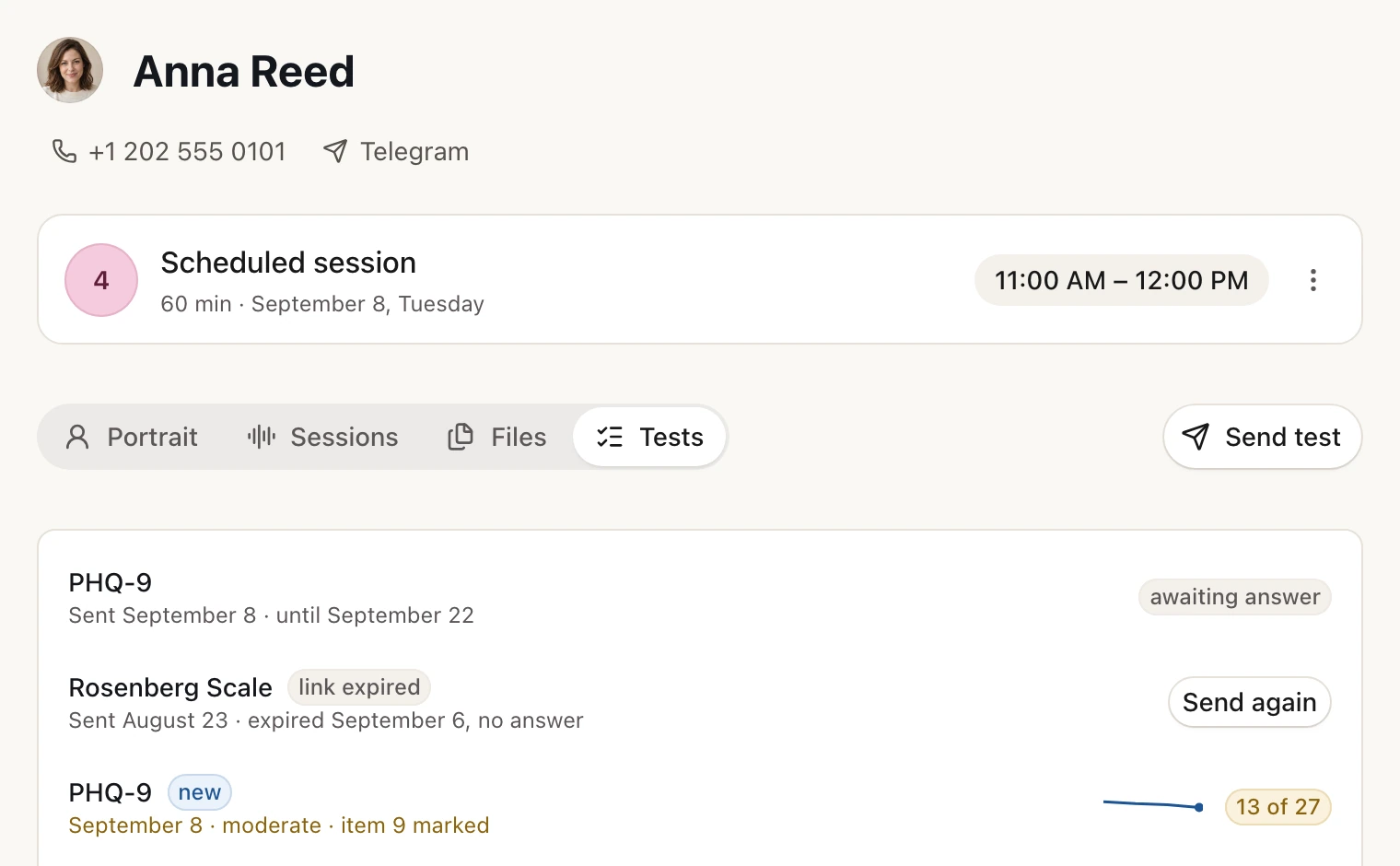
Send scales to clients and watch the change in their card
The client takes the test from a link, no account needed. The result lands in their card and Sessio compares it with last time.