Ten statements show how far your smartphone use is getting in the way of daily life: missed work, trouble concentrating, restlessness without the phone, comments from people around you. You get a score from 10 to 60. It is a self-check, not a diagnosis of addiction.
The SAS-SV (Smartphone Addiction Scale, Short Version) was published by Kwon and colleagues in 2013, in a study of 540 Korean junior-high students. Its ten statements cover missed work, trouble concentrating, pain in the wrists or neck, impatience without the phone, thinking about it, using it longer than planned and comments from other people. Each answer scores 1 to 6, so the total runs from 10 to 60, and a higher total means more problematic use.
This is not a diagnosis
The scale shows how much phone use is troubling your daily life, not whether you are addicted. Its authors describe it as a way to spot higher risk, and problematic smartphone use is not listed as a disorder in the DSM-5 or ICD-11 (Hidalgo-Fuentes et al., 2025). If your phone use hurts your sleep, work, studies or relationships, talk to a therapist or a doctor.
What happens to your answers
Your score is calculated right in your browser. Your answers reach our server only if you ask for your result by email: we write the email and do not keep them.
What score means smartphone addiction?
No score does by itself. In the 2013 study of Korean junior-high students the authors proposed cut-offs of 31 for boys and 33 for girls, found by comparing scores with consultations with clinical psychologists. That study was done in schools, not in a clinic, and other studies have proposed other cut-offs for other groups. So Sessio shows your total, not a level.
Can adults take the SAS-SV?
Yes, you can answer it. The scale was built with teenagers and later used with older groups, for example 530 university students aged 17 to 64 in Honduras, where the Spanish version worked as one reliable scale (Hidalgo-Fuentes et al., 2025). Cut-offs for adults differ between studies, which is why this page gives only your total.
Does “addiction” in the name mean I am addicted?
No. It is the word in the scale’s title, but some researchers prefer the term problematic smartphone use, because they see too little evidence to call it an addictive disorder (Hidalgo-Fuentes et al., 2025). A high score means your answers describe trouble with phone use, and that is worth a conversation.
Source: SAS-SV: Kwon M., Kim D.-J., Cho H., Yang S., 2013, The Smartphone Addiction Scale: Development and Validation of a Short Version for Adolescents, PLoS ONE 8(12): e83558, DOI 10.1371/journal.pone.0083558 (CC BY). Statements and answers: Appendix S1 of the article; the instruction is written by Sessio. Cut-offs: Results and Table 5 of the article. On DSM-5 and ICD-11: Hidalgo-Fuentes S. et al., 2025, PLoS ONE 20(7): e0327226.
For therapists
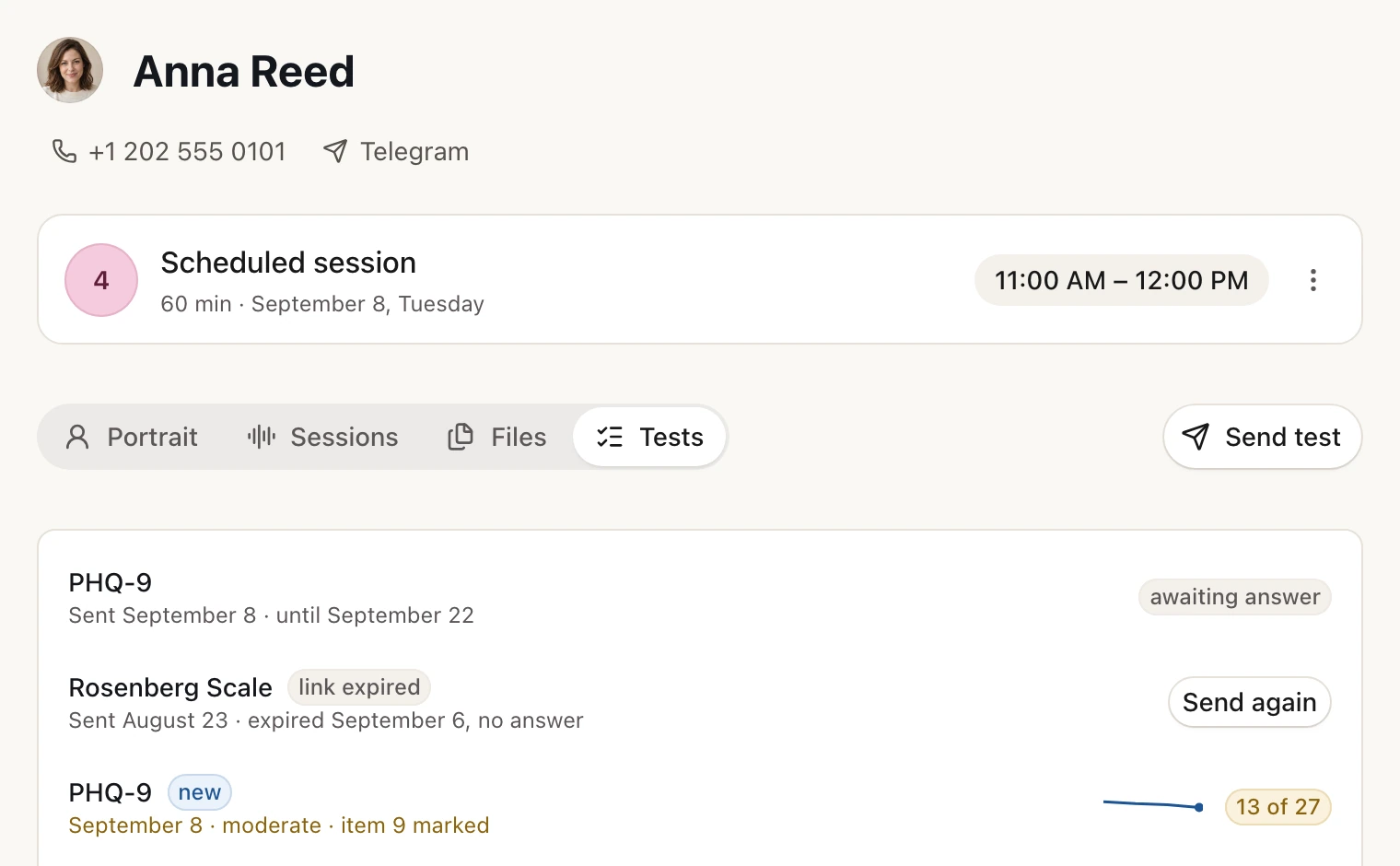
Send scales to clients and watch the change in their card
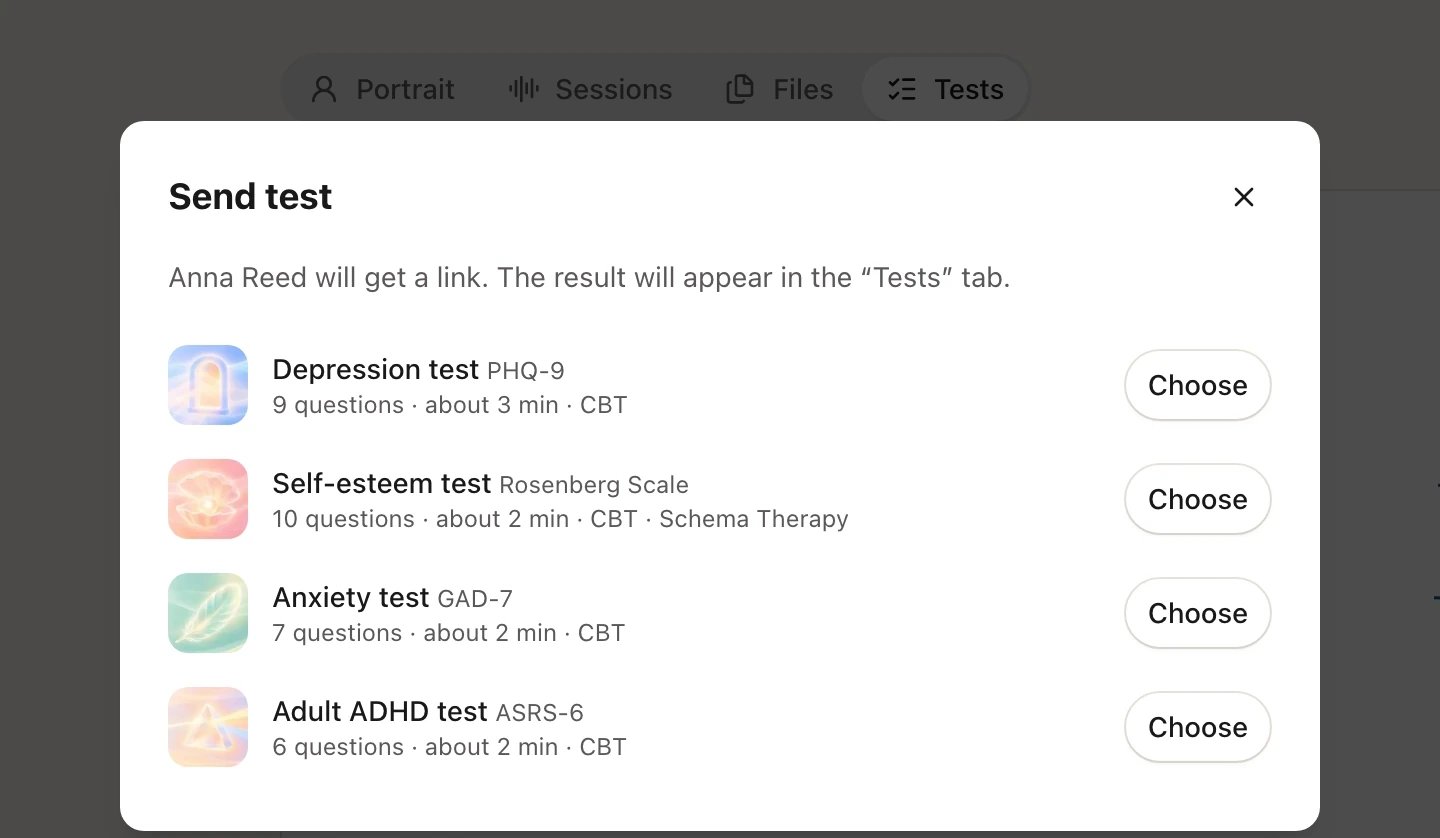
The client takes the test from a link, no account needed. The result lands in their card and Sessio compares it with last time.