Five questions show how much anger has been a problem for you over the past 4 weeks: how often it came, how strong it was, how long it lasted, and whether it got in the way of getting along with people. It is a screening tool, not a diagnosis.
The DAR-5 (Dimensions of Anger Reactions-5) was developed by David Forbes and colleagues and published in 2014. It covers how often you got angry, how intense the anger was, how long it lasted, the urge to hit someone and the effect on your relationships over the past 4 weeks. Each answer scores 1 to 5, so the total runs from 5 to 25. Phoenix Australia gives 12 or more as the cutoff for problem anger.
This is not a diagnosis
A short questionnaire shows how much anger is weighing on you, not why. The cutoff comes from a screening study. Only a professional can judge after a conversation.
What happens to your answers
Your score is calculated right in your browser. Your answers reach our server only if you ask for your result by email: we write the email and do not keep them.
Does a score of 12 or more mean I have an anger problem?
It means anger is bothering you enough to be worth talking about with a therapist or a doctor. It does not say what is behind the anger, and a score below 12 does not mean you have nothing to work on.
Source: DAR-5: Forbes D., Alkemade N., Mitchell D., Elhai J. D., McHugh T., Bates G., Novaco R. W., Bryant R., Lewis V., 2014, Utility of the Dimensions of Anger Reactions-5 (DAR-5) scale as a brief anger measure, Depression and Anxiety 31(2), 166-173, DOI 10.1002/da.22148.
For rights holders: if you hold the rights to this scale or its translation and object to it being here, write to support@sessio.health. We will take it down or ask for your permission.
For therapists
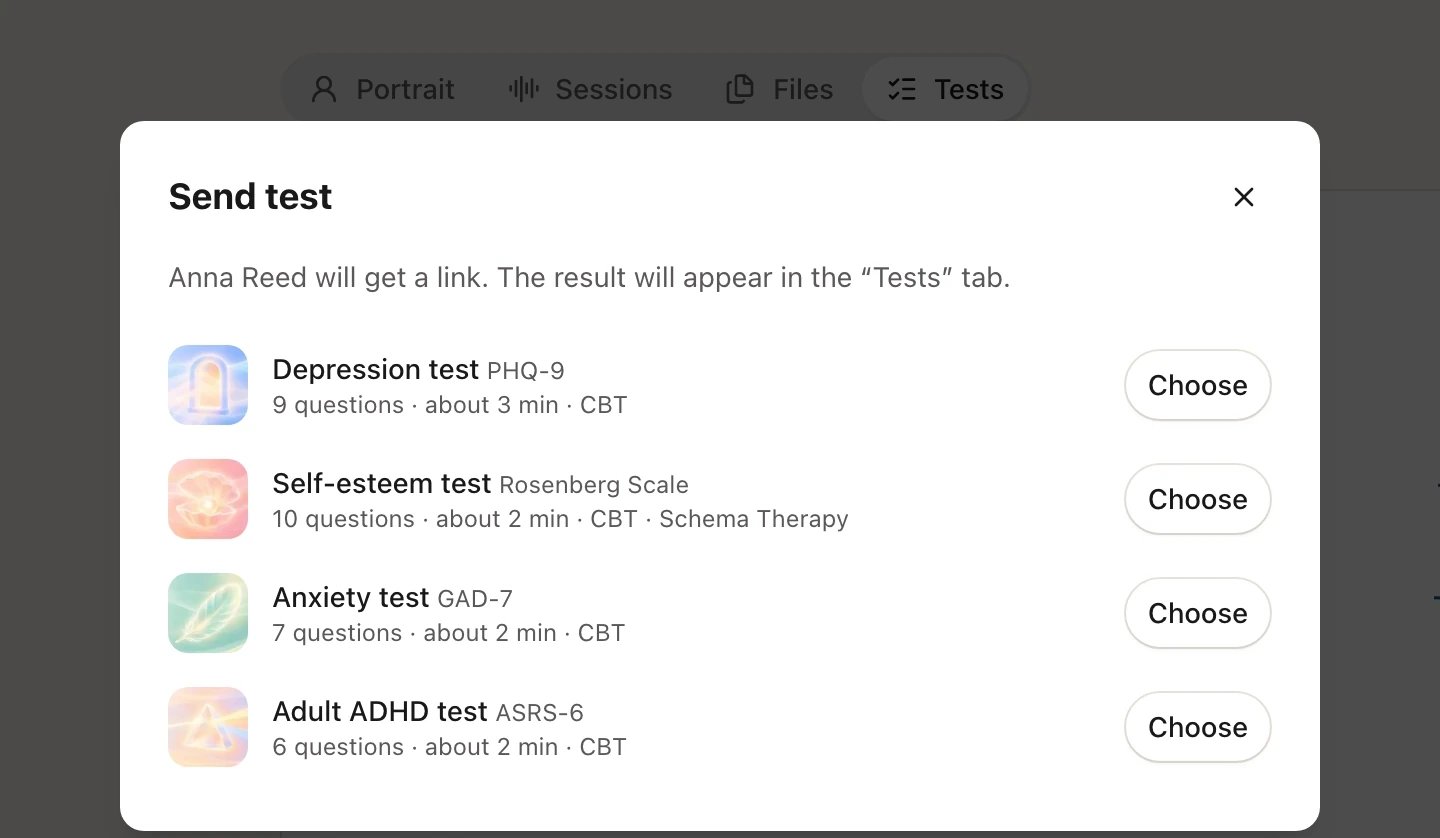
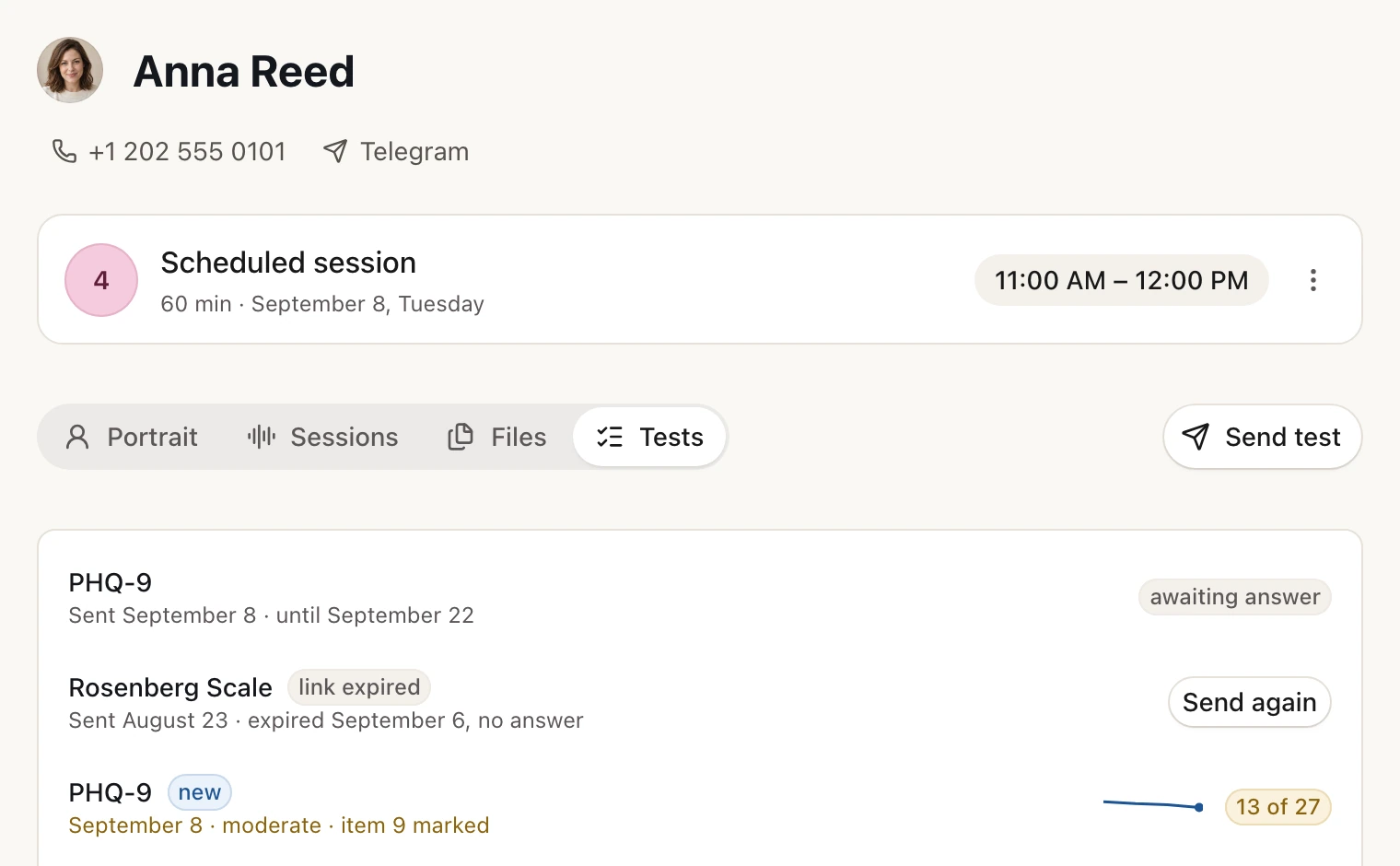
Send scales to clients and watch the change in their card
The client takes the test from a link, no account needed. The result lands in their card and Sessio compares it with last time.