Is cannabis use causing you problems? Six questions about the past 12 months cover smoking before midday, smoking alone, memory, comments from people close to you, attempts to cut down, and trouble caused by use. The result is a score from 0 to 24, not a diagnosis. The test is for people who smoked cannabis in that time.
The CAST (Cannabis Abuse Screening Test) was developed in France at the OFDT, the French monitoring center for drugs and addictions (Legleye, Karila, Beck and Reynaud, 2007). Its six questions cover the last 12 months: smoking before midday, smoking alone, memory problems, friends or family saying you should cut down, trying to cut down or stop without success, and problems caused by cannabis use. Each answer scores 0 (never) to 4 (very often), for a total of 0 to 24. On its form, the OFDT says a score of 7 or more very probably means problems linked to use. In a French survey of 1,351 people aged 15 to 64 who had used cannabis in the past year, a score of 5 best picked out moderate or severe cannabis use disorder under DSM-5, and a score of 8 picked out severe disorder (Legleye, 2018). In a 2013 note the OFDT adds that the thresholds are not definitively set and that the test overestimates the share of people at high risk.
This is not a diagnosis
The score describes how often certain situations came up around your cannabis use. It does not say whether you have a use disorder or dependence, and it does not judge you. Only a doctor or an addiction specialist can assess that, after a conversation. The OFDT itself says the test cannot replace a clinical diagnosis.
What happens to your answers
Your score is calculated right in your browser. Your answers reach our server only if you ask for your result by email: we write the email and do not keep them.
I have not smoked cannabis in the past 12 months. Should I take this test?
No. The questions are written for people who smoked cannabis in the past 12 months, and on the OFDT form that is the very first question. If that is not you, the questions do not apply.
Does a high score mean I am addicted?
No. The score counts how often the situations in the questions came up. The OFDT form reads 7 or more as probable problems linked to use, but the OFDT also says the test overestimates the share of people at high risk and is not a diagnosis. The way to find out more is a conversation with a specialist.
The questions say “smoked”. What if I use cannabis another way?
The wording is the same as on the original form, which asks about smoking. If you use cannabis another way, you can answer for the way you use it. More than the number, what matters is whether the questions describe something you recognize in your own life.
Source: CAST, Cannabis Abuse Screening Test: Legleye S., Karila L., Beck F., Reynaud M., 2007, Validation of the CAST, a general population Cannabis Abuse Screening Test, Journal of Substance Use 12(4), 233-242. Developed at the OFDT (Observatoire français des drogues et des tendances addictives). Questions and answer options: English wording published by the author in Legleye S., 2018, Int J Methods Psychiatr Res 27(2), e1597, DOI 10.1002/mpr.1597, section 2.2 (PMC6877270); the first sentence of the instruction is Sessio’s.
For rights holders: if you hold the rights to this scale or its translation and object to it being here, write to support@sessio.health. We will take it down or ask for your permission.
For therapists
Send scales to clients and watch the change in their card
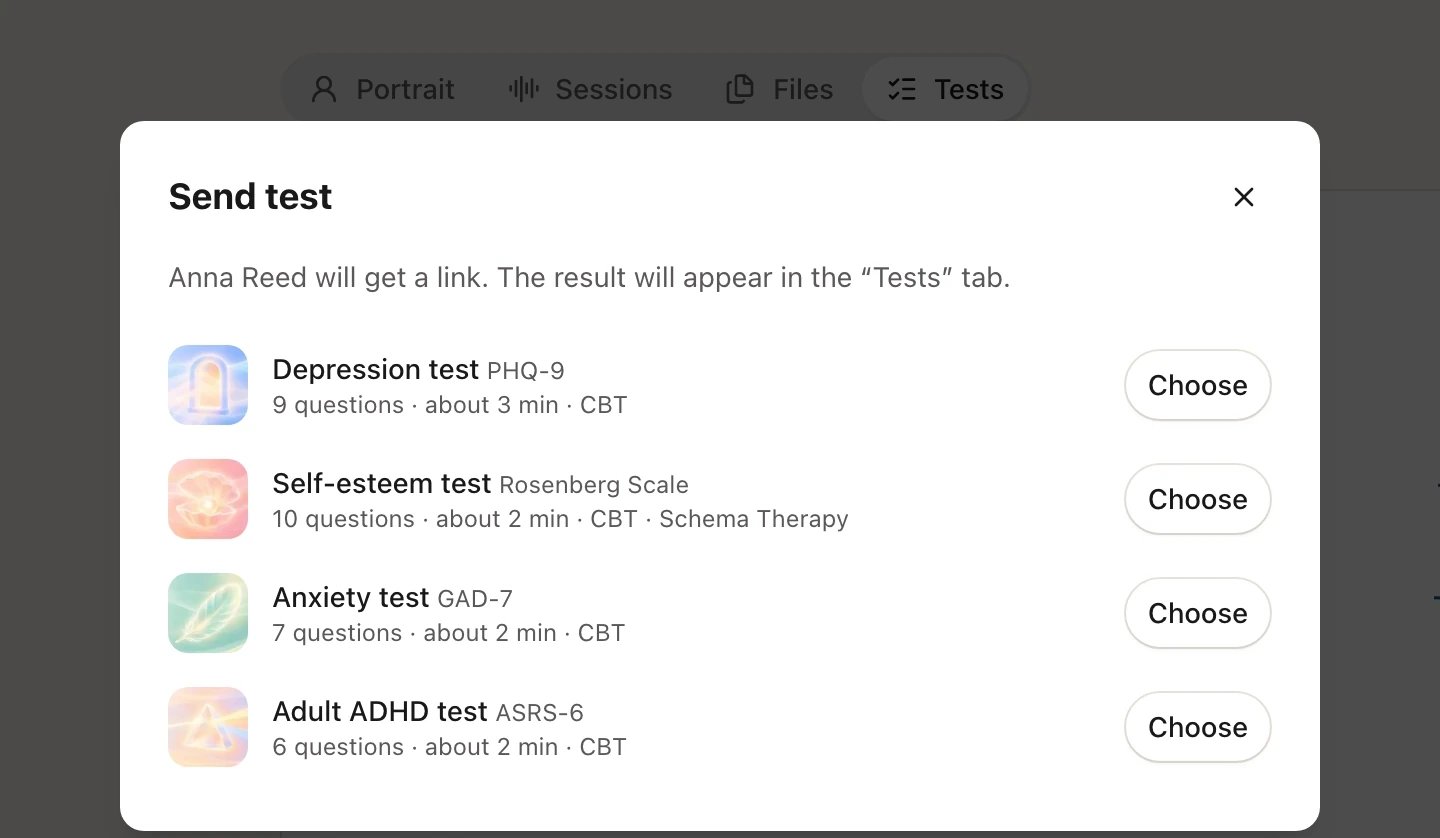
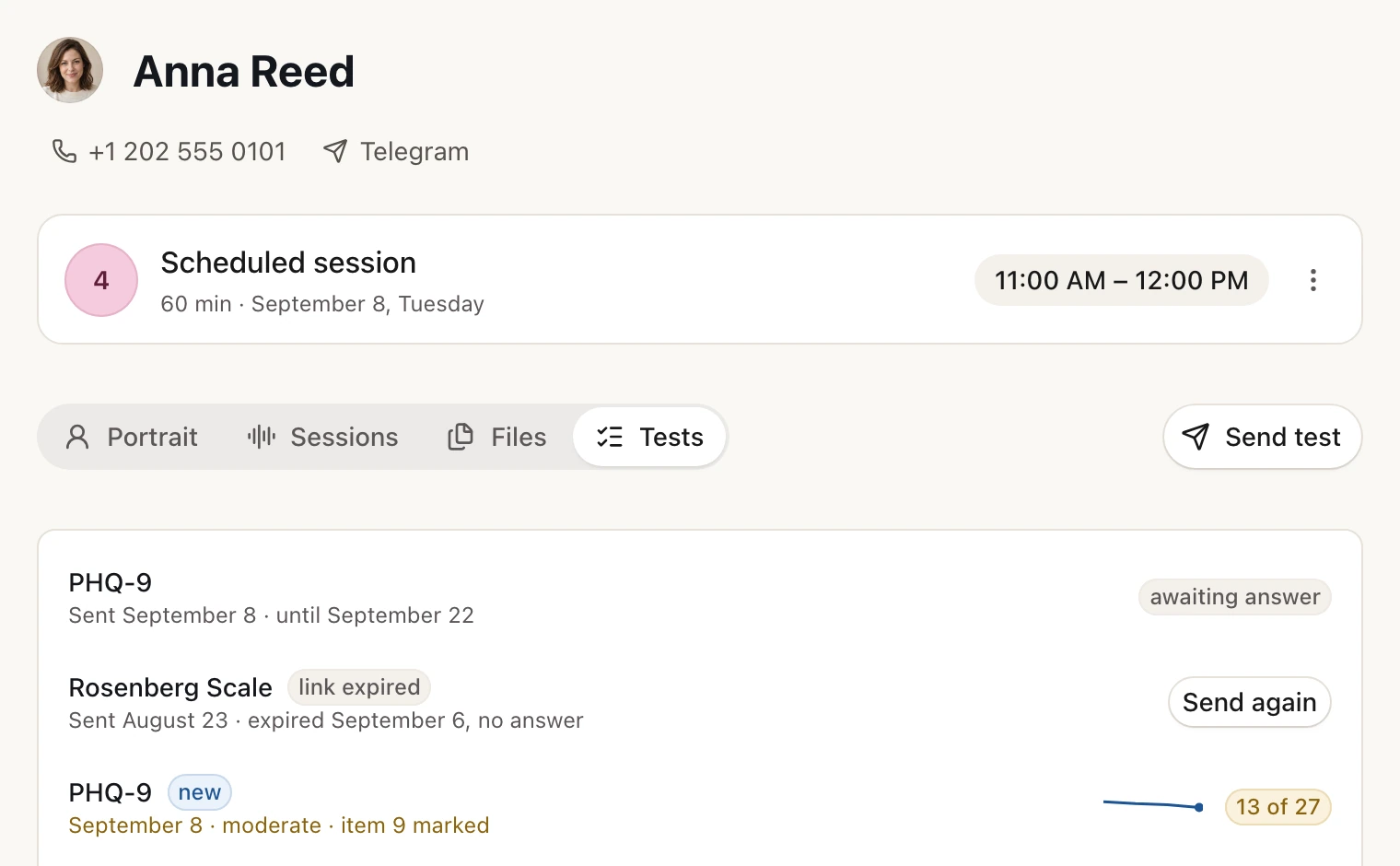
The client takes the test from a link, no account needed. The result lands in their card and Sessio compares it with last time.