Ten statements about how you felt over the past week: mood, energy, sleep, hope and loneliness. You get a score from 0 to 30. It is a screening tool, not a diagnosis: a high score is a reason to talk to a professional.
The CES-D-10 is the short form of the Center for Epidemiologic Studies Depression Scale (Andresen and colleagues, 1994). It asks how often you had each of ten feelings during the past week. Each answer scores 0 to 3; items 5 and 8 are positive and are scored in reverse. The total runs from 0 to 30, and 10 or more is the cutoff commonly used in the literature for a likely depression screen.
This is not a diagnosis
The score shows how many depressive symptoms you reported for one week. It cannot tell depression from a hard stretch of life. A doctor or therapist makes a diagnosis after a conversation.
What happens to your answers
Your score is calculated right in your browser. Your answers reach our server only if you ask for your result by email: we write the email and do not keep them.
How is the CES-D-10 different from the full CES-D?
It is a short version with 10 of the 20 statements, so it takes 2 to 3 minutes. For a bit more detail, take the full 20-item scale: Depression test, 20 questions (CES-D)
Source: CES-D-10: Andresen E. M., Malmgren J. A., Carter W. B., Patrick D. L., 1994, Screening for depression in well older adults: evaluation of a short form of the CES-D, American Journal of Preventive Medicine 10(2), 77-84, DOI 10.1016/S0749-3797(18)30622-6; Radloff L. S., 1977, Applied Psychological Measurement 1, 385-401. Text: CES form of the Pittsburgh Mind-Body Center (CMU Common Cold Project, pmbc_ces-d.pdf), verbatim, without the interviewer script.
For rights holders: if you hold the rights to this scale or its translation and object to it being here, write to support@sessio.health. We will take it down or ask for your permission.
For therapists
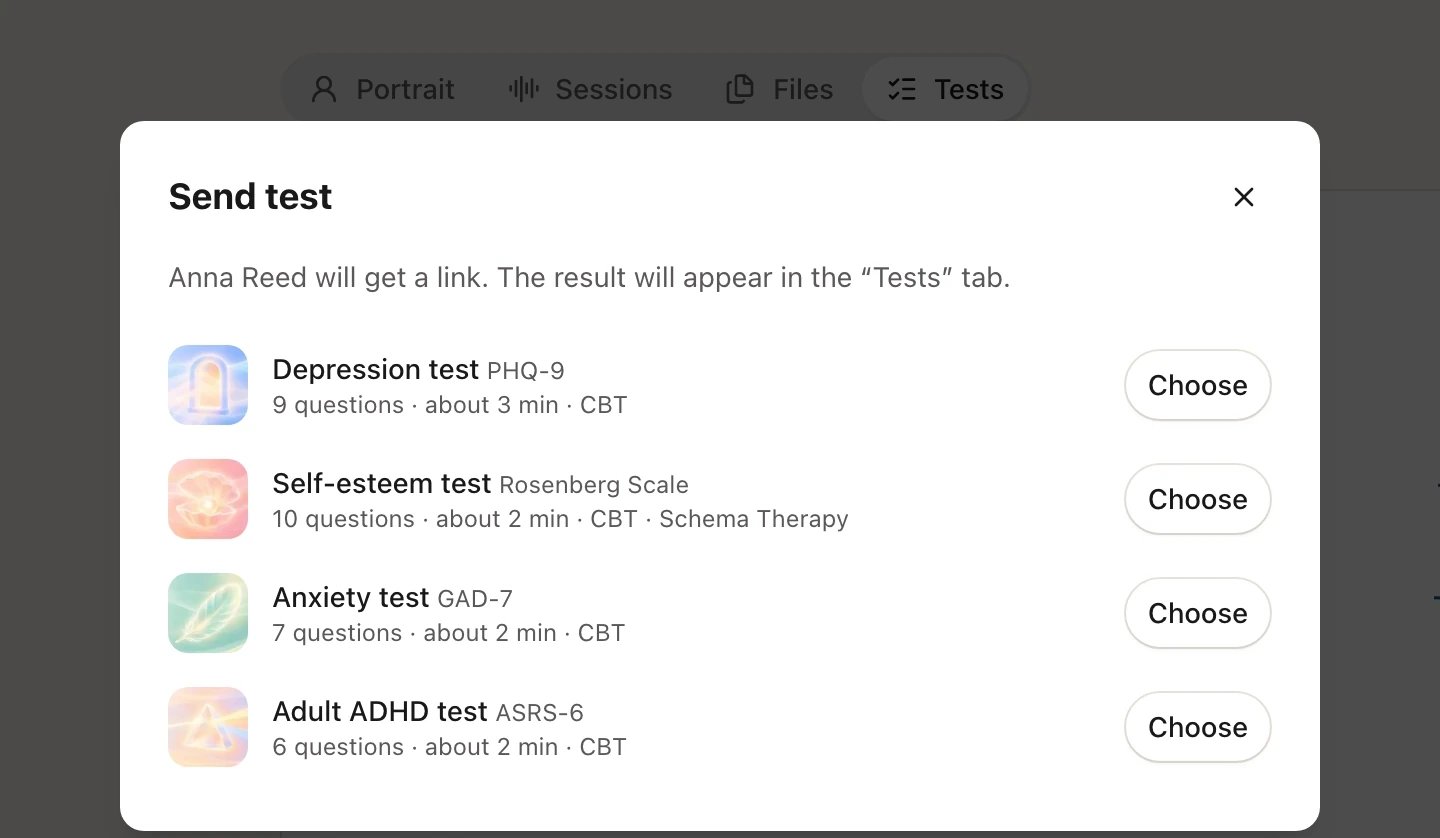
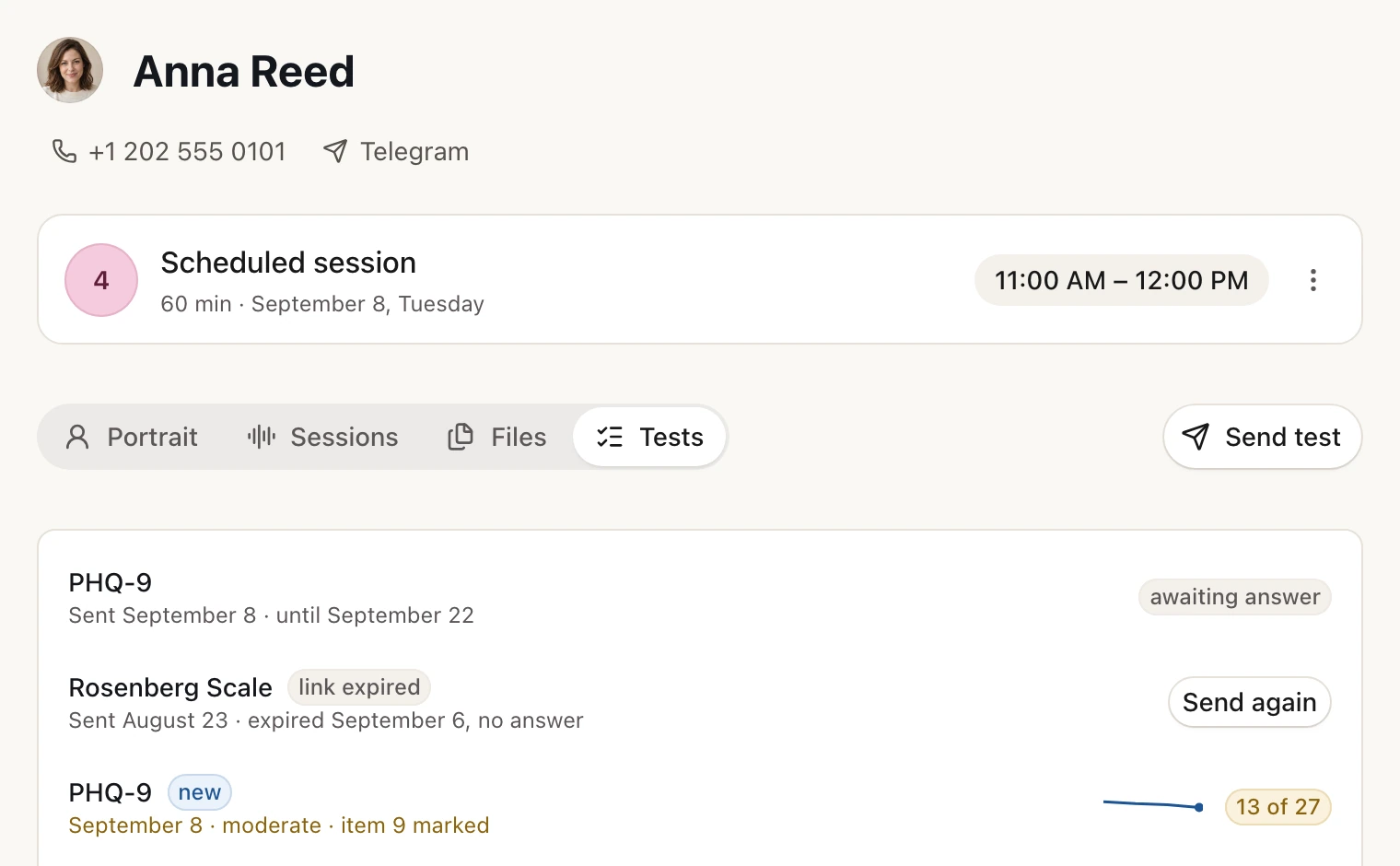
Send scales to clients and watch the change in their card
The client takes the test from a link, no account needed. The result lands in their card and Sessio compares it with last time.