Free test · K10

Psychological distress test (K10)

Ten questions show how much distress you have felt over the past 30 days: nervousness, restlessness, exhaustion, low mood and hopelessness. It is a screen, not a diagnosis. The score shows whether the distress is low or high and whether it is worth talking to a professional.

K10: 10 questions. Shorter: K6.

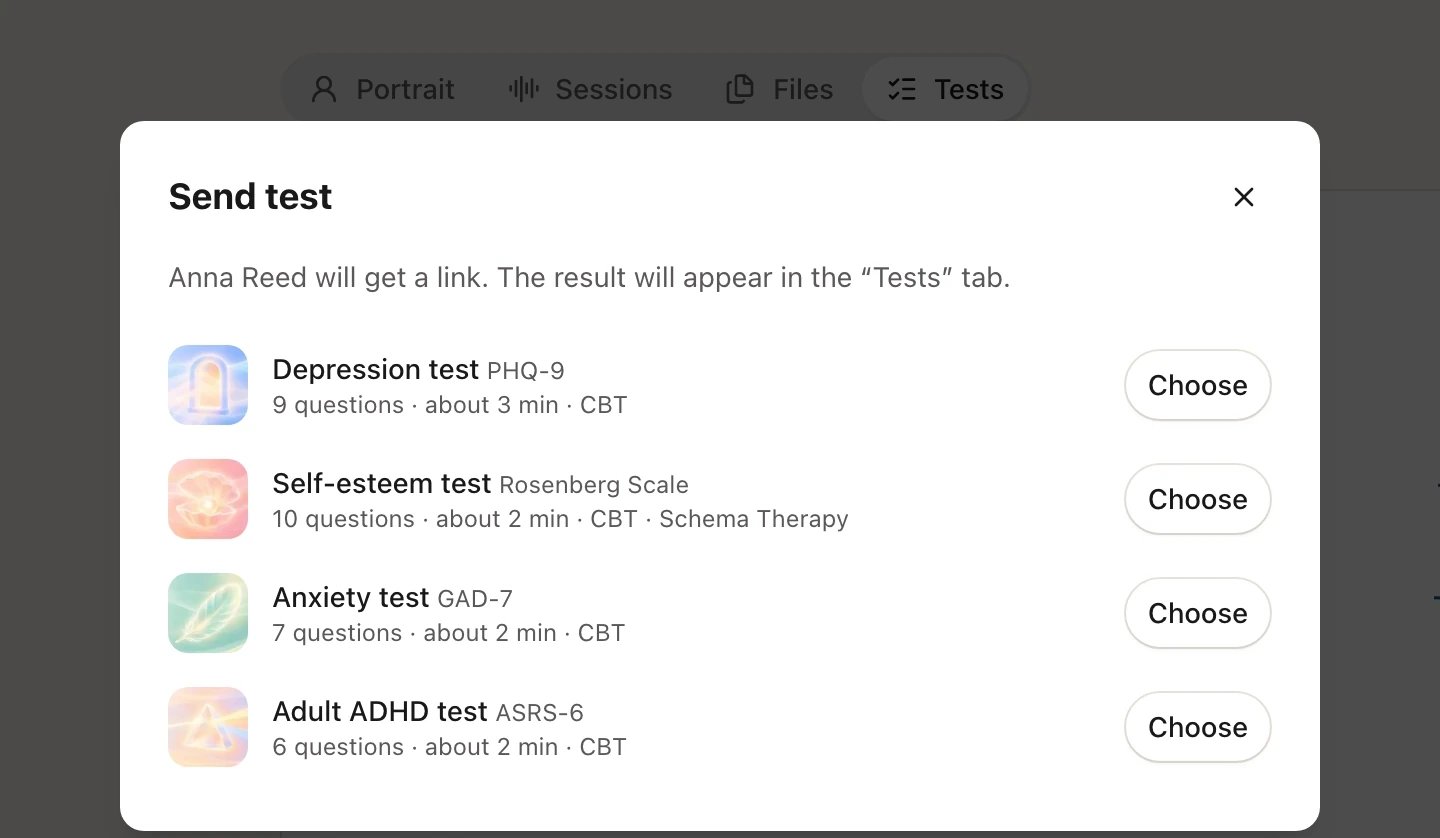
Send to a client

What it measures

The K10 (Kessler Psychological Distress Scale) asks how often over the past 30 days you felt tired out for no good reason, nervous, hopeless, restless, depressed, that everything was an effort, or worthless. Each answer scores 1 to 5, for a total of 10 to 50. Scores of 10 to 15 mean low distress, 16 to 21 moderate, 22 to 29 high and 30 to 50 very high (Andrews and Slade, 2001). The scale measures general distress, not one particular condition.

This is not a diagnosis

The K10 shows how heavy the distress is, not what lies behind it. High scores go with anxiety and depression more often, but only a doctor or therapist can tell after a conversation.

What happens to your answers

Your score is calculated right in your browser. Your answers reach our server only if you ask for your result by email: we write the email and do not keep them.

How is the K10 different from the K6?

The K6 keeps six of the ten K10 questions, so it is quicker, but its score cannot be compared directly with the K10 score. If you want a quicker check, take the short version: Psychological distress test, 6 questions (K6)

Similar tests

All tests

Source: Kessler Psychological Distress Scale (K10): Kessler R. C., Andrews G., Colpe L. J., Hiripi E., Mroczek D. K., Normand S.-L. T., Walters E. E., Zaslavsky A. M., 2002, Short screening scales to monitor population prevalences and trends in non-specific psychological distress, Psychological Medicine 32(6), 959-976, DOI 10.1017/S0033291702006074. Text: self-administered English K10 (items 1a-1j of the K10+ form), rckessler.scholars.harvard.edu/k10-and-k6-scales. Copyright © Ronald C. Kessler, PhD. Cited as the copyright holder asks: Kessler R. C., Barker P. R., Colpe L. J., Epstein J. F., Gfroerer J. C., Hiripi E., Howes M. J., Normand S.-L. T., Manderscheid R. W., Walters E. E., Zaslavsky A. M., 2003, Screening for serious mental illness in the general population, Archives of General Psychiatry 60(2), 184-189, DOI 10.1001/archpsyc.60.2.184. Levels: Andrews G., Slade T., 2001, Interpreting scores on the Kessler Psychological Distress Scale (K10), Australian and New Zealand Journal of Public Health 25(6), 494-497, DOI 10.1111/j.1467-842x.2001.tb00310.x.

For therapists

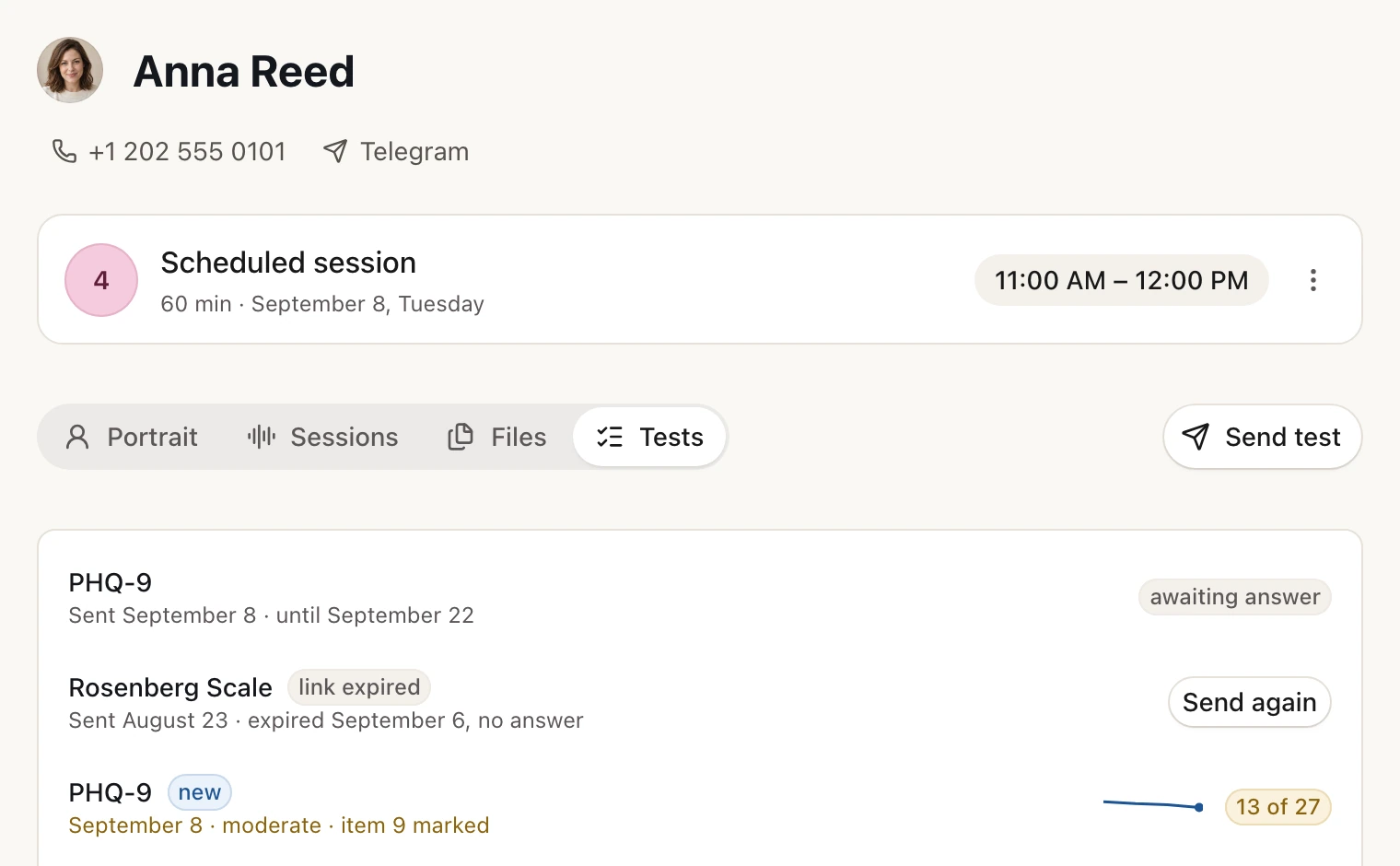
Send scales to clients and watch the change in their card

The client takes the test from a link, no account needed. The result lands in their card and Sessio compares it with last time.

  • A link for the client, no sign-up
  • The result and the change since last time
  • Suitable scales are already inside

Sessio Beta is free for now