Fifteen yes or no questions about the past week show whether low mood, loss of interest or a sense of hopelessness deserve a closer look. The scale was built for older adults and is easy to answer. It is a screen, not a diagnosis: a high score is a reason to talk to a doctor or therapist.
The short form of the Geriatric Depression Scale (Sheikh and Yesavage, 1986) asks about mood, interest in activities, energy, hope and sense of worth over the past week. Each question is answered yes or no. An answer that points to depression scores 1 point (no on five of the questions, yes on the other ten), so the total runs from 0 to 15. The scale's authors treat a score above 5 as suggestive of depression and a score above 10 as almost always depression.
This is not a diagnosis
The scale is a screen: it shows whether low mood is worth looking into, not what causes it. In later life low mood can also come from illness, medicines, grief or loneliness. A doctor or therapist makes a diagnosis after a conversation. The scale has no question about suicidal thoughts, so a low score does not rule out serious distress.
What happens to your answers
Your score is calculated right in your browser. Your answers reach our server only if you ask for your result by email: we write the email and do not keep them.
How is the GDS-15 different from the GDS-30?
The GDS-15 is the short form: 15 questions, about five minutes, easier for people who tire quickly. The GDS-30 is the original long form with 30 questions; it covers more and takes longer. The short form is enough for a first look, and for a fuller picture you can take the long form: Geriatric depression test, 30 questions (GDS-30)
Can a relative answer for the person?
No. The questions are about the person's own past week. A relative can read them aloud and help with the screen, but each answer should be the person's own.
Source: Geriatric Depression Scale, short form (GDS-15): Sheikh J. I., Yesavage J. A., 1986, Geriatric Depression Scale (GDS): recent evidence and development of a shorter version, in Brink T. L. (ed.), Clinical Gerontology: A Guide to Assessment and Intervention, Haworth Press, 165-173; original 30-item scale: Yesavage J. A. et al., 1983, Journal of Psychiatric Research 17(1), 37-49, DOI 10.1016/0022-3956(82)90033-4. Text and cutoffs: J. Yesavage, Stanford, web.stanford.edu/~yesavage/GDS.html (short form and scoring page).
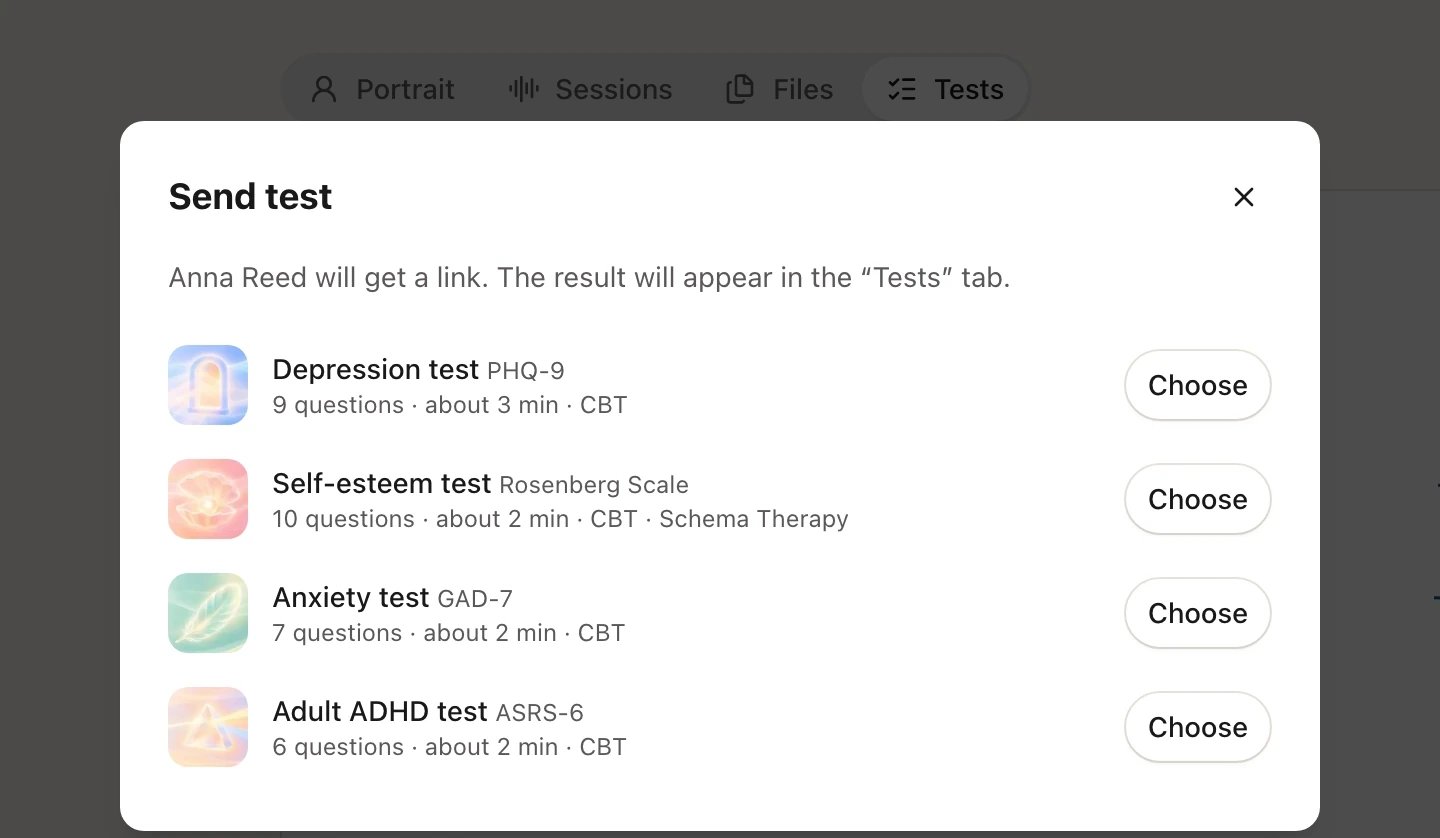
For therapists
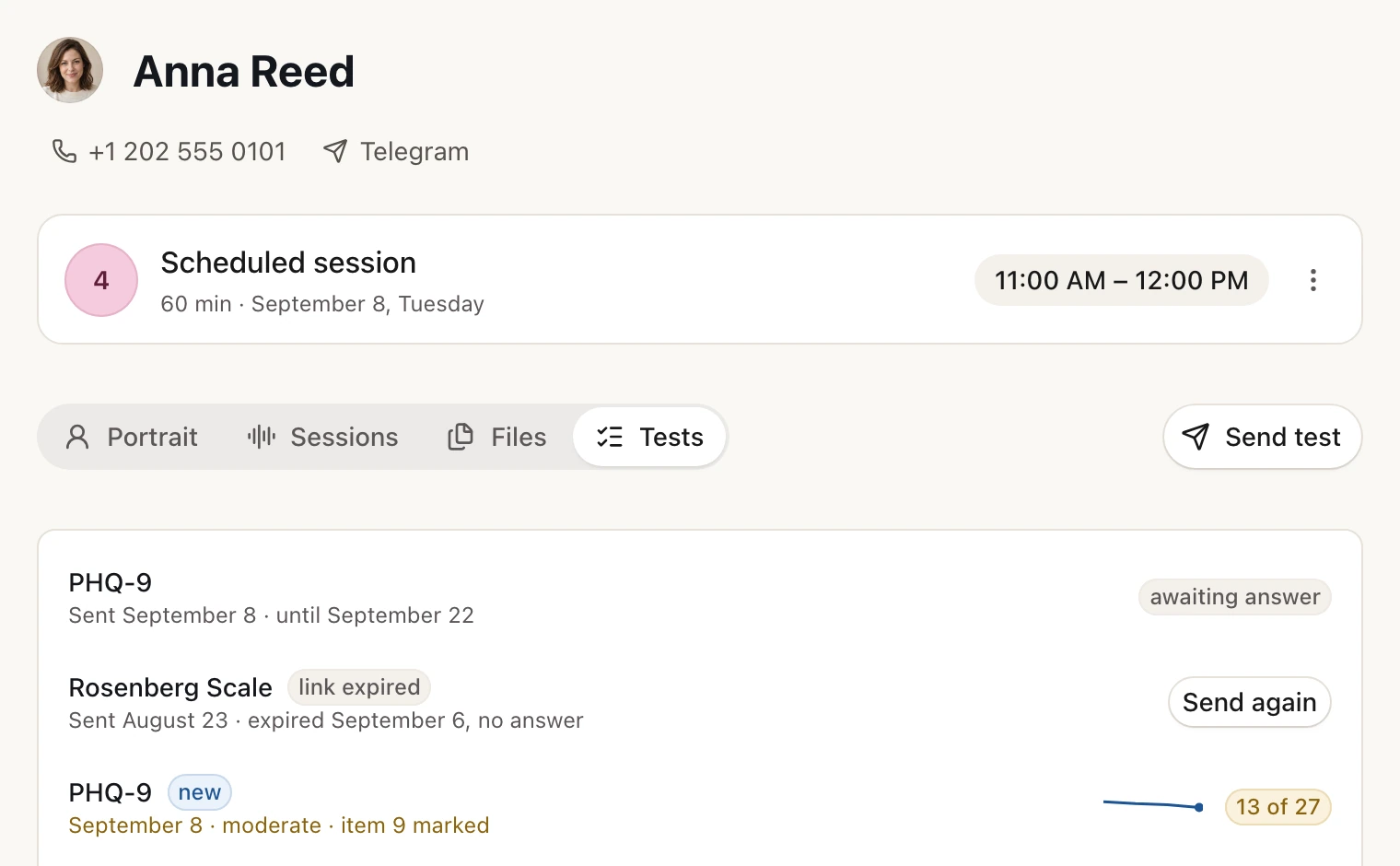
Send scales to clients and watch the change in their card
The client takes the test from a link, no account needed. The result lands in their card and Sessio compares it with last time.