Thirty yes or no questions show how much low mood has weighed on you over the past week. The scale was made for older adults and asks about mood, hope and interest in life rather than sleep or appetite. It is a screen, not a diagnosis: a prompt to decide whether to talk to someone.
The Geriatric Depression Scale (GDS) was developed by Yesavage, Brink and colleagues (1983) as a basic screening measure for depression in older adults. This is the original 30-question long form. Each question is answered yes or no, and an answer that points toward low mood scores 1 point: “no” to questions such as being satisfied with life or full of energy, “yes” to questions such as feeling empty, helpless or worthless. The total runs from 0 to 30: 0 to 9 is the normal range, 10 to 19 mild depression, 20 to 30 severe depression (the authors’ original scoring).
This is not a diagnosis
The score shows how many signs of low mood there are, not what lies behind them. Illness, grief and some medicines can also affect mood, and a questionnaire cannot tell them apart. A doctor or therapist makes a diagnosis after a conversation.
What happens to your answers
Your score is calculated right in your browser. Your answers reach our server only if you ask for your result by email: we write the email and do not keep them.
How is the GDS-30 scored?
Every answer is worth 0 or 1 point, and the point goes to the answer that points toward low mood. That is “no” to questions 1, 5, 7, 9, 15, 19, 21, 27, 29, 30 (satisfied with life, hopeful, in good spirits, happy, glad to be alive, finding life exciting, full of energy, enjoying the morning, deciding easily, thinking clearly) and “yes” to the other 20. The page adds it up for you.
What is the difference between the GDS-30 and the GDS-15?
The GDS-15 is a short form whose 15 questions are all among these 30, so it takes about half the time and has its own score ranges. Scores from the two forms cannot be compared directly. If you are short on time, take the short one: Geriatric depression test, 15 questions (GDS-15)
Source: GDS-30: Yesavage J. A., Brink T. L., Rose T. L., Lum O., Huang V., Adey M., Leirer V. O., 1983, Development and validation of a geriatric depression screening scale: a preliminary report, Journal of Psychiatric Research 17(1), 37-49, DOI 10.1016/0022-3956(82)90033-4. Items, key and scoring: Geriatric Depression Scale, long form, Jerome Yesavage, Stanford University (web.stanford.edu/~yesavage/GDS.html).
For therapists
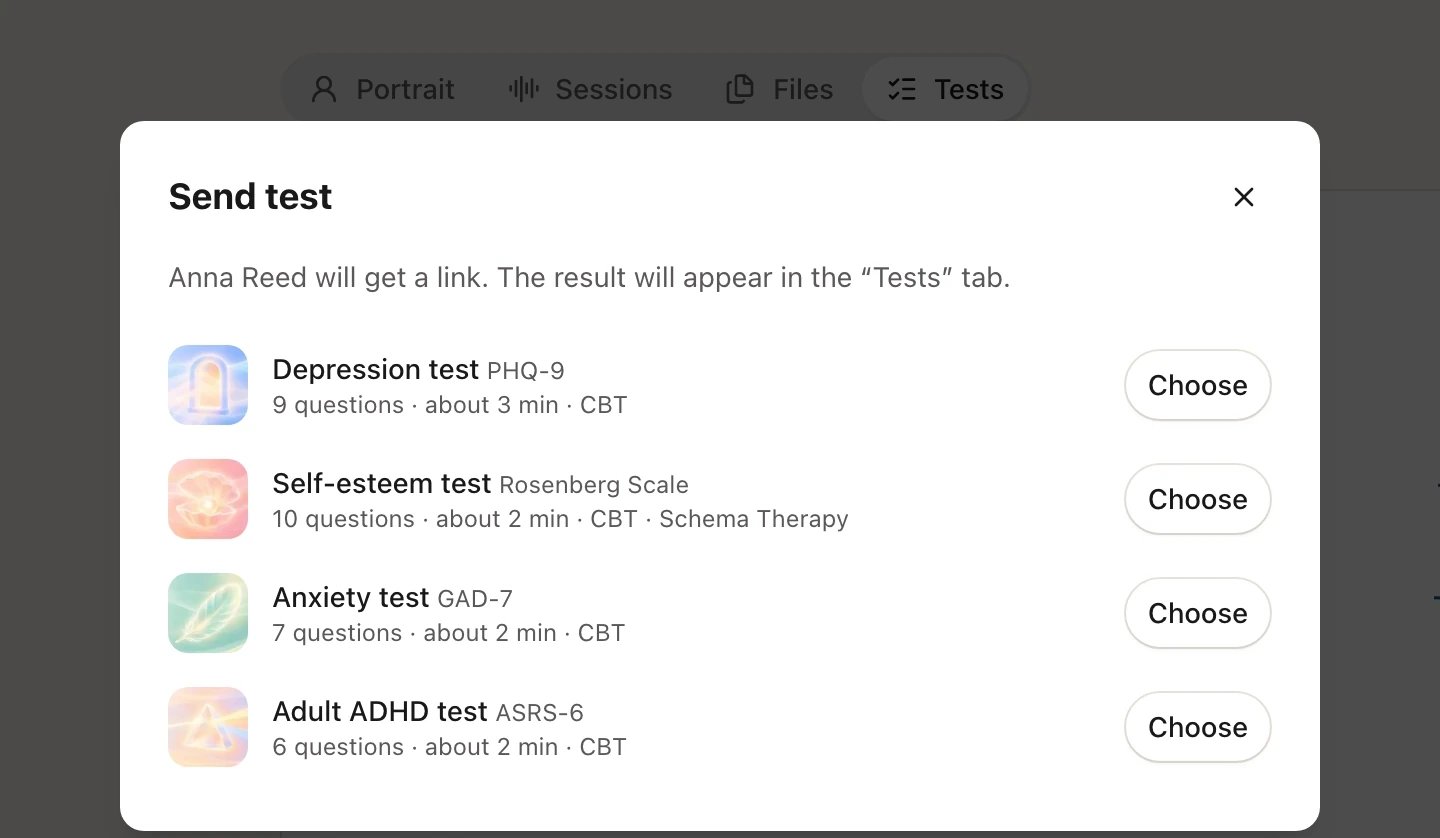
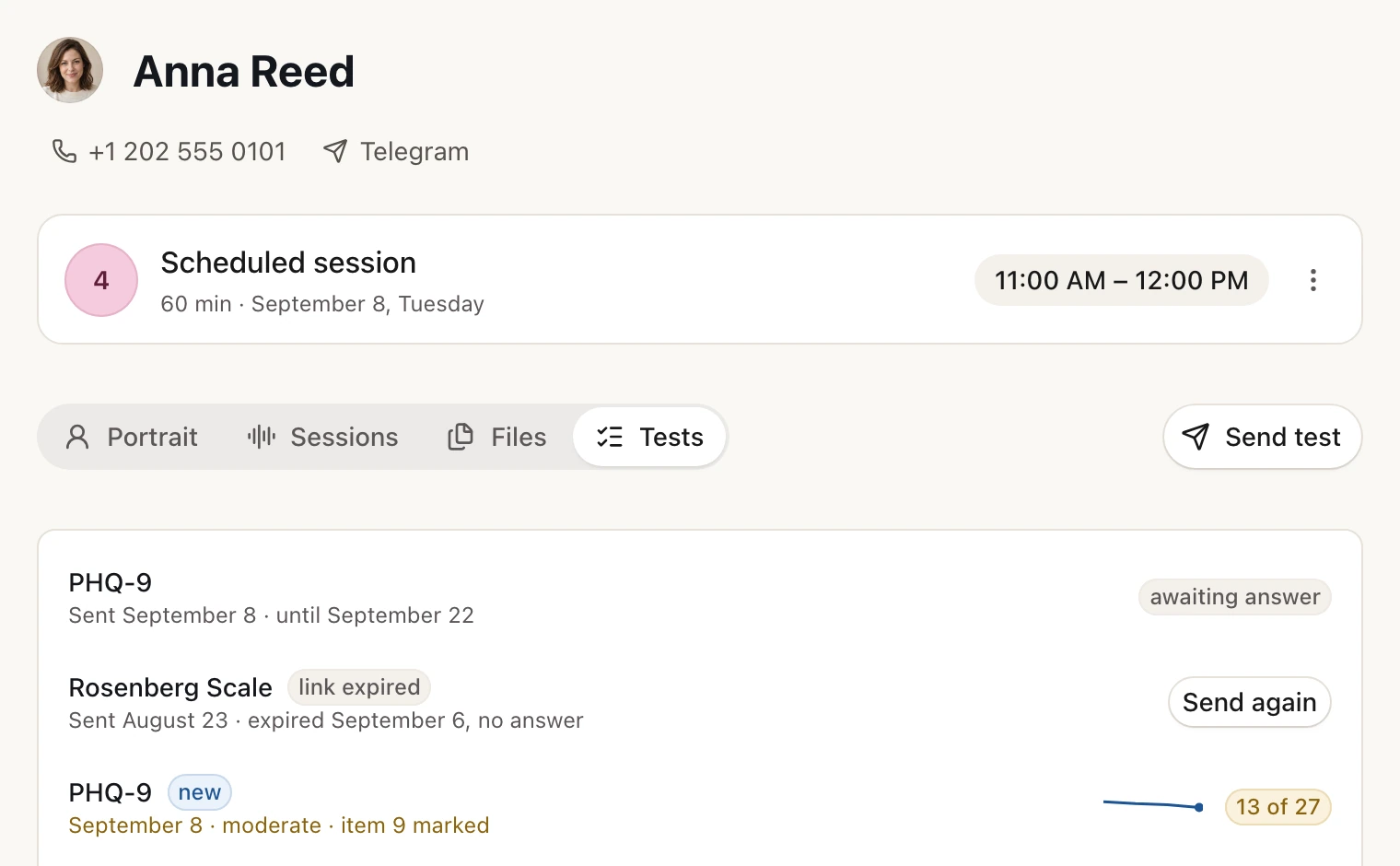
Send scales to clients and watch the change in their card
The client takes the test from a link, no account needed. The result lands in their card and Sessio compares it with last time.