Twelve questions about how much of the time over the past two weeks you have felt low, lost interest, lacked energy, or had trouble with sleep or appetite. You get a score from 0 to 50 and see which range it falls in on the form's own key. It is a screen, not a diagnosis.
The Major Depression Inventory (MDI) comes from Per Bech and colleagues at the Psychiatric Research Unit in Hillerød, Denmark, who described and tested it in 2001. Its ten items follow the symptoms of depression in ICD-10 and DSM-IV: low mood, loss of interest, low energy, self-confidence, guilt, feeling that life is not worth living, concentration, restlessness or slowing down, sleep and appetite. Items 8 and 10 each have two questions, a and b, and only the higher answer of the pair counts. Each item scores 0 to 5, so the total runs from 0 to 50. A higher score means the symptoms were present more of the time.
This is not a diagnosis
The score shows how much of the time you had symptoms of depression over two weeks. It cannot tell depression from a hard stretch of life. The MDI form also has a diagnostic algorithm for clinicians; Sessio does not use it. Only a doctor or a therapist can say whether it is depression, after a conversation. If you feel that life is not worth living, tell someone you trust or call a helpline today.
What happens to your answers
Your score is calculated right in your browser. Your answers reach our server only if you ask for your result by email: we write the email and do not keep them.
Why 12 questions if the scale has 10 items?
Items 8 and 10 (questions 8 and 9, 11 and 12 here) ask about changes that can go either way in depression: very restless or slowed down, less or more appetite. You answer both questions of each pair, and only the higher of the two scores counts toward the total. That keeps the maximum at 50.
Where do the levels come from?
From the scoring page of the official form (version 2003), which cites Olsen and colleagues, 2003: 20 to 24 mild, 25 to 29 moderate, 30 or more severe depression. The form names no level below 20.
Which test should I take next?
The PHQ-9 also covers the past two weeks, in nine questions. For a second look, you can take it too: Depression test
Source: Bech P. et al., 2001, Journal of Affective Disorders 66, 159-164. Text and scoring: the form "PB ICD-10/DSM-IV v 2003", Psychiatric Research Unit, Hillerød (copy on chiro.org). Levels: the scoring page of the same form, citing Olsen L. R. et al., 2003, Psychological Medicine 33, 351-356.
For rights holders: if you hold the rights to this scale or its translation and object to it being here, write to support@sessio.health. We will take it down or ask for your permission.
For therapists
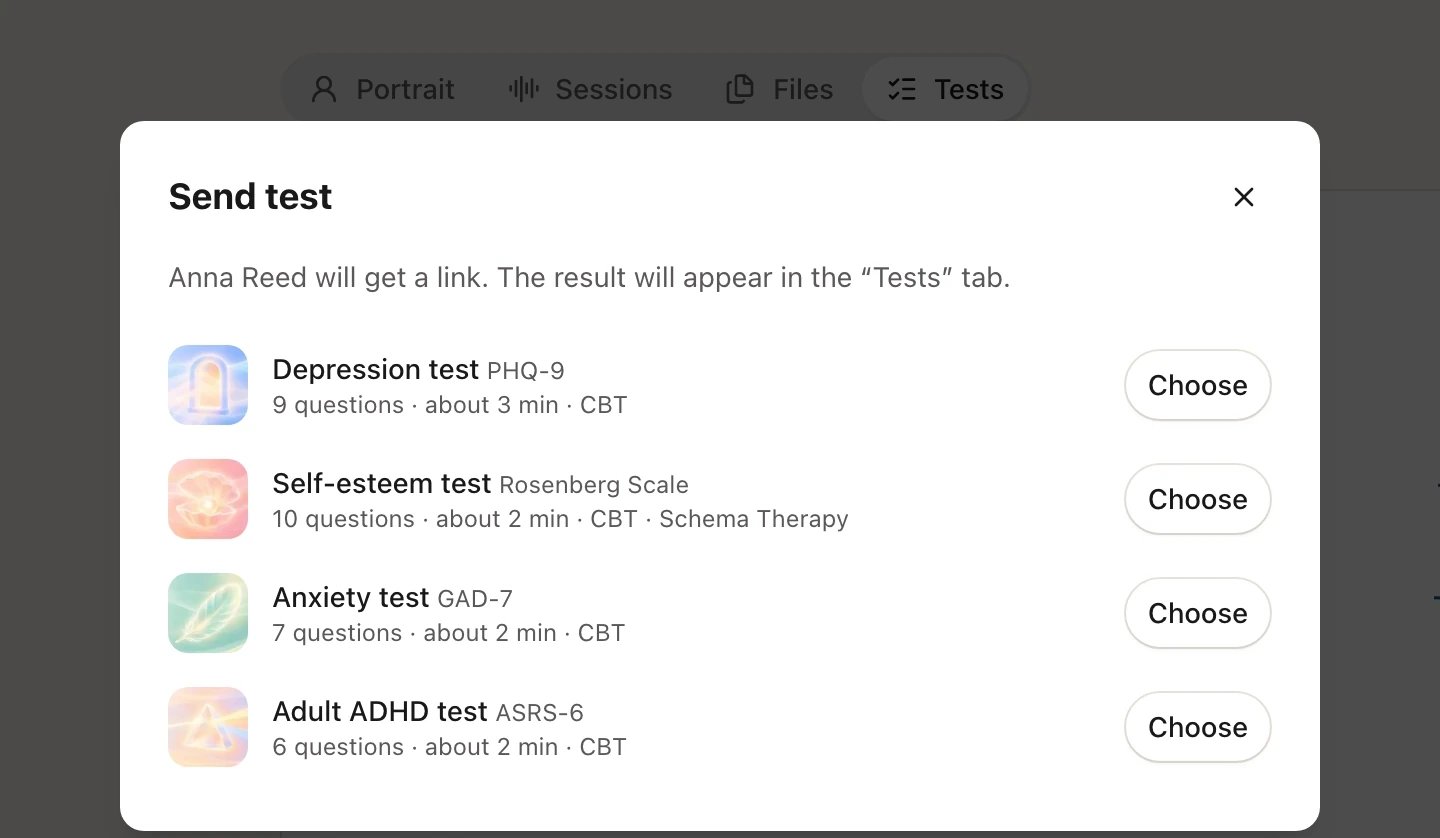
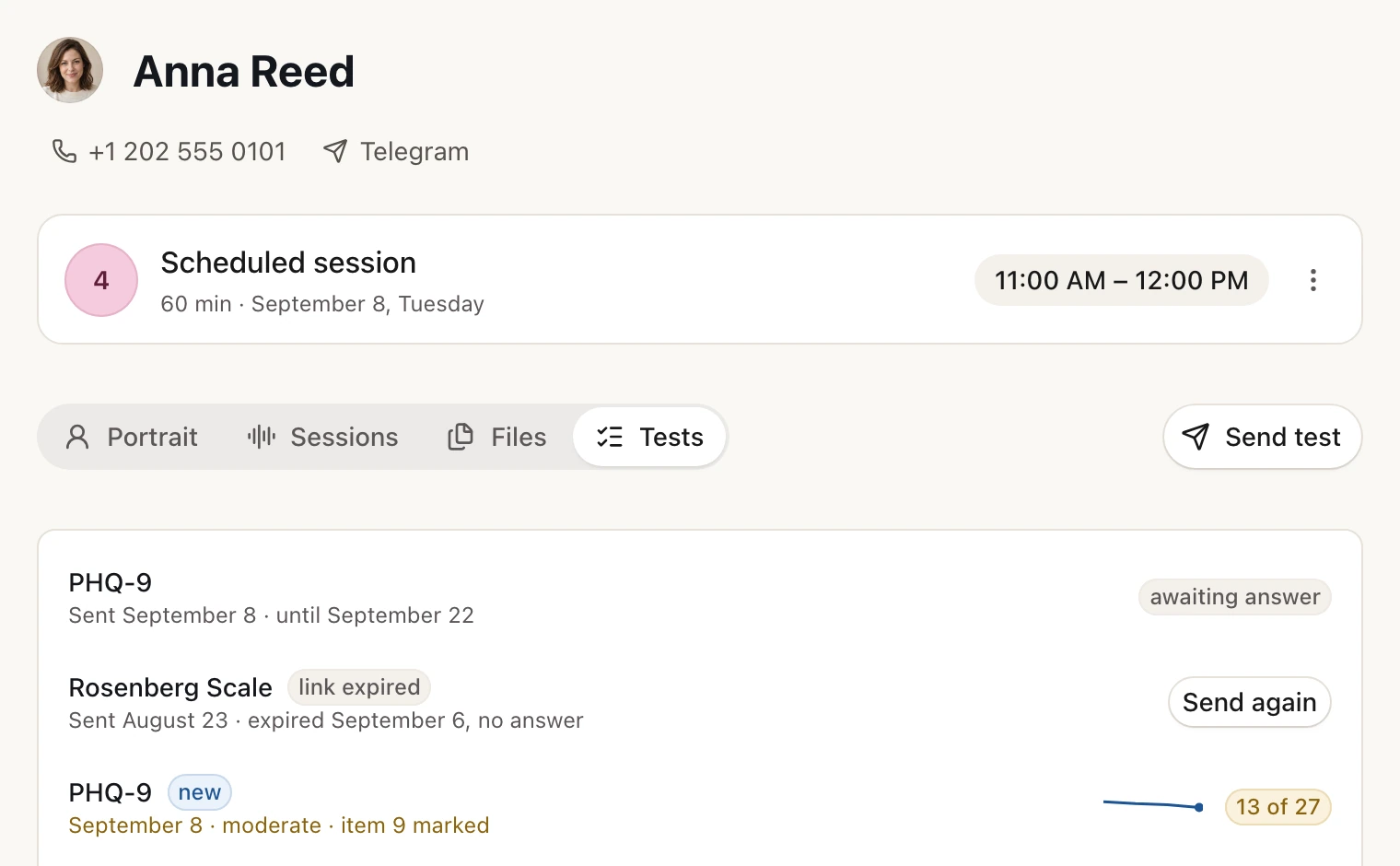
Send scales to clients and watch the change in their card
The client takes the test from a link, no account needed. The result lands in their card and Sessio compares it with last time.