Twenty statements show how often you have felt low, tired, restless or lost interest over the past week or two. It is a screen, not a diagnosis: the score shows how many symptoms of depression are present and whether it is worth talking to a specialist.
The CESD-R is the 2004 revision of the CES-D by William Eaton and colleagues at Johns Hopkins. Its 20 statements cover the symptoms of depression in the DSM: sadness, loss of interest, appetite, sleep, concentration, guilt, tiredness, slowing or restlessness, and thoughts of death or self-harm. Each answer scores 0 to 3 (the two highest options both count as 3, as on cesd-r.com), so the total runs from 0 to 60. The authors treat 16 or more as a reason to look closer.
This is not a diagnosis
A questionnaire counts symptoms, it does not find their cause. Only a doctor or therapist can say whether it is depression, after a conversation. If thoughts of dying or of hurting yourself come, tell someone you trust or call a helpline today.
What happens to your answers
Your score is calculated right in your browser. Your answers reach our server only if you ask for your result by email: we write the email and do not keep them.
The question says "past week" but the last answer says "2 weeks". Which one counts?
That is how the original form is worded. Answer for the past week or so; the last option, "nearly every day for 2 weeks", means the feeling has lasted that long. It scores the same as 5-7 days (3 points), as on cesd-r.com.
Which test should I take next?
The CESD-R counts symptoms over the past week or two. For the last two weeks and nine DSM symptoms, take the PHQ-9: Depression test
Source: CESD-R: Eaton W. W., Smith C., Ybarra M., Muntaner C., Tien A., 2004, Center for Epidemiologic Studies Depression Scale: review and revision (CESD and CESD-R), in M. E. Maruish (ed.), The Use of Psychological Testing for Treatment Planning and Outcomes Assessment, 3rd ed., Lawrence Erlbaum, 363-377. Text and scoring: the English form and explanation on cesd-r.com ("The CESD-R is in the public domain").
For therapists
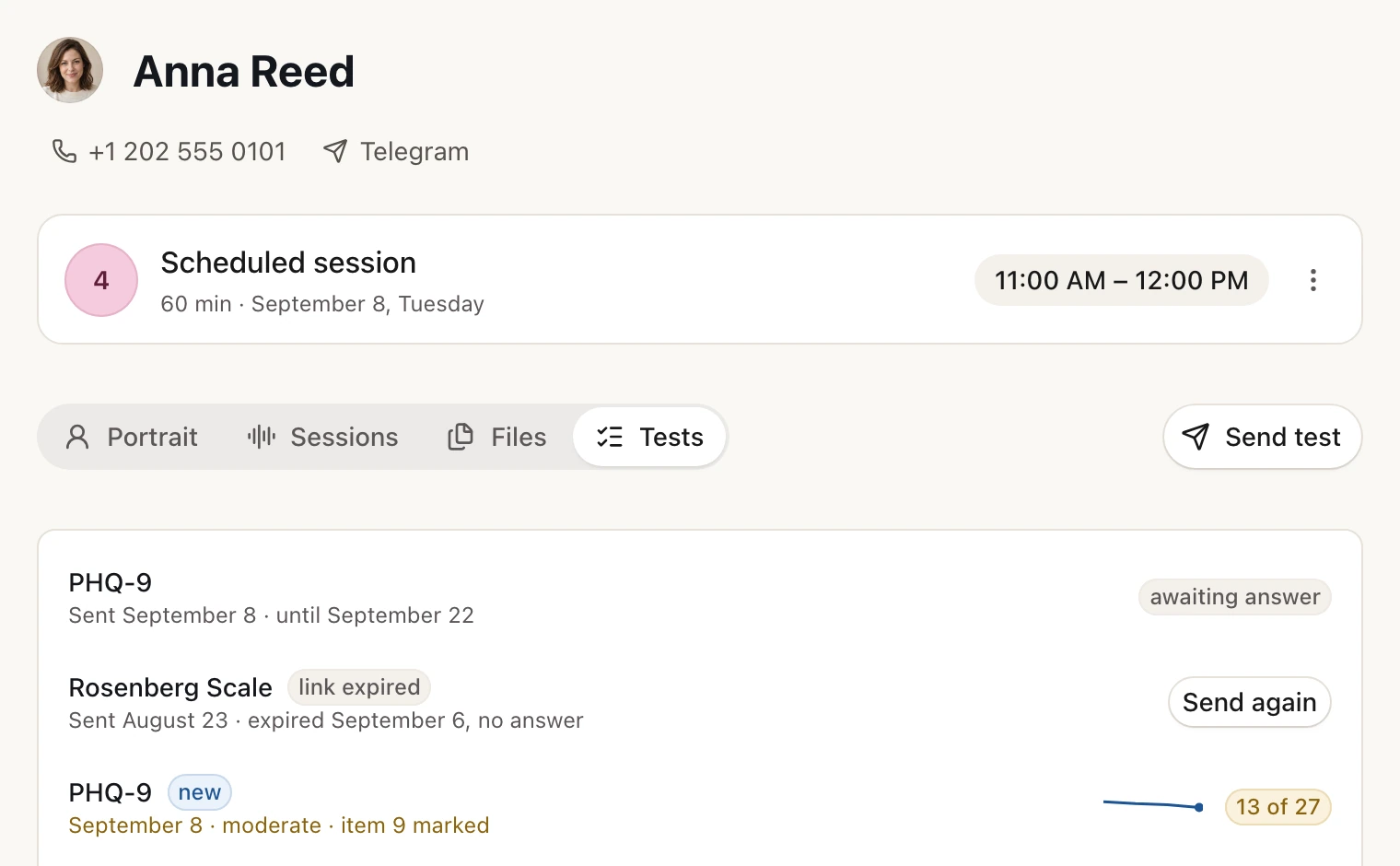
Send scales to clients and watch the change in their card
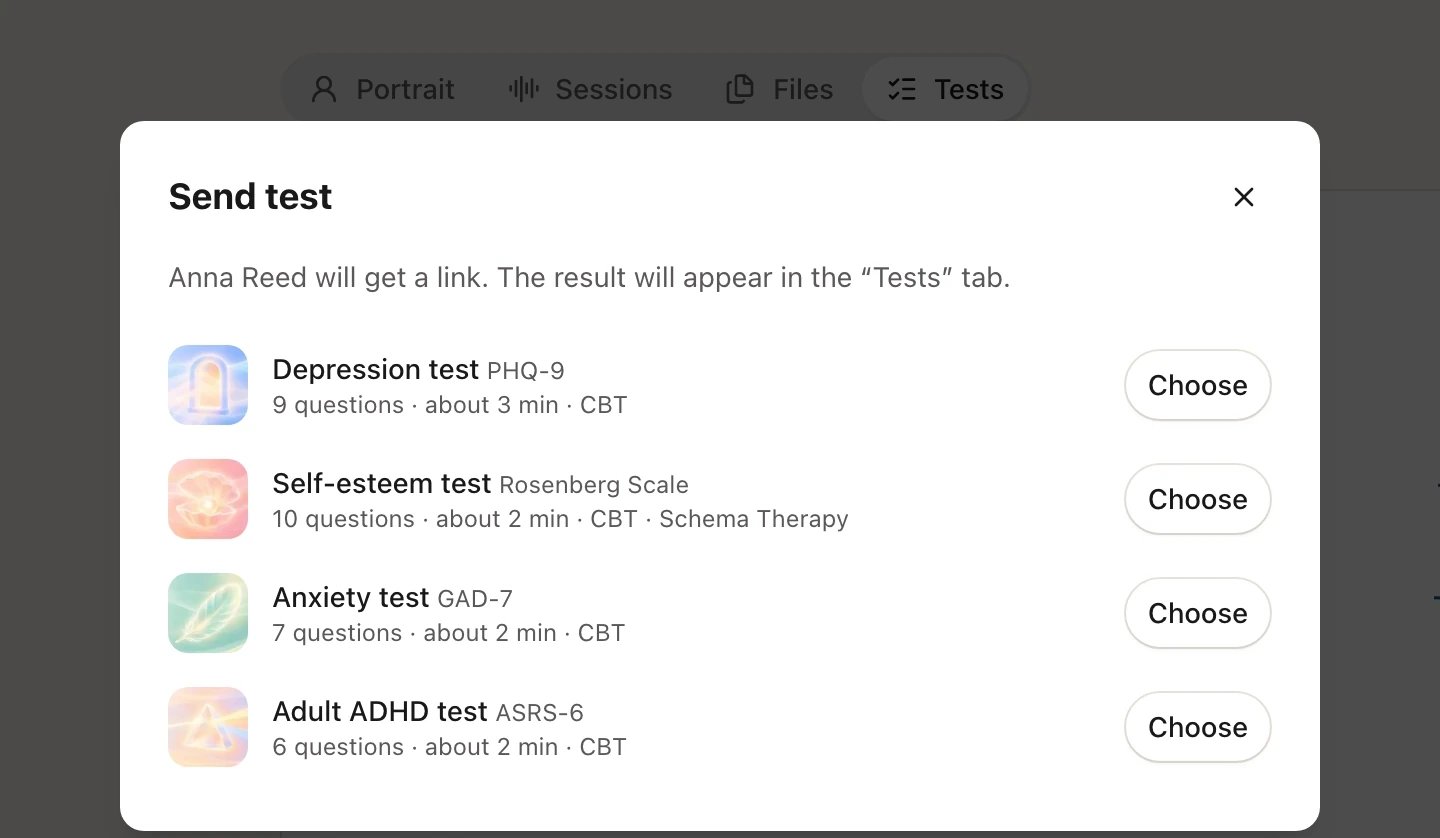
The client takes the test from a link, no account needed. The result lands in their card and Sessio compares it with last time.