Rates you on 24 character strengths, such as curiosity, kindness, gratitude, perseverance and fairness, each from four statements about how you usually think and act. It takes about 15 minutes and shows 24 averages from 1 to 5. It describes how you see yourself and is not a diagnosis.
The IPIP-VIA-R was built by Bluemke, Partsch, Saucier and Lechner (2021) from the public-domain International Personality Item Pool. It covers the 24 character strengths of the classification by Peterson and Seligman (2004), with four statements per strength, two worded in each direction. Each answer scores 1 to 5, statements worded the other way are flipped, and this page shows the average of the four for each strength. There is no total score and there are no cut-offs. The test is independent and not affiliated with the VIA Institute.
This is not a diagnosis
Character strengths are not symptoms, and a lower score on one of them is not a deficit or a disorder. The test shows how you describe yourself today and cannot say whether you need treatment. Only a professional can assess difficulties, after a conversation.
What happens to your answers
Your score is calculated right in your browser. Your answers reach our server only if you ask for your result by email: we write the email and do not keep them.
Is this the official VIA survey?
No. It uses the 24-strength classification of Peterson and Seligman (2004), but it is a separate, open questionnaire from the International Personality Item Pool. It is not affiliated with the VIA Institute, and its scores and descriptions are not VIA reports.
How exact is a score based on four statements?
Each strength rests on only four statements, so a score is a rough indication. On the IPIP page the authors list omega reliabilities from .57 to .84 across the 24 scales in German and UK samples, lowest for self-regulation. Compare strengths by clear gaps, not by a few tenths. For the broad personality traits, a short test gives a first look: Big Five personality test
Is a higher score better, and can I compare with other people?
A higher average means the statements describe you more closely, not that you are a better person, and a lower one is not a flaw. The page has no norm tables, so it cannot tell how you rank among other people. Take 3 as the middle of the answer scale and compare your strengths with each other.
Source: IPIP-VIA-R: Bluemke M., Partsch M. V., Saucier G., Lechner C. M., 2021, Human Character in the IPIP: Towards Shorter, More Content-Valid, and Cross-Culturally Comparable IPIP-VIA Character Strength Scales, PsyArXiv, DOI 10.31234/osf.io/k79qf. Items and key: International Personality Item Pool, ipip.ori.org/IPIP-VIA-R_Key.html (public domain). The 24 strengths follow the classification of Peterson C. and Seligman M. E. P., 2004, Character strengths and virtues. Not affiliated with the VIA Institute.
For therapists
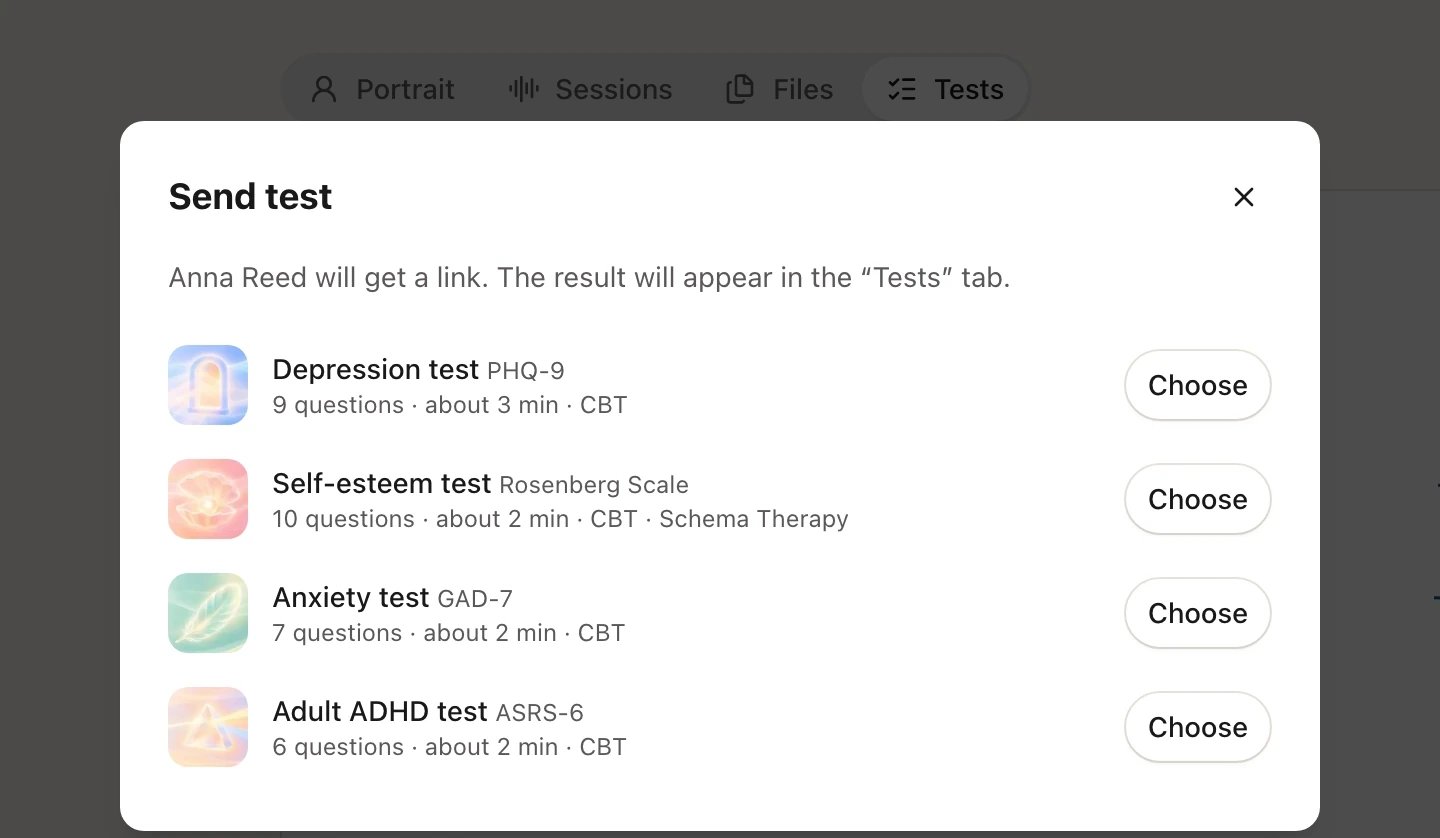
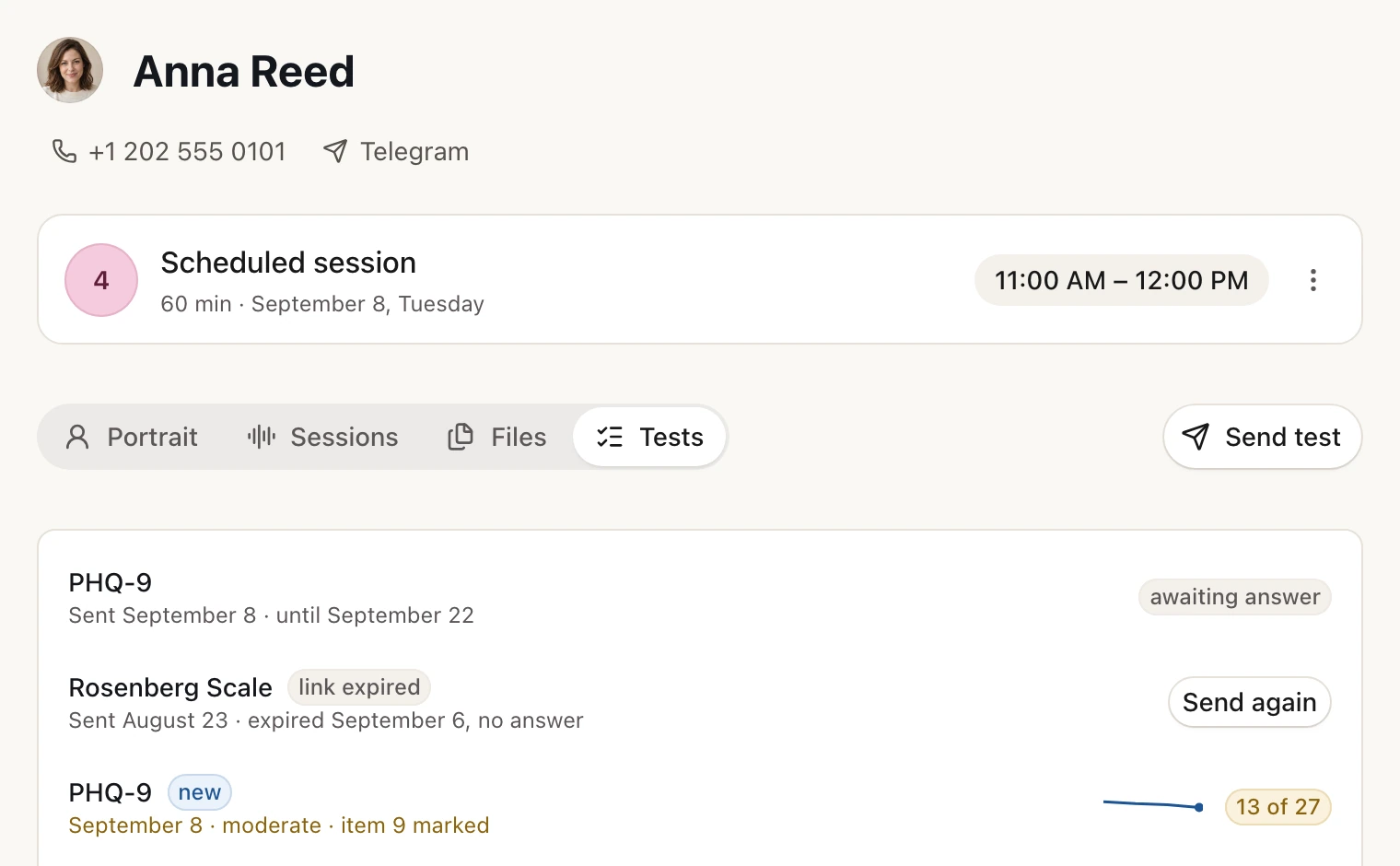
Send scales to clients and watch the change in their card
The client takes the test from a link, no account needed. The result lands in their card and Sessio compares it with last time.