Shows where you stand on the five broad personality traits: neuroticism, extraversion, openness, agreeableness and conscientiousness. Each trait rests on 60 of your own answers, so the picture is more detailed than in shorter Big Five tests, and the test takes about 45 minutes. It describes how you see yourself and is not a diagnosis.
The IPIP-NEO-300 is a set of 300 statements from the public-domain International Personality Item Pool (IPIP), described by Lewis Goldberg (1999) and written to measure constructs similar to the 30 facets of the NEO PI-R. The statements make up 30 narrower facets of ten statements each, such as anxiety, friendliness, imagination, trust and orderliness, grouped into the five Big Five domains of six facets each. Each answer scores 1 to 5, reverse-keyed statements are flipped, and this page shows the average of the 60 statements of each domain, not the facets.
This is not a diagnosis
Personality traits are not good or bad, and a high neuroticism score is not a disorder. The test shows how you describe yourself today and can shift with your mood and with who you compare yourself to. Only a professional can assess difficulties, after a conversation.
What happens to your answers
Your score is calculated right in your browser. Your answers reach our server only if you ask for your result by email: we write the email and do not keep them.
Is this the NEO PI-R?
No. The NEO PI-R is a separate inventory by Costa and McCrae (1992). This page uses 300 public-domain statements that Goldberg (1999) wrote for the International Personality Item Pool to measure similar constructs. In the IPIP's comparison table, the five 60-statement domain scales correlated .84 to .89 with the NEO PI-R domain scales in a community sample of 501 people. Sessio is not affiliated with the authors or publisher of the NEO PI-R, and this test does not replace it.
How is this different from the 120-question and 10-question Big Five tests?
The 120-question IPIP-NEO-120 uses four of the ten statements per facet and takes about 15 minutes, and the 10-question TIPI gives a rough sketch of the five traits in about two minutes. This test asks all 300 statements, 60 per trait, so each score rests on more answers, and it takes about 45 minutes. Like the 120-question version, this page shows the five domain averages, not the 30 facets. If 300 questions is too many, take the 120-question version: Big Five test, 120 questions (IPIP-NEO-120)
Can I compare my scores with other people?
Not directly. The IPIP pages for this inventory give no norm tables or cut-offs, so this page shows only your own averages from 1 to 5. Take 3 as the middle of the answer scale, not as the typical person's score, compare the five traits with each other, and retake the test later to see change.
Source: IPIP-NEO-300: Goldberg L. R., 1999, A broad-bandwidth, public domain, personality inventory measuring the lower-level facets of several five-factor models, in Mervielde I., Deary I., De Fruyt F., Ostendorf F. (Eds.), Personality Psychology in Europe, Vol. 7, 7-28, Tilburg University Press. Items and key: International Personality Item Pool, ipip.ori.org/newNEOFacetsKey.htm (public domain). IPIP scales written to measure constructs similar to the 30 facets of the NEO-PI-R; not the NEO-PI-R itself and not affiliated with its authors or publisher.
For therapists
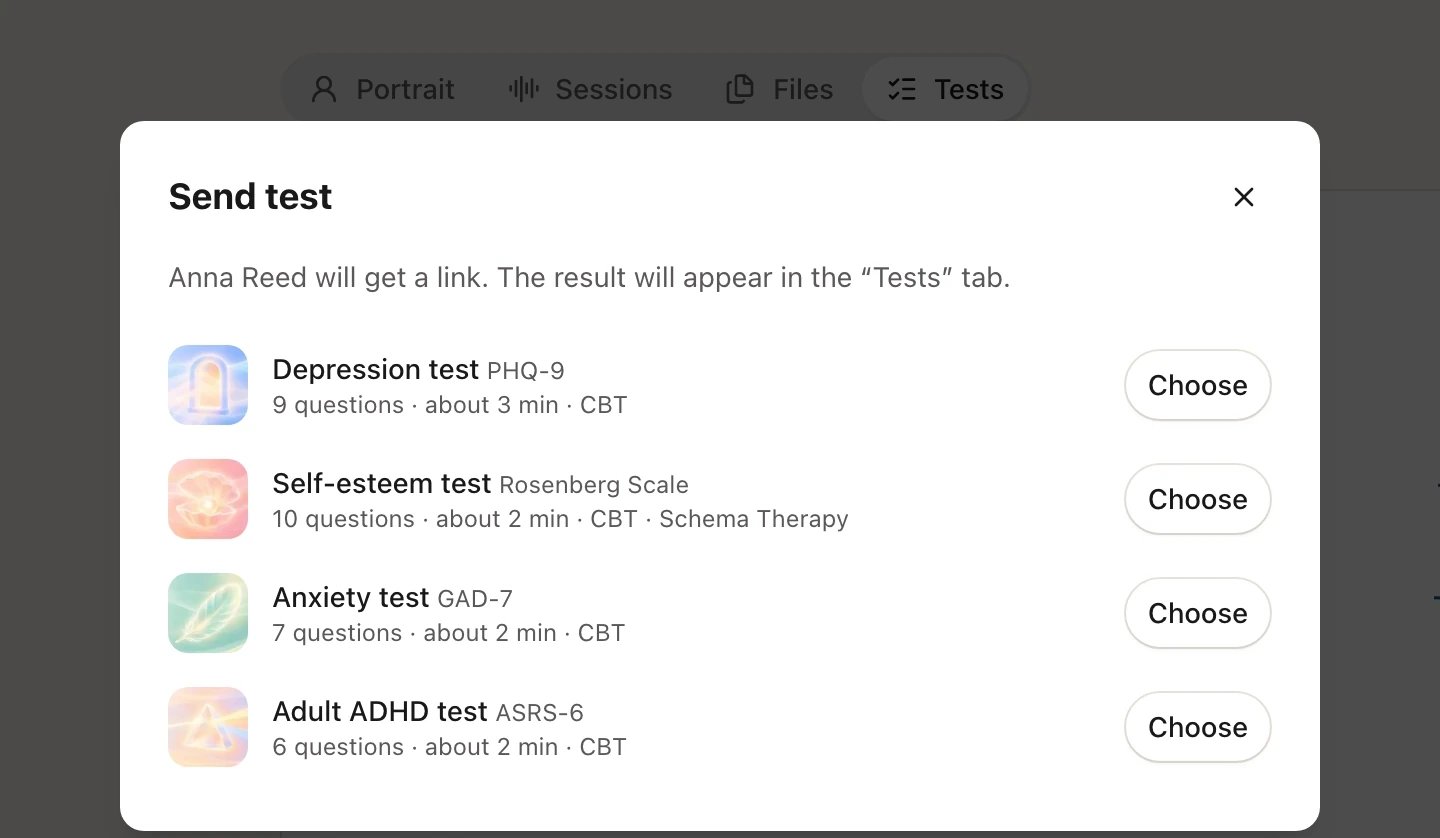
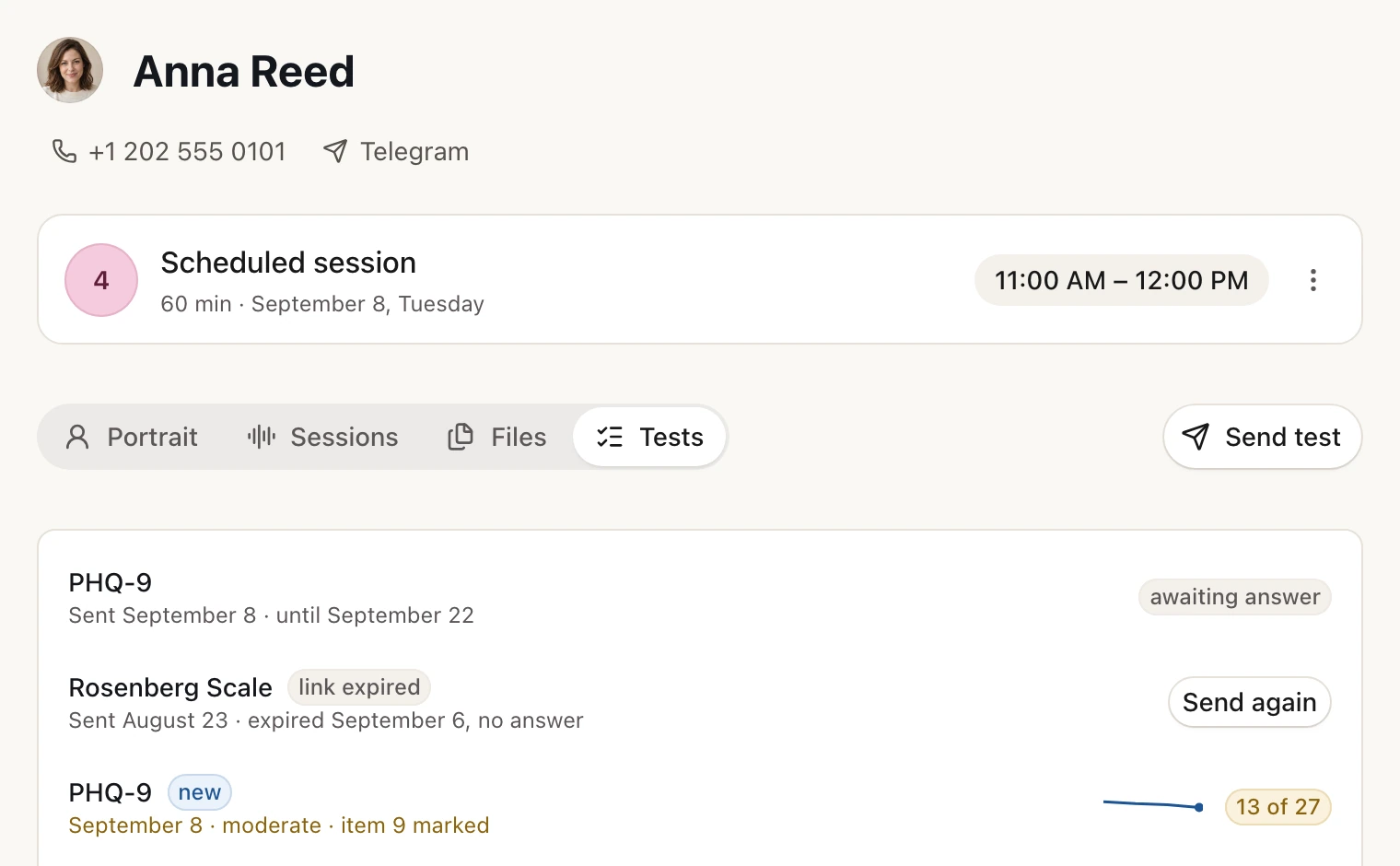
Send scales to clients and watch the change in their card
The client takes the test from a link, no account needed. The result lands in their card and Sessio compares it with last time.