Shows how strongly you believe you can handle difficult problems and unexpected situations. It is not a diagnosis and not a verdict on your abilities, only a picture of how confident you feel in coping at the moment. It takes about three minutes, and the score appears on screen right away.
The General Self-Efficacy Scale (GSE) was developed by Ralf Schwarzer and Matthias Jerusalem, first in German in 1979 and later in many languages. Its 10 statements describe confidence in solving problems, staying calm and finding a way out. Each answer scores 1 to 4 and the total runs from 10 to 40. A higher score means stronger belief in your own coping. The authors set no cut-off scores, so this page shows only your score.
This is not a diagnosis
The scale shows how confident you feel about coping, not how well you actually cope. The authors do not divide people into high and low self-efficacy, and there is no cut-off. Confidence also changes with mood and circumstances.
What happens to your answers
Your score is calculated right in your browser. Your answers reach our server only if you ask for your result by email: we write the email and do not keep them.
What is a good score on the GSE?
There is no good or bad score and no cut-off. Use your score to compare yourself with yourself over time.
Source: GSE: Schwarzer R., Jerusalem M., 1995, Generalized Self-Efficacy scale, in Weinman J., Wright S., Johnston M. (eds), Measures in health psychology: A user's portfolio. Causal and control beliefs, pp. 35-37, Windsor, UK: NFER-NELSON.
For rights holders: if you hold the rights to this scale or its translation and object to it being here, write to support@sessio.health. We will take it down or ask for your permission.
For therapists
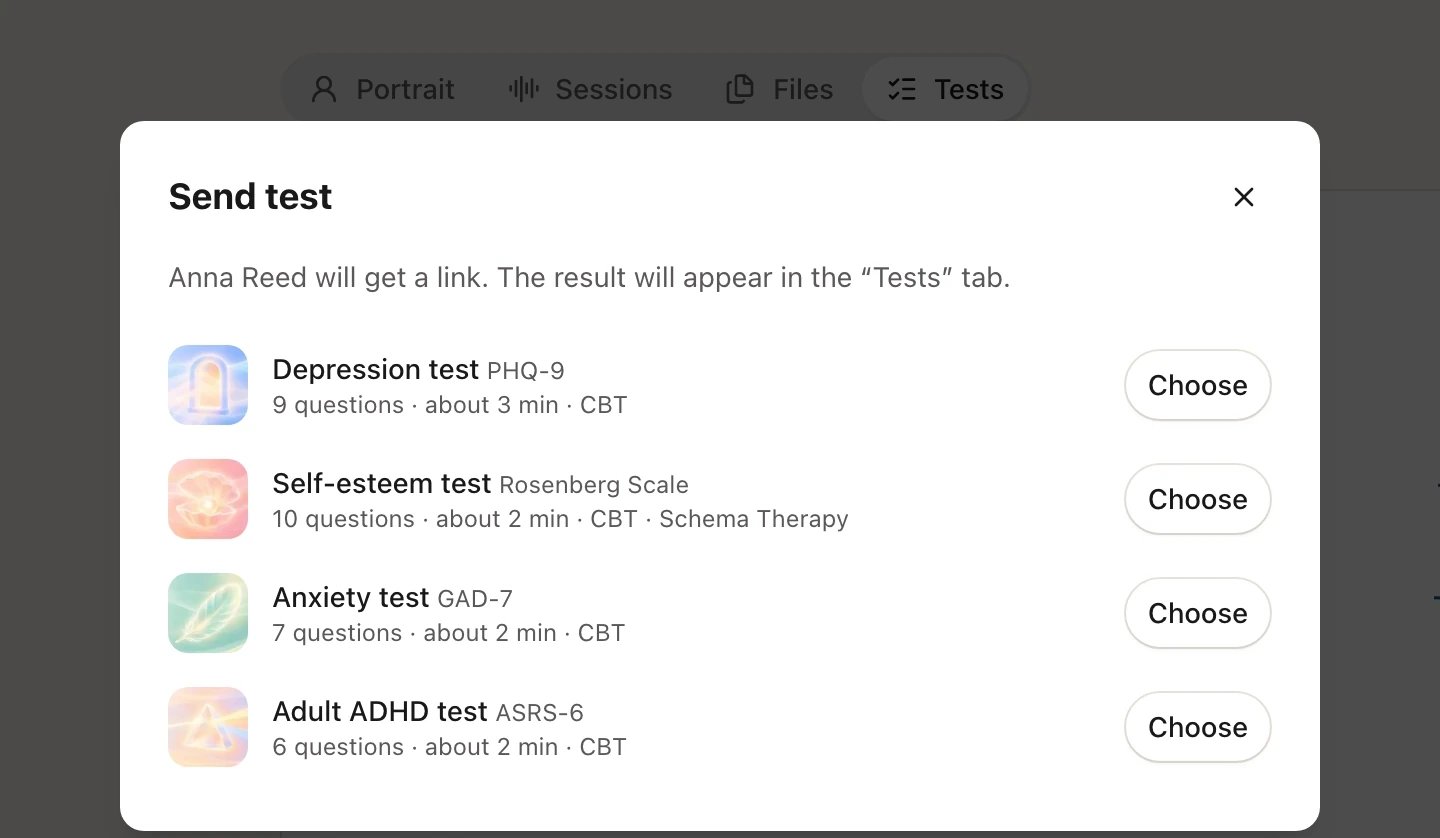
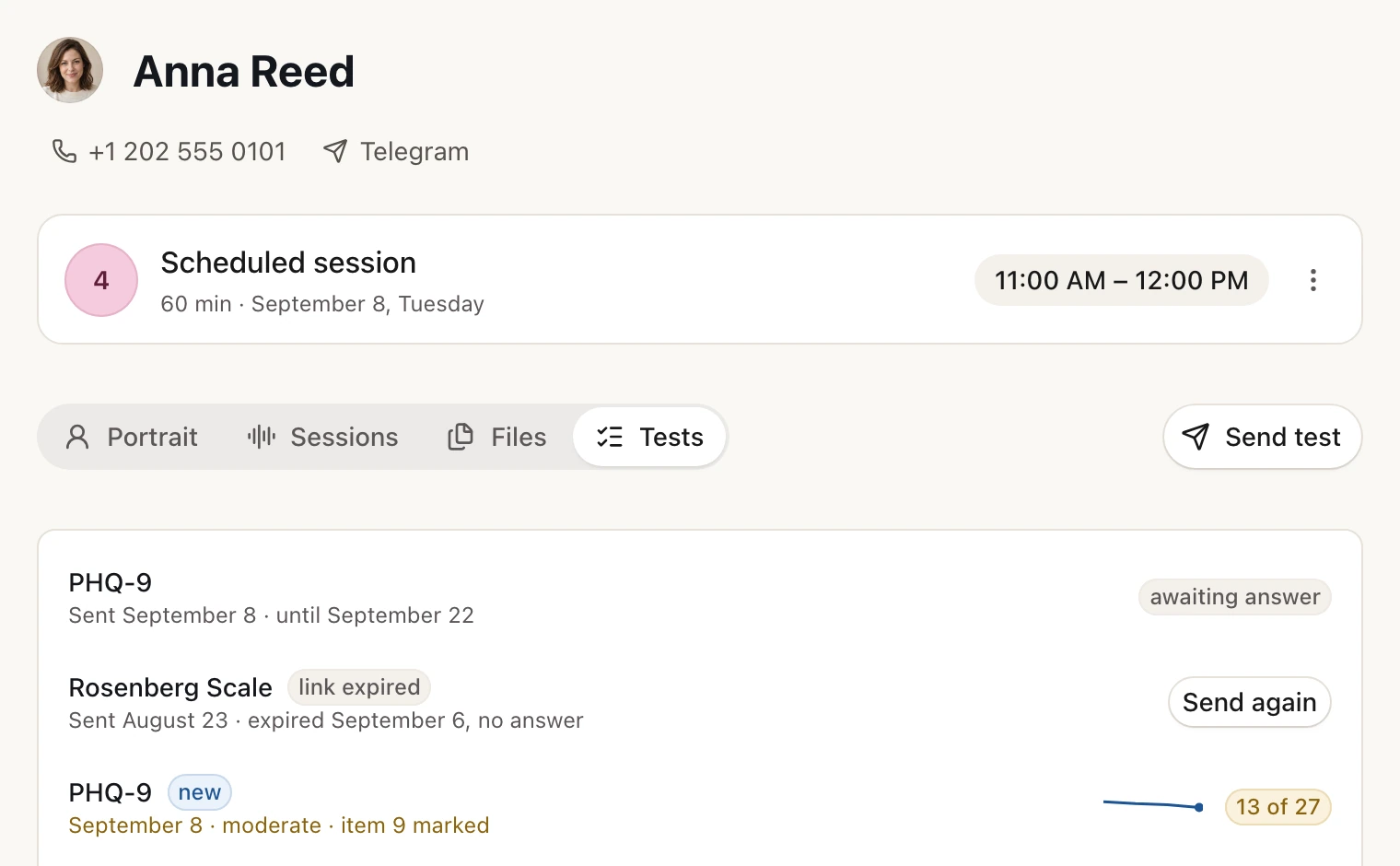
Send scales to clients and watch the change in their card
The client takes the test from a link, no account needed. The result lands in their card and Sessio compares it with last time.