Tick the life events that happened to you over the last 12 months, from a move or a new job to a loss. Each event has a weight, and your score is the sum of the ones you tick: the more change you have had to absorb, the higher it is. It takes about 5 minutes and shows the load of change, not how you feel.
The Social Readjustment Rating Scale (SRRS) was created by Holmes and Rahe in 1967. This page uses the updated version by Wallace and colleagues (2023, PLOS ONE): 44 life events as a yes-or-no list, each with a weight in life change units (LCU) from 20 to 87. The weights come from 540 adults, mostly in the UK, who rated how much readjustment each event needs compared with marriage (50). Your score is the sum of the weights of the events you tick, from 0 to 1909.
This is not a diagnosis
The score counts events, not how you cope with them. Two people with the same score can feel very differently, and a happy event such as a wedding counts as change too. Whether stress is affecting your health is something to discuss with a doctor or therapist.
What happens to your answers
Your score is calculated right in your browser. Your answers reach our server only if you ask for your result by email: we write the email and do not keep them.
What score counts as high?
The authors of the updated scale give no levels for the new weights. Older cut-offs were set for the 1967 weights, which are lower, so this page shows your score without a level. Compare it with your own earlier results rather than with a norm.
Why 12 months?
The scale is applied to a set period, for example the previous 12 months, and the weights stay the same. The 2023 study asked about events at any time in life; here the period is shorter so that the score reflects your current load.
Source: Wallace D., Cooper N. R., Sel A., Russo R., Olorunlana A., 2023, The social readjustment rating scale: Updated and modernised, PLOS ONE 18(12): e0295943, DOI 10.1371/journal.pone.0295943 (CC BY 4.0). Items: S3 Appendix, Yes/No form; weights: Table 3, mean of 540 raters rounded to a whole number. Original scale: Holmes T. H., Rahe R. H., 1967, Journal of Psychosomatic Research 11(2), 213-218.
For therapists
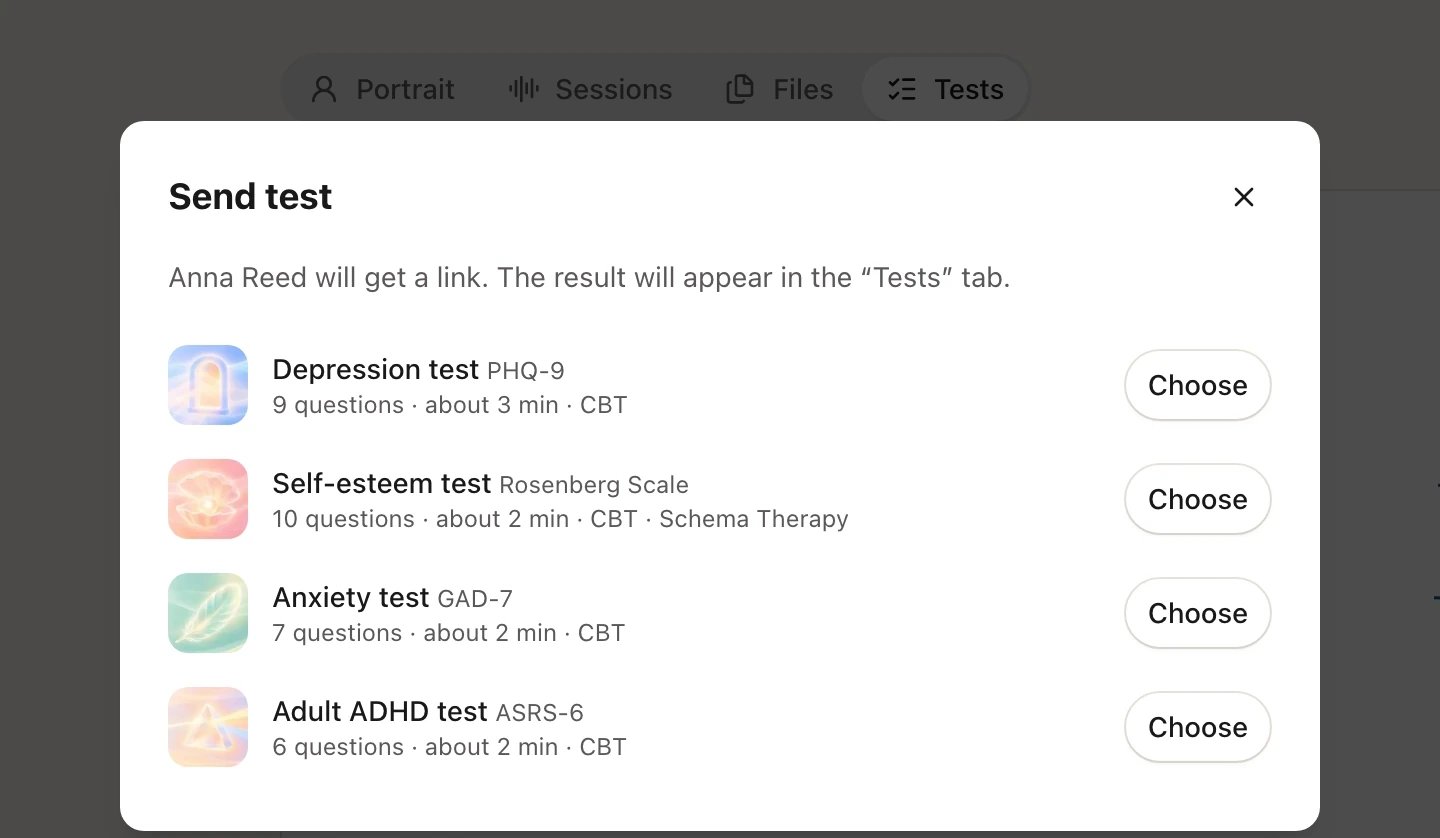
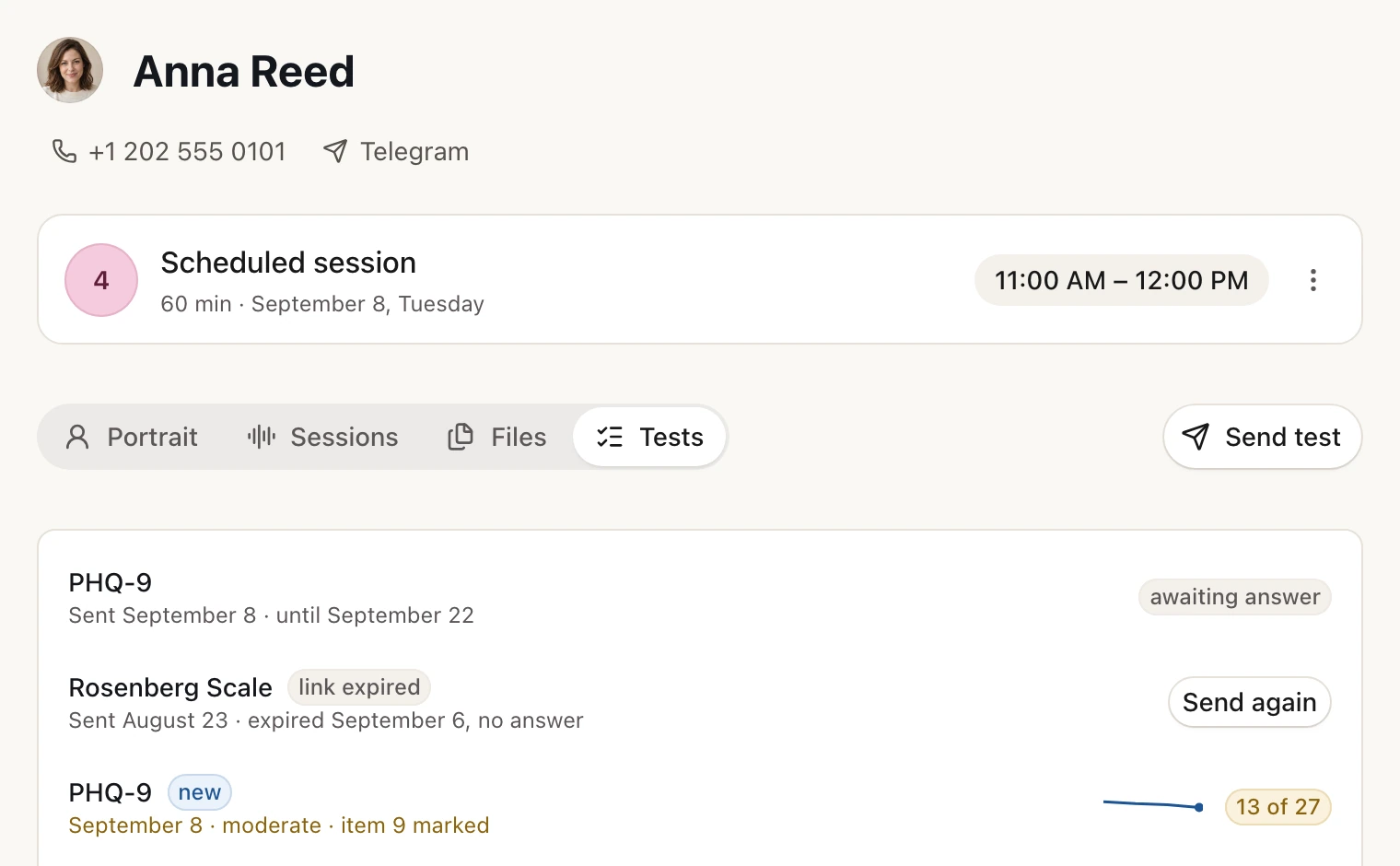
Send scales to clients and watch the change in their card
The client takes the test from a link, no account needed. The result lands in their card and Sessio compares it with last time.