Four questions give a quick read on how much anxiety and low mood have weighed on you over the last two weeks. It is a screen, not a diagnosis: the score shows how much distress to take seriously and whether to look further.
4 questions
about 1 minutes
instant result
Other versions of this test: PHQ-9 (9 questions) · PHQ-2 (2 questions) · GAD-7 (7 questions) · GAD-2 (2 questions)
The PHQ-4 joins the GAD-2 (the first two questions, anxiety) and the PHQ-2 (the last two, depression). Each answer scores 0 to 3, for a total of 0 to 12: 0 to 2 is little or no distress, 3 to 5 mild, 6 to 8 moderate, 9 to 12 severe (Kroenke and colleagues, 2009; Löwe and colleagues, 2010). 3 or more on either pair is a positive screen for that pair.
This is not a diagnosis
Four questions only show how much distress there is, not what lies behind it. A doctor or therapist makes a diagnosis after a conversation.
What happens to your answers
Your score is calculated right in your browser. Your answers reach our server only if you ask for your result by email: we write the email and do not keep them.
How do I read the PHQ-4 for anxiety and for depression separately?
The first two questions are the GAD-2 and the last two are the PHQ-2. Add up each pair: 3 or more points on a pair is a positive screen for it. For a closer look, take the full version: Depression test
Source: PHQ-4: Kroenke K., Spitzer R. L., Williams J. B. W., Löwe B., 2009, An ultra-brief screening scale for anxiety and depression: the PHQ-4, Psychosomatics 50(6), 613-621, DOI 10.1176/appi.psy.50.6.613; levels: Löwe B. et al., 2010, Journal of Affective Disorders 122(1-2), 86-95, DOI 10.1016/j.jad.2009.06.019. Text: the first two items of the official GAD-7 and PHQ-9 translations (Pfizer, phqscreeners.com), in the order of the official PHQ-4 form.
For therapists
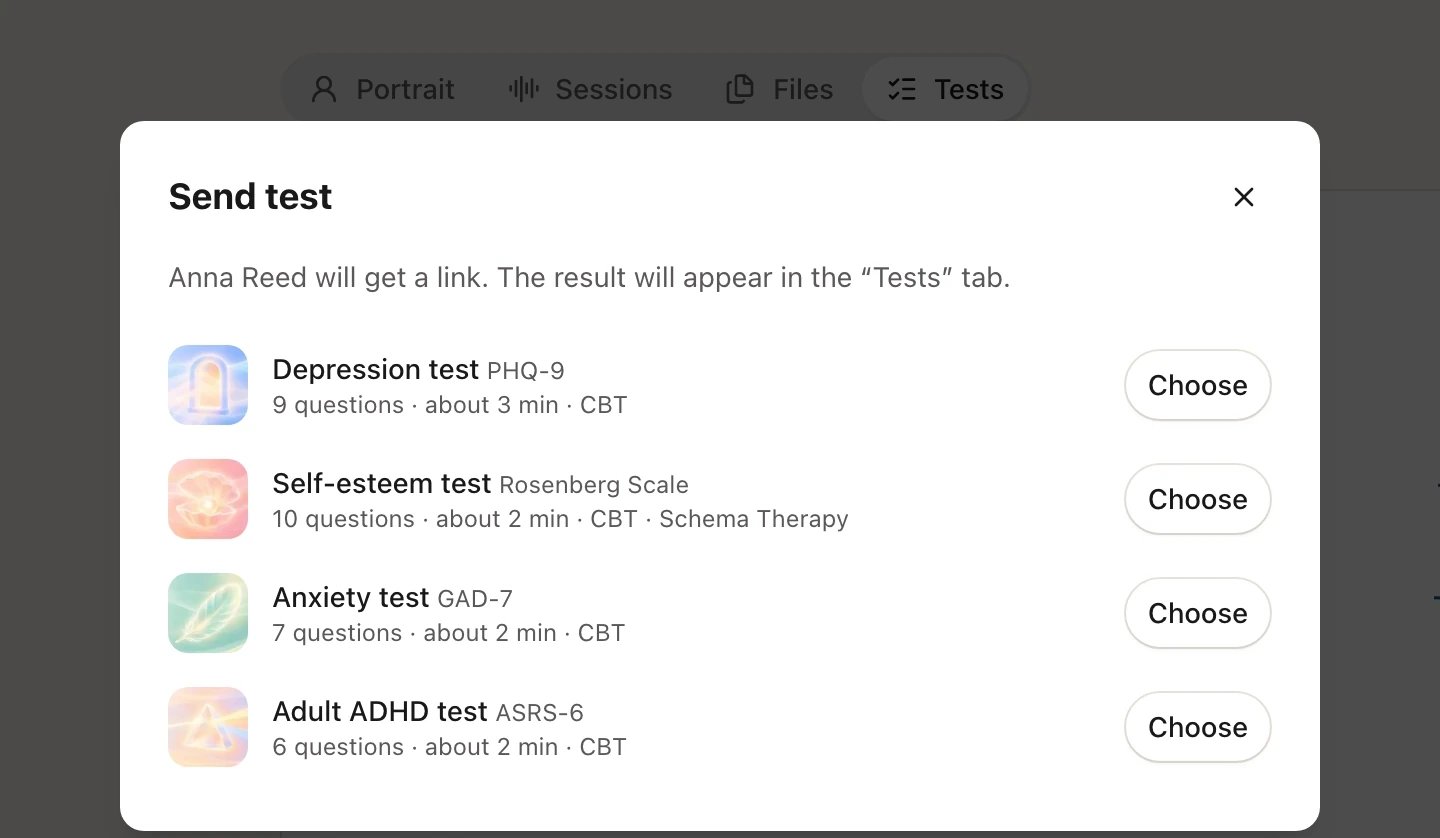
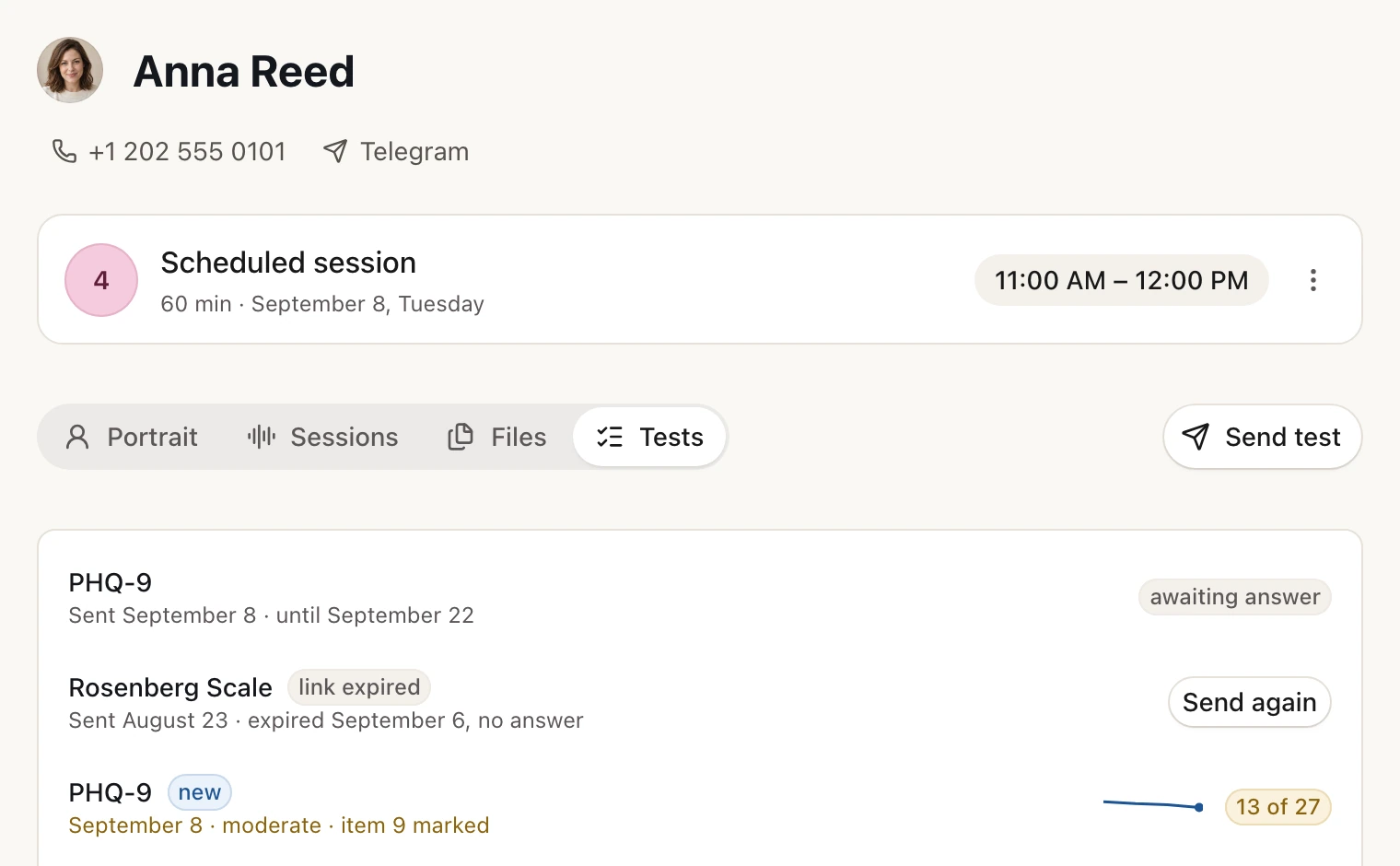
Send scales to clients and watch the change in their card
The client takes the test from a link, no account needed. The result lands in their card and Sessio compares it with last time.