Shows how quickly you tend to recover after hard times and stressful events. Six statements, about a minute. It is not a diagnosis: the score describes a tendency, which changes with circumstances and support.
The Brief Resilience Scale (BRS) was developed by Bruce Smith and colleagues in 2008. It asks about one thing: the ability to bounce back from stress. Each statement is answered from 1 to 5, three statements are reversed, and the result is the average from 1 to 5. Higher means quicker recovery. The levels on this page (below 3.00, 3.00 to 4.30, above 4.30) are the ones the authors give.
This is not a diagnosis
Resilience is not a trait you either have or lack. A low score can follow a hard period, and it says nothing about your character. It is a reason to look at what supports you, not a verdict.
What happens to your answers
Your score is calculated right in your browser. Your answers reach our server only if you ask for your result by email: we write the email and do not keep them.
Is a low resilience score a bad sign?
No. It describes how you recover right now. After loss, overload or illness, scores often dip and then rise again. If recovery feels slow for weeks, a conversation with a therapist can help.
Source: BRS: Smith B. W., Dalen J., Wiggins K., Tooley E., Christopher P., Bernard J., 2008, The brief resilience scale: Assessing the ability to bounce back, International Journal of Behavioral Medicine 15(3), 194-200, DOI 10.1080/10705500802222972. English text: Translation Guide for the Brief Resilience Scale by B. W. Smith (agingcenter.duke.edu), unchanged apart from the instruction wording for a screen. Levels: Smith et al. 2013, as quoted by PsyToolkit.
For rights holders: if you hold the rights to this scale or its translation and object to it being here, write to support@sessio.health. We will take it down or ask for your permission.
For therapists
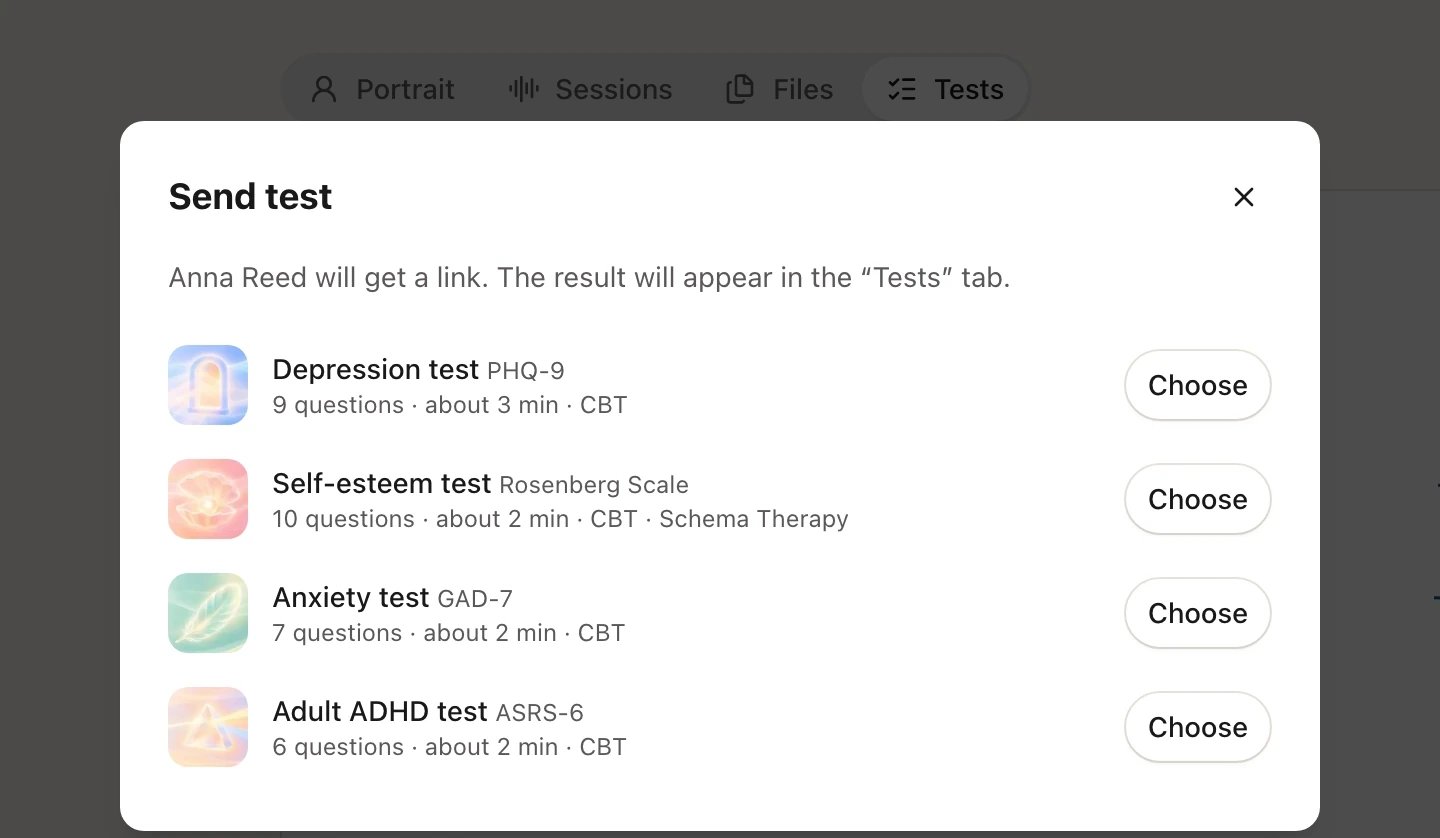
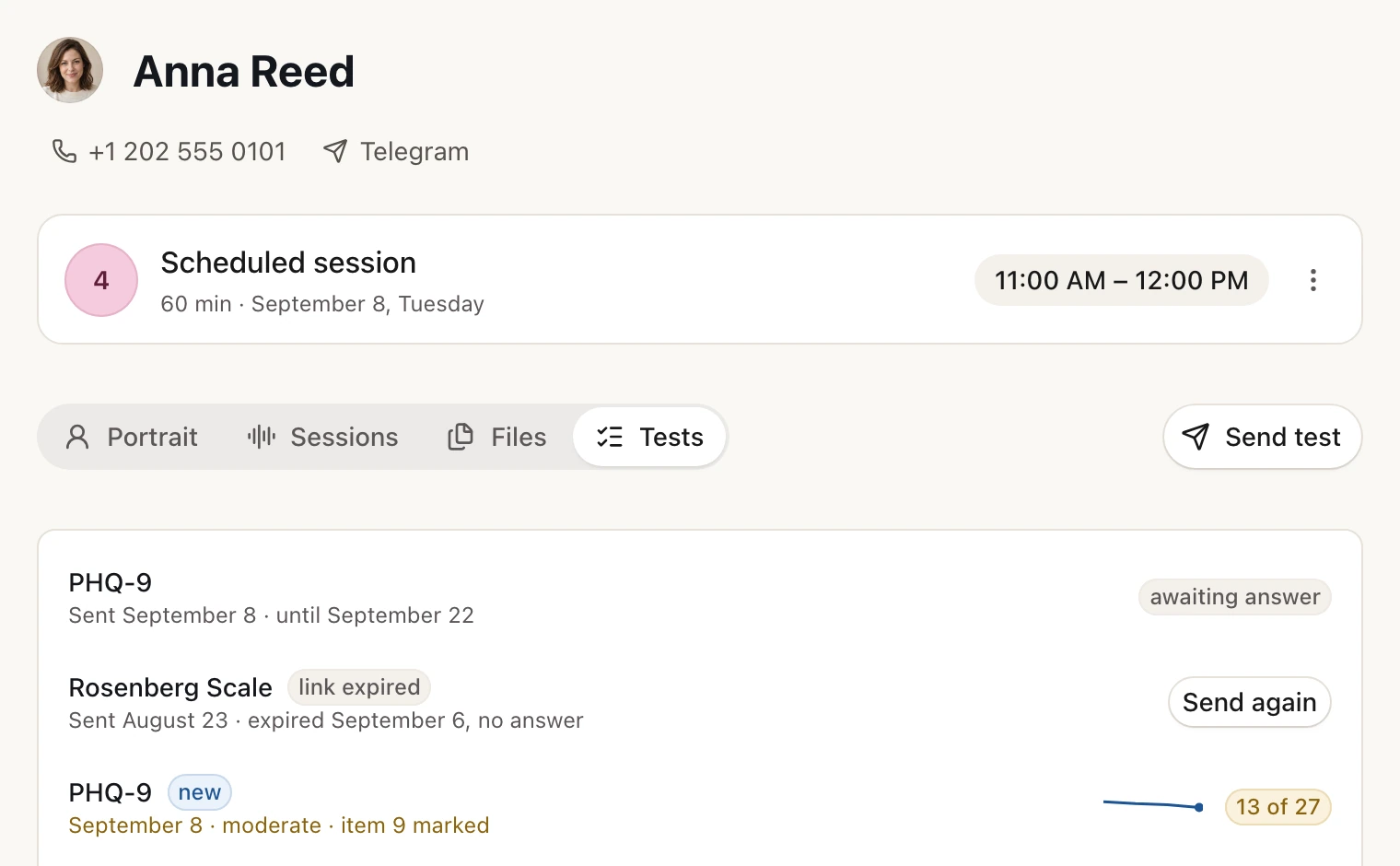
Send scales to clients and watch the change in their card
The client takes the test from a link, no account needed. The result lands in their card and Sessio compares it with last time.