Twenty statements about how you have felt over the past week: mood, sleep, appetite, energy and the body. You get a score from 0 to 60 and see where it falls among the ranges the scale's author gave. It is a screening tool, not a diagnosis: a higher score is a reason to talk to a professional.
The Zung Self-Rating Depression Scale (SDS) was published by William Zung in 1965. Its 20 statements cover mood, sleep, appetite, weight, energy, thinking and bodily symptoms; ten are worded positively and are scored in reverse. Zung scores each answer 1 to 4 (total 20 to 80). Sessio counts 0 to 3 (total 0 to 60), so add 20 to compare with his tables. A higher score means more symptoms. Zung's ranges on his scale are 40 to 47 mild to moderate, 48 to 55 moderate to severe and 56 and above severe; here that is 20 to 27, 28 to 35 and 36 and above.
This is not a diagnosis
The score shows how many depression symptoms you reported for one week. It cannot tell depression from a hard stretch of life. Only a doctor or a therapist can say, after a conversation. If thoughts come that others would be better off without you, or of dying, tell someone you trust or call a helpline today.
What happens to your answers
Your score is calculated right in your browser. Your answers reach our server only if you ask for your result by email: we write the email and do not keep them.
Other sites give a cut-off of 50. Which number is right?
Both, on different scales. Zung's clinical cut-off is 50 on his index (the raw sum divided by 80, times 100) and 40 on the raw sum of 20 to 80. Mixing the two up is a known mistake in published studies. Here you see the raw sum minus 20, so the same cut-off is 20.
Why does a depression scale ask about sex, weight and constipation?
The scale counts the bodily side of depression as well as mood: sleep, appetite, weight, tiredness, heartbeat, constipation and interest in sex. If a statement does not quite fit your life, choose the closest answer.
Which test should I take next?
The PHQ-9 is shorter: nine questions about the last two weeks. For a second look, you can take it too: Depression test
Source: Zung W. W. K., 1965, A Self-Rating Depression Scale, Archives of General Psychiatry 12, 63-70, DOI 10.1001/archpsyc.1965.01720310065008. Text: the NIMH form of the Zung SDS in Guy W., 1976, ECDEU Assessment Manual for Psychopharmacology (DHEW Publication ADM 76-338), checked against the SABI form (UNC) and three open-access papers. Ranges: Zung 1974, as tabulated in Dunstan D. A., Scott N., 2018, Depression Research and Treatment, DOI 10.1155/2018/9250972 (CC BY). Sessio scores the answers 0 to 3 (the author uses 1 to 4).
For rights holders: if you hold the rights to this scale or its translation and object to it being here, write to support@sessio.health. We will take it down or ask for your permission.
For therapists
Send scales to clients and watch the change in their card
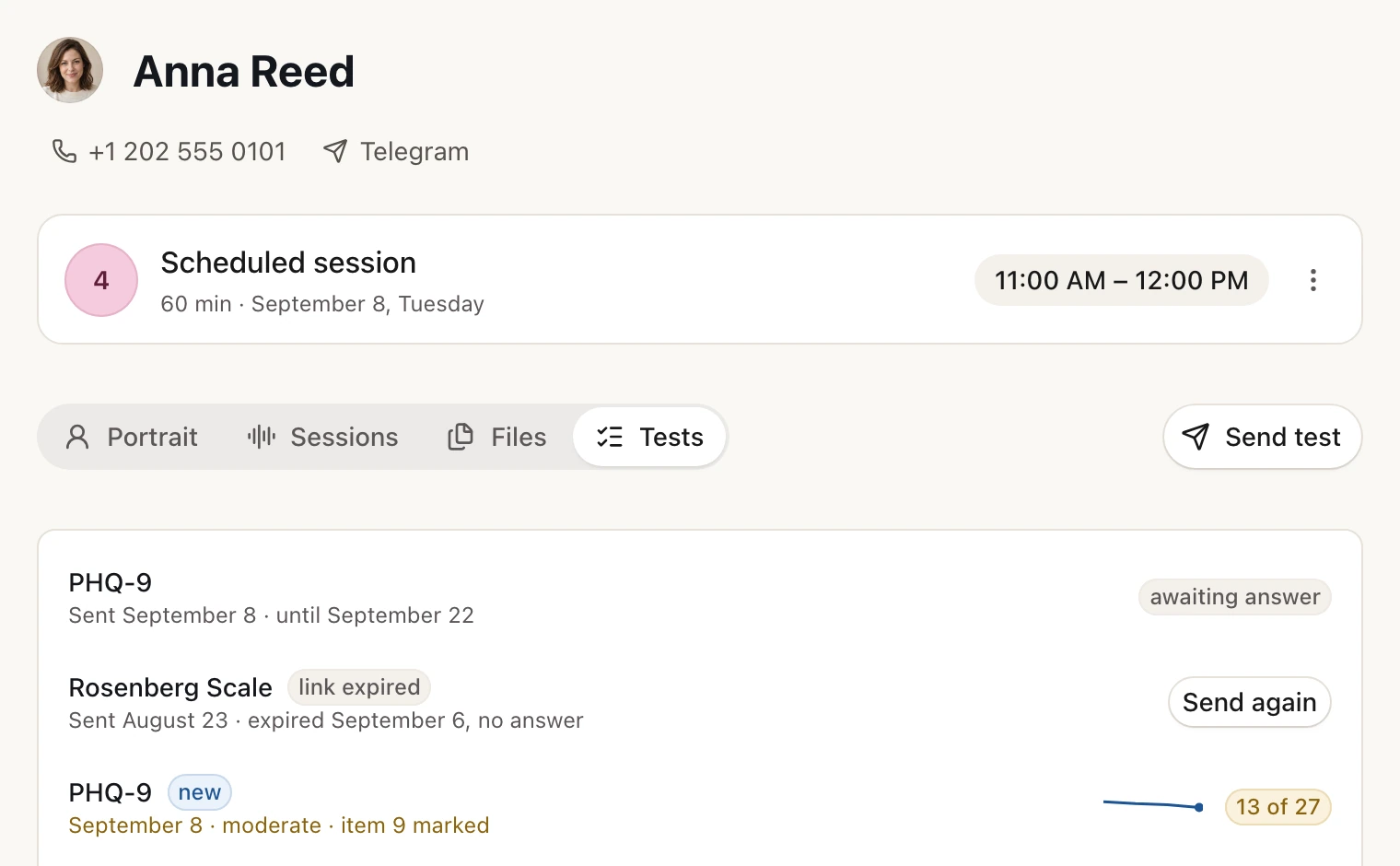
The client takes the test from a link, no account needed. The result lands in their card and Sessio compares it with last time.