Thirty questions show how helping work has been affecting you over the last 30 days: how much satisfaction it gives, how worn out you feel and how much other people's trauma stays with you. It is a self-check, not a diagnosis.
The ProQOL 5 (Stamm, 2009) is the most widely used measure of the professional quality of life of helpers: therapists, nurses, teachers, social workers. It has three scales of 10 questions each: compassion satisfaction, burnout and secondary traumatic stress. Each answer scores 1 to 5 and each scale is shown as the average of its questions, from 1 to 5. In the burnout scale questions 1, 4, 15, 17 and 29 are reverse scored. The authors' levels are low (a sum of 22 or less, an average up to 2.2), moderate (23 to 41, up to 4.1) and high (42 or more).
This is not a diagnosis
The ProQOL shows how work with people is affecting you now, not whether you have a disorder. A bad week can raise a score. If a high score stays or you feel unwell, talk to a supervisor, a therapist or a doctor.
What happens to your answers
Your score is calculated right in your browser. Your answers reach our server only if you ask for your result by email: we write the email and do not keep them.
Why are there three scores and no total?
Compassion satisfaction, burnout and secondary traumatic stress are different experiences and can move in different directions: you can enjoy your work and still be worn out. Each scale is read on its own.
How is burnout different from secondary traumatic stress?
Burnout builds up slowly from workload, little support and the feeling that your effort changes nothing. Secondary traumatic stress comes from exposure to other people's trauma: fear, poor sleep, intrusive images, avoiding reminders. To look closer at burnout, take the burnout test: Burnout test
Source: Stamm B. H., 2009, Professional Quality of Life: Compassion Satisfaction and Fatigue Version 5 (ProQOL 5), www.ProQOL.org; ownership transferred to the Center for Victims of Torture (CVT) in 2016. English version from proqol.org.
For rights holders: if you hold the rights to this scale or its translation and object to it being here, write to support@sessio.health. We will take it down or ask for your permission.
For therapists
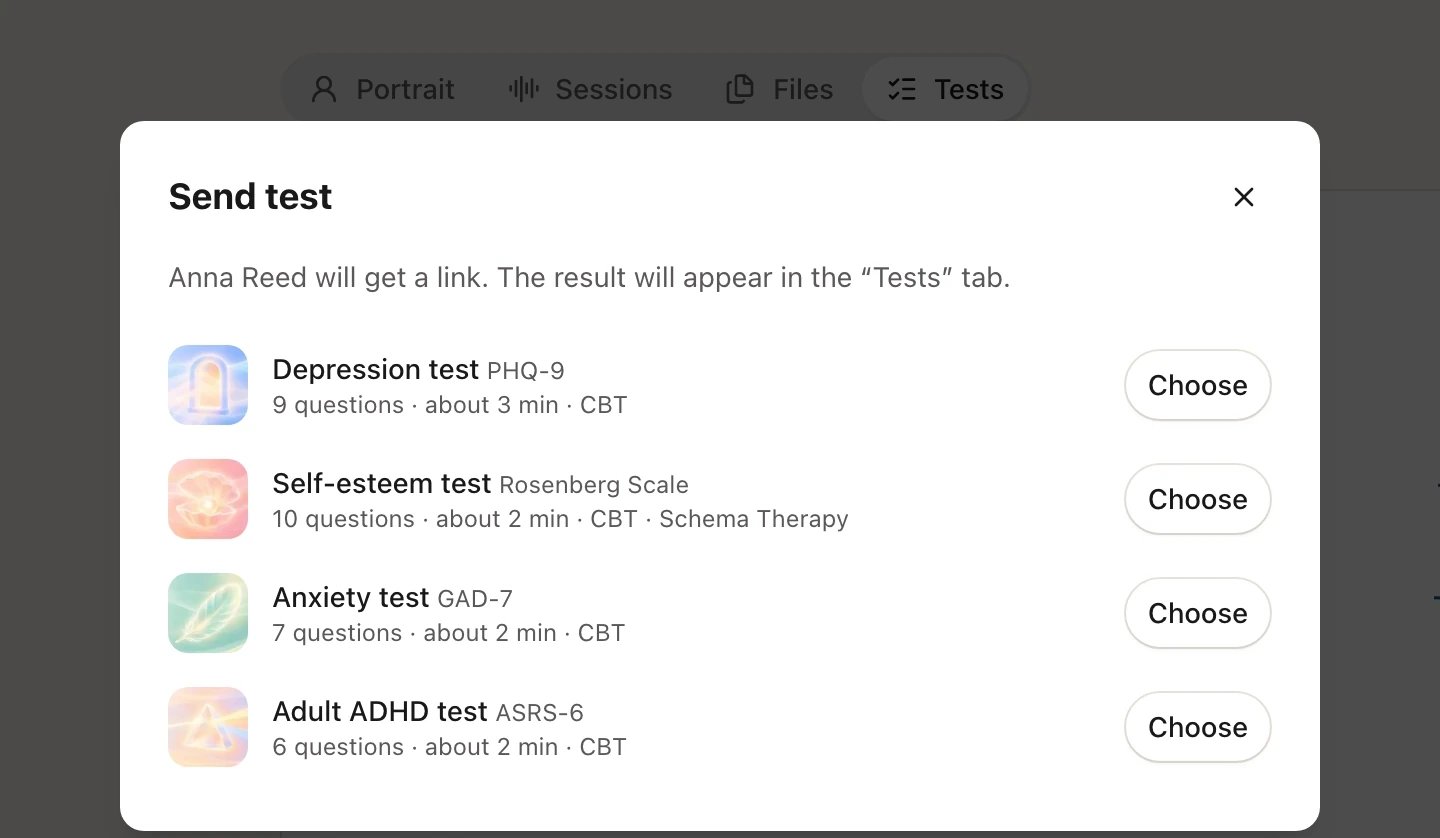
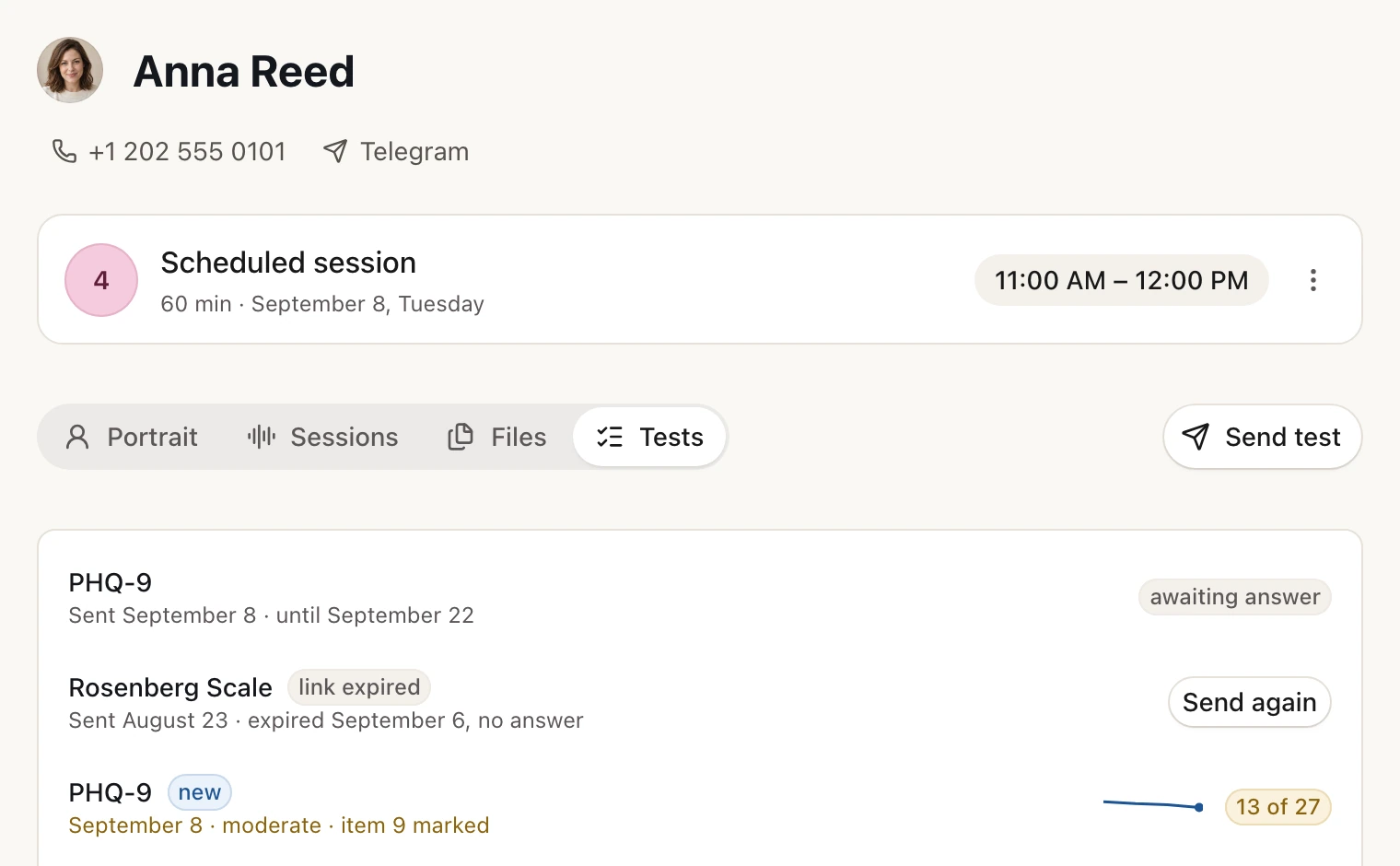
Send scales to clients and watch the change in their card
The client takes the test from a link, no account needed. The result lands in their card and Sessio compares it with last time.